


Śrī Caitanya Mahāprabhu, who is known as Gaurāṅga, is the ocean of all conclusive knowledge in devotional service. He empowered Śrī Rāmānanda Rāya, who may be likened to a cloud of devotional service. This cloud was filled with the water of all the conclusive purports of devotional service and was empowered by the ocean to spread this water over the sea of Śrī Caitanya Mahāprabhu Himself. Thus the ocean of Caitanya Mahāprabhu became filled with the jewels of the knowledge of pure devotional service. (1) All glories to Lord Śrī Caitanya Mahāprabhu! All glories to Lord Nityānanda! All glories to Advaita Ācārya! And all glories to all the devotees of Lord Śrī Caitanya Mahāprabhu! (2) According to His previous program, Lord Śrī Caitanya Mahāprabhu went forward on His tour and after some days arrived at the place of pilgrimage known as Jiyaḍa- nṛsiṁha. (3) Upon seeing the Deity of Lord Nṛsiṁha in the temple, Śrī Caitanya Mahāprabhu offered His respectful obeisances by falling flat. Then, in ecstatic love, He performed various dances, chanted, and offered prayers. (4)
“‘All glories to Nṛsiṁhadeva! All glories to Nṛsiṁhadeva, who is the Lord of Prahlāda Mahārāja and, like a honeybee, is always engaged in beholding the lotuslike face of the goddess of fortune.’ (5) “‘Although very ferocious, the lioness is very kind to her cubs. Similarly, although very ferocious to nondevotees like Hiraṇyakaśipu, Lord Nṛsiṁhadeva is very, very soft and kind to devotees like Prahlāda Mahārāja.’” (6) In this way Lord Śrī Caitanya Mahāprabhu recited different verses from the śāstra. The priest of Lord Nṛsiṁhadeva then brought garlands and the remnants of the Lord’s food and offered them to Śrī Caitanya Mahāprabhu. (7) As usual, a brāhmaṇa offered Śrī Caitanya Mahāprabhu an invitation. The Lord passed the night in the temple and then commenced His tour again. (8)
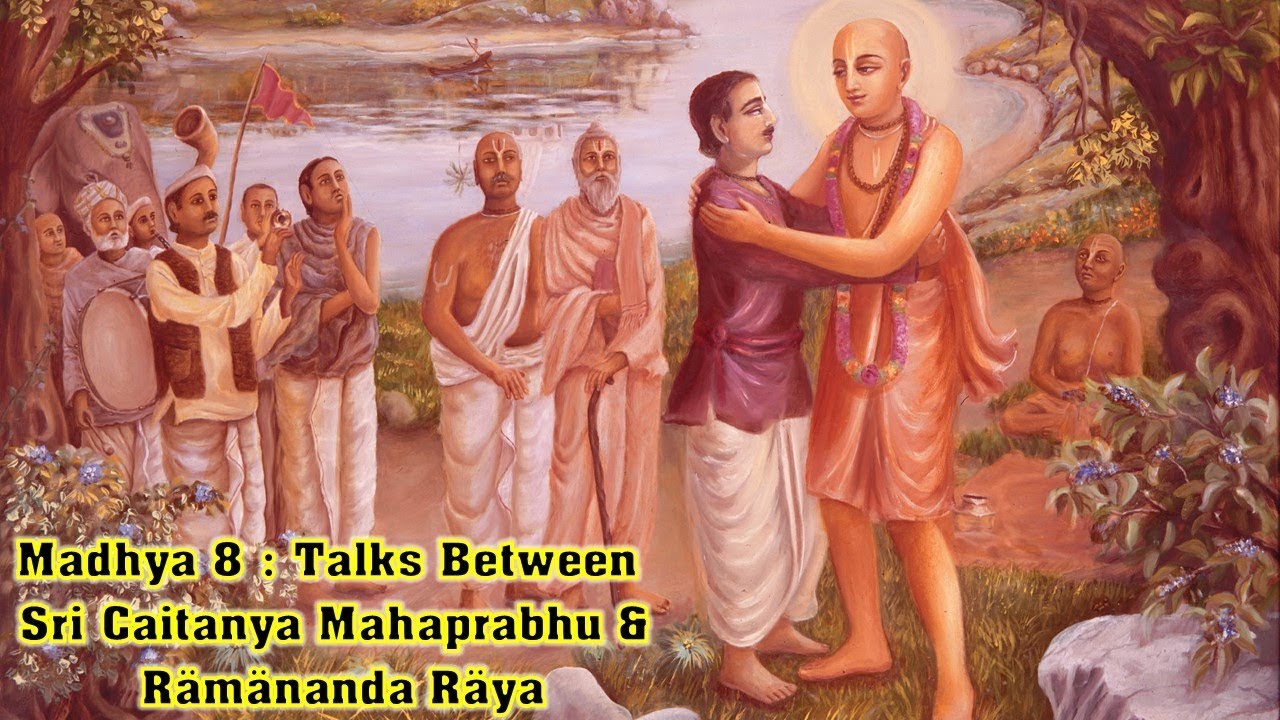
The next morning, in the great ecstasy of love, Lord Śrī Caitanya Mahāprabhu started on His tour with no knowledge of the proper direction, and He continued the whole day and night. (9) As previously, Śrī Caitanya Mahāprabhu converted to Vaiṣṇavism many people He met on the road. After some days, the Lord reached the banks of the river Godāvarī. (10) When He saw the river Godāvarī, the Lord remembered the river Yamunā, and when He saw the forest on the banks of the river, He remembered Śrī Vṛndāvana- dhāma. (11) After performing His usual chanting and dancing for some time in this forest, the Lord crossed the river and took His bath on the other bank. (12) After bathing in the river, the Lord walked a little distance from the bathing place and engaged in chanting the holy name of Kṛṣṇa. (13) At that time, accompanied by the sounds of music, Rāmānanda Rāya came there on a palanquin to take his bath. (14)
Many brāhmaṇas following the Vedic principles accompanied Rāmānanda Rāya. According to the Vedic rituals, Rāmānanda Rāya took his bath and offered oblations to his forefathers. (15) Śrī Caitanya Mahāprabhu could understand that the person who had come to bathe in the river was Rāmānanda Rāya. The Lord wanted so much to meet him that His mind immediately began running after him. (16) Although Śrī Caitanya Mahāprabhu was running after him mentally, He patiently remained sitting. Rāmānanda Rāya, seeing the wonderful sannyāsī, then came to see Him. (17) Śrīla Rāmānanda Rāya then saw Śrī Caitanya Mahāprabhu to be as brilliant as a hundred suns. The Lord was covered by a saffron garment. He was large in body and very strongly built, and His eyes were like lotus petals. (18)
When Rāmānanda Rāya saw the wonderful sannyāsī, he was struck with wonder. He went to Him and immediately offered his respectful obeisances, falling down flat like a rod. (19) The Lord stood up and asked Rāmānanda Rāya to arise and chant the holy name of Kṛṣṇa. Indeed, Śrī Caitanya Mahāprabhu was very eager to embrace him. (20) Śrī Caitanya Mahāprabhu then inquired whether he was Rāmānanda Rāya, and he replied, “Yes, I am Your very low servant, and I belong to the śūdra community.” (21) Śrī Caitanya Mahāprabhu then embraced Śrī Rāmānanda Rāya very firmly. Indeed, both the master and the servant almost lost consciousness due to ecstatic love. (22) Their natural love for each other was awakened in them both, and they embraced and fell to the ground. (23) When they embraced each other, ecstatic symptoms—paralysis, perspiration, tears, shivering, paleness and standing up of the bodily hairs—appeared. The word “Kṛṣṇa” came from their mouths falteringly. (24) When the stereotyped, ritualistic brāhmaṇas who were following the Vedic principles saw this ecstatic manifestation of love, they were struck with wonder. All these brāhmaṇas began to reflect as follows. (25)
The brāhmaṇas thought, “We can see that this sannyāsī has a luster like the effulgence of Brahman, but how is it He is crying upon embracing a śūdra, a member of the fourth caste in the social order?” (26) They thought, “This Rāmānanda Rāya is the Governor of Madras, a highly learned and grave person, a mahā-paṇḍita, but upon touching this sannyāsī he has become restless like a madman.” (27) While the brāhmaṇas were thinking in this way about the activities of Śrī Caitanya Mahāprabhu and Rāmānanda Rāya, Śrī Caitanya Mahāprabhu saw those outsiders and restrained His transcendental emotions. (28) When they regained their sanity, they both sat down, and Śrī Caitanya Mahāprabhu smiled and began to speak as follows. (29) “Sārvabhauma Bhaṭṭācārya spoke of your good qualities, and he made a great endeavor to convince Me to meet you. (30)
“Indeed, I have come here just to meet you. It is very good that even without making an effort I have gotten your interview here.” (31) Rāmānanda Rāya replied, “Sārvabhauma Bhaṭṭācārya thinks of me as his servant. Even in my absence he is very careful to do me good. (32) “By his mercy I have received Your interview here. Consequently I consider that today I have become a successful human being. (33) “I can see that You have bestowed special mercy upon Sārvabhauma Bhaṭṭācārya. Therefore You have touched me, although I am untouchable. This is due only to his love for You. (34) “You are the Supreme Personality of Godhead, Nārāyaṇa Himself, and I am only a government servant interested in materialistic activities. Indeed, I am the lowest among men of the fourth caste. (35)
“You do not fear the Vedic injunctions stating that You should not associate with a śūdra. You were not contemptuous of my touch, although in the Vedas You are forbidden to associate with śūdras. (36) “You are the Supreme Personality of Godhead Himself; therefore no one can understand Your purpose. By Your mercy You are touching me, although this is not sanctioned by the Vedas. (37) “You have come here specifically to deliver me. You are so merciful that You alone can deliver all fallen souls. (38) “It is the general practice of all saintly people to deliver the fallen. Therefore they go to people’s houses, although they have no personal business there. (39) “‘My dear Lord, sometimes great saintly persons go to the homes of householders, although these householders are generally low-minded. When a saintly person visits their homes, one can understand that it is for no other purpose than to benefit the householders.’ (40)
“Along with me there are about a thousand men—including the brāhmaṇas—and all of them appear to have had their hearts melted simply by seeing You. (41) “I hear everyone chanting the holy name of Kṛṣṇa. Everyone’s body is thrilled with ecstasy, and there are tears in everyone’s eyes. (42) “My dear Sir, according to Your behavior and bodily features, You are the Supreme Personality of Godhead. It is impossible for ordinary living beings to possess such transcendental qualities.” (43) The Lord replied to Rāmānanda Rāya, “Sir, you are the best of the topmost devotees; therefore simply the sight of you has melted everyone’s heart. (44) “Although I am a Māyāvādī sannyāsī, a nondevotee, I am also floating in the ocean of love of Kṛṣṇa simply by touching you. And what to speak of others? (45) “Sārvabhauma Bhaṭṭācārya knew this would happen, and thus to rectify My heart, which is very hard, he asked Me to meet you.” (46)
In this way each of them praised the qualities of the other, and both of them were pleased to see each other. (47) At this time a brāhmaṇa Vaiṣṇava following the Vedic principles came and offered obeisances. He fell flat before Śrī Caitanya Mahāprabhu and invited Him for lunch. (48) Lord Śrī Caitanya Mahāprabhu accepted the invitation, knowing the brāhmaṇa to be a devotee, and slightly smiling, He spoke as follows to Rāmānanda Rāya. (49) “I wish to hear from you about Lord Kṛṣṇa. Indeed, My mind is inclined to desire this; therefore I wish to see you again.” (50) Rāmānanda Rāya replied, “My Lord, although You have come to correct me, a fallen soul, my mind is not yet purified simply by seeing You. Please stay for five or seven days and kindly cleanse my polluted mind. After that much time, my mind will certainly be pure.” (51 52) Although neither could tolerate separation from the other, Rāmānanda Rāya nonetheless offered his obeisances to Lord Śrī Caitanya Mahāprabhu and departed. (53) Lord Śrī Caitanya Mahāprabhu then went to the house of the brāhmaṇa who had invited Him and took His lunch there. When the evening of that day arrived, both Rāmānanda Rāya and the Lord were eager to meet each other again. (54)
After finishing His evening bath, Śrī Caitanya Mahāprabhu sat down and waited for Rāmānanda Rāya to come. Then Rāmānanda Rāya, accompanied by one servant, came to meet Him. (55) Rāmānanda Rāya approached Lord Śrī Caitanya and offered his respectful obeisances, and the Lord embraced him. Then they began to discuss Kṛṣṇa in a secluded place. (56) Śrī Caitanya Mahāprabhu ordered Rāmānanda Rāya, “Recite a verse from the revealed scriptures concerning the ultimate goal of life.” Rāmānanda replied, “If one executes the prescribed duties of his social position, he awakens his original Kṛṣṇa consciousness. (57) “‘The Supreme Personality of Godhead, Lord Viṣṇu, is worshiped by the proper execution of prescribed duties in the system of varṇa and āśrama. There is no other way to satisfy the Supreme Personality of Godhead. One must be situated in the institution of the four varṇas and āśramas.’” (58)
The Lord replied, “This is external. You had better tell Me of some other means.” Rāmānanda replied, “To offer the results of one’s activities to Kṛṣṇa is the essence of all perfection.” (59) Rāmānanda Rāya continued, “‘My dear son of Kuntī, whatever you do, whatever you eat, whatever you offer in sacrifice, whatever you give in charity, and whatever austerities you perform, all the results of such activities should be offered to Me, Kṛṣṇa, the Supreme Personality of Godhead.’” (60) “This is also external,” Śrī Caitanya Mahāprabhu said. “Please proceed and speak further on this matter.” Rāmānanda Rāya replied, “To give up one’s occupational duties in the varṇāśrama system is the essence of perfection.” (61) Rāmānanda Rāya continued, “‘Occupational duties are described in the religious scriptures. If one analyzes them, he can fully understand their qualities and faults and then give them up completely to render service unto the Supreme Personality of Godhead. Such a person is considered a first-class man.’ (62)
“As stated in scripture [Bg. 18.66], ‘After giving up all kinds of religious and occupational duties, if you come to Me, the Supreme Personality of Godhead, and take shelter, I will give you protection from all of life’s sinful reactions. Do not worry.’” (63) After hearing Rāmānanda Rāya speak in this way, Lord Śrī Caitanya Mahāprabhu again rejected his statement and said, “Go ahead and say something more.” Rāmānanda Rāya then replied, “Devotional service mixed with empiric knowledge is the essence of perfection.” (64) Rāmānanda Rāya continued, “According to the Bhagavad-gītā, ‘One who is thus transcendentally situated at once realizes the Supreme Brahman and becomes fully joyful. He never laments or desires to have anything. He is equally disposed toward every living entity. In that state he attains pure devotional service unto Me.’” (65) After hearing this, the Lord, as usual, rejected it, considering it to be external devotional service. He again asked Rāmānanda Rāya to speak further, and Rāmānanda Rāya replied, “Pure devotional service without any touch of speculative knowledge is the essence of perfection.” (66)
Rāmānanda Rāya continued, “Lord Brahmā said, ‘My dear Lord, those devotees who have thrown away the impersonal conception of the Absolute Truth and have therefore abandoned discussing empiric philosophical truths should hear from self realized devotees about Your holy name, form, pastimes and qualities. They should completely follow the principles of devotional service and remain free from illicit sex, gambling, intoxication and animal slaughter. Surrendering themselves fully with body, words and mind, they can live in any āśrama or social status. Indeed, You are conquered by such persons, although You are always unconquerable.’” (67) At this point, Śrī Caitanya Mahāprabhu replied, “This is all right, but still you can speak more on the subject.” Rāmānanda Rāya then replied, “Ecstatic love for the Supreme Personality of Godhead is the essence of all perfection.” (68) Rāmānanda Rāya continued, “‘As long as there is hunger and thirst within the stomach, varieties of food and drink make one feel very happy. Similarly, when the Lord is worshiped with pure love, the various activities performed in the course of that worship awaken transcendental bliss in the heart of the devotee.’ (69)
“‘Pure devotional service in Kṛṣṇa consciousness cannot be had even by pious activity in hundreds and thousands of lives. It can be attained only by paying one price—that is, intense greed to obtain it. If it is available somewhere, one must purchase it without delay.’” (70) Hearing up to the point of spontaneous love, the Lord said, “This is all right, but if you know more, please tell Me.” In reply, Rāmānanda Rāya said, “Spontaneous loving service in servitude—as exchanged by master and servant—is the highest perfection. (71) “‘A man becomes purified simply by hearing the holy name of the Supreme Personality of Godhead, whose lotus feet create the holy places of pilgrimage. Therefore what remains to be attained by those who have become His servants?’ (72) “‘By serving You constantly, one is freed from all material desires and is completely pacified. When shall I engage as Your permanent eternal servant and always feel joyful to have such a perfect master?’” (73) Hearing this from Rāmānanda Rāya, the Lord again requested him to go a step further. In reply, Rāmānanda Rāya said, “Loving service to Kṛṣṇa rendered in fraternity is the highest perfection. (74)
“‘Neither those engaged in the self-realization of appreciating the Brahman effulgence of the Lord, nor those engaged in devotional service while accepting the Supreme Personality of Godhead as master, nor those under the clutches of Māyā, thinking the Lord an ordinary person, can understand that certain exalted personalities, after accumulating volumes of pious activities, are now playing with the Lord in friendship as cowherd boys.’” (75) The Lord said, “This statement is very good, but please proceed even further.” Rāmānanda Rāya then replied, “Loving service to the Lord in the parental relationship is the highest perfectional stage.” (76) Rāmānanda Rāya continued, “‘O brāhmaṇa, what pious activities did Nanda Mahārāja perform by which he received the Supreme Personality of Godhead Kṛṣṇa as his son? And what pious activities did mother Yaśodā perform that made the Absolute Supreme Personality of Godhead Kṛṣṇa call her “Mother” and suck her breasts?’ (77) “‘The favor mother Yaśodā obtained from Śrī Kṛṣṇa, the bestower of liberation, was never obtained even by Lord Brahmā or Lord Śiva, nor even by the goddess of fortune, who always remains on the chest of the Supreme Personality of Godhead Viṣṇu.’” (78)
The Lord said, “Your statements are certainly getting better and better one after the other, but surpassing all of them is another transcendental mellow, and you can speak of that as the most sublime.” Rāmānanda Rāya then replied, “Conjugal attachment for Kṛṣṇa is the topmost position in love of Godhead. (79) “‘When Lord Śrī Kṛṣṇa was dancing with the gopīs in the rāsa-līlā, the gopīs were embraced around the neck by the Lord’s arms. This transcendental favor was never bestowed upon the goddess of fortune or the other consorts in the spiritual world. Nor was such a thing ever imagined by the most beautiful girls in the heavenly planets, girls whose bodily luster and aroma resemble the beauty and fragrance of lotus flowers. And what to speak of worldly women, who may be very, very beautiful according to material estimation?’ (80) “‘Suddenly, due to their feelings of separation, Lord Kṛṣṇa appeared among the gopīs dressed in yellow garments and wearing a flower garland. His lotus face was smiling, and He was directly attracting the mind of Cupid.’ (81)
“There are various means and processes by which one may attain the favor of Lord Kṛṣṇa. All those transcendental processes will be studied from the viewpoint of comparative importance. (82) “It is true that whatever relationship a particular devotee has with the Lord is the best for him; still, when we study all the different methods from a neutral position, we can understand that there are higher and lower degrees of love. (83) “‘Increasing love is experienced in various tastes, one above another. But that love which has the highest taste in the gradual succession of desires manifests itself in the form of conjugal love.’ (84) “There is a gradual order of improvement in transcendental mellows from the initial ones to the later ones. In each subsequent mellow the qualities of the previous mellows are manifested, counting from two, then three, and up to the point of five complete qualities. (85) “As the qualities increase, so the taste also increases in each and every mellow. Therefore the qualities found in śānta-rasa, dāsya-rasa, sakhya-rasa and vātsalya-rasa are all manifested in conjugal love [mādhurya-rasa]. (86) “The qualities in the material elements—sky, air, fire, water and earth—increase one after another by a gradual process of one, two and three, and at the last stage, in the element earth, all five qualities are completely visible. (87)
“Complete attainment of the lotus feet of Lord Kṛṣṇa is made possible by love of Godhead, specifically mādhurya-rasa, or conjugal love. Lord Kṛṣṇa is indeed captivated by this standard of love. This is stated in Śrīmad-Bhāgavatam. (88) “Lord Kṛṣṇa told the gopīs, ‘The means of attaining My favor is loving service unto Me, and fortunately you are all thus engaged. Those living beings who render service unto Me are eligible to be transferred to the spiritual world and attain eternal life with knowledge and bliss.’ (89) “Lord Kṛṣṇa has made a firm promise for all time. If one renders service unto Him, Kṛṣṇa correspondingly gives him an equal amount of success in devotional service to the Lord. (90) “[According to Lord Kṛṣṇa in the Bhagavad-gītā (4.11):] ‘As all surrender unto Me, I reward them accordingly. Everyone follows My path in all respects, O son of Pṛthā.’ (91) “In Śrīmad-Bhāgavatam [10.32.22] it is said that Lord Kṛṣṇa cannot proportionately reciprocate devotional service in the mādhurya-rasa; therefore He always remains a debtor to such devotees. (92)
“When the gopīs were overwhelmed with dissatisfaction due to Lord Kṛṣṇa’s absence from the rāsa-līlā, Kṛṣṇa returned to them and told them, ‘My dear gopīs, our meeting is certainly free of all material contamination. I must admit that in many lives it would be impossible for Me to repay My debt to you because you have cut off the bondage of family life just to search for Me. Consequently I am unable to repay you. Therefore please be satisfied with your honest activities in this regard.’ (93) “Although Kṛṣṇa’s unparalleled beauty is the topmost sweetness of love of Godhead, His sweetness increases unlimitedly when He is in the company of the gopīs. Consequently Kṛṣṇa’s exchange of love with the gopīs is the topmost perfection of love of Godhead. (94) “‘Although the son of Devakī, the Supreme Personality of Godhead, is the reservoir of all kinds of beauty, when He is among the gopīs He nonetheless becomes more beautiful, for He resembles a marakata jewel surrounded by gold and other jewels.’” (95) Lord Caitanya Mahāprabhu replied, “This is certainly the limit of perfection, but please be merciful to Me and speak more if there is more.” (96)
Rāya Rāmānanda replied, “Until this day I did not know anyone within this material world who could inquire beyond this perfectional stage of devotional service. (97) “Among the loving affairs of the gopīs,” Rāmānanda Rāya continued, “Śrīmatī Rādhārāṇī’s love for Śrī Kṛṣṇa is topmost. Indeed, the glories of Śrīmatī Rādhārāṇī are highly esteemed in all revealed scriptures. (98) “‘Just as Śrīmatī Rādhārāṇī is most dear to Śrī Kṛṣṇa, Her bathing place [Rādhā-kuṇḍa] is also dear to Him. Among all the gopīs, Śrīmatī Rādhārāṇī is supermost and very dear to Lord Kṛṣṇa.’ (99) “[When the gopīs began to talk among themselves, they said:] ‘Dear friends, the gopī who has been taken away by Kṛṣṇa to a secluded place must have worshiped the Lord more than anyone else.’” (100) Lord Śrī Caitanya Mahāprabhu said, “Please speak on. I am very happy to hear you because a river of unprecedented nectar is flowing from your mouth. (101) “During the rāsa dance Śrī Kṛṣṇa did not exchange loving affairs with Śrīmatī Rādhārāṇī due to the presence of the other gopīs. Because of the dependence of the others, the intensity of love between Rādhā and Kṛṣṇa was not manifest. Therefore He stole Her away. (102)
“If Lord Kṛṣṇa rejected the company of the other gopīs for Śrīmatī Rādhārāṇī, we can understand that Lord Śrī Kṛṣṇa has intense affection for Her.” (103) Rāmānanda Rāya continued, “Please therefore hear from me about the glories of Śrīmatī Rādhārāṇī’s loving affairs. They are beyond compare within these three worlds. (104) “Finding Herself treated equally with all the other gopīs, Śrīmatī Rādhārāṇī displayed Her tricky behavior and left the circle of the rāsa dance. Missing Śrīmatī Rādhārāṇī’s presence, Kṛṣṇa became very unhappy and began to lament and wander throughout the forest to search Her out. (105) “‘Lord Kṛṣṇa, the enemy of Kaṁsa, took Śrīmatī Rādhārāṇī within His heart, for He desired to dance with Her. Thus He left the arena of the rāsa dance and the company of all the other beautiful damsels of Vraja. (106) “‘Being afflicted by the arrow of Cupid and unhappily regretting His mistreating Śrīmatī Rādhārāṇī, Mādhava, Lord Kṛṣṇa, began to search for Her along the banks of the Yamunā River. When He failed to find Her, He entered the bushes of Vṛndāvana and began to lament.’ (107)
“Simply by considering these two verses one can understand what nectar there is in such dealings. It is exactly like freeing a mine of nectar. (108) “Although Kṛṣṇa was in the midst of hundreds of thousands of gopīs during the rāsa dance, He still kept Himself in one of His transcendental forms by the side of Śrīmatī Rādhārāṇī. (109) “Lord Kṛṣṇa is equal to everyone in His general dealings, but due to the conflicting ecstatic love of Śrīmatī Rādhārāṇī, there were opposing elements. (110) “‘The progress of loving affairs between a young boy and a young girl is like the movement of a snake. On account of this, two types of anger arise between a young boy and girl—anger with cause and anger without cause.’ (111) “When Rādhārāṇī left the rāsa dance out of anger and resentment, Lord Śrī Kṛṣṇa became very anxious because He could not see Her. (112) “Lord Kṛṣṇa’s desire in the rāsa-līlā circle is perfectly complete, but Śrīmatī Rādhārāṇī is the binding link in that desire. (113) “The rāsa dance does not shine in the heart of Kṛṣṇa without Śrīmatī Rādhārāṇī. Therefore, He also gave up the circle of the rāsa dance and went out to search for Her. (114)
“When Kṛṣṇa went out to search for Śrīmatī Rādhārāṇī, He wandered here and there. Not finding Her, He became afflicted by the arrow of Cupid and began to lament. (115) “Since Kṛṣṇa’s lusty desires were not satisfied even in the midst of hundreds of thousands of gopīs and He was thus searching after Śrīmatī Rādhārāṇī, we can easily imagine how transcendentally qualified She is.” (116) After hearing this, Lord Caitanya Mahāprabhu said to Rāmānanda Rāya, “That for which I have come to your residence has now become an object of truth in My knowledge. (117) “Now I have come to understand the sublime goal of life and the process of achieving it. Nevertheless, I think that there is something more ahead, and My mind is desiring to have it. (118) “Kindly explain the transcendental features of Kṛṣṇa and Śrīmatī Rādhārāṇī. Also explain the truth of transcendental mellows and the transcendental form of love of Godhead. (119) “Kindly explain all these truths to Me. But for yourself, no one can ascertain them.” (120) Śrī Rāmānanda Rāya replied, “I do not know anything about this. I simply vibrate the sound You make me speak. (121) “I simply repeat like a parrot whatever instructions You have given me. You are the Supreme Personality of Godhead Himself. Who can understand Your dramatic performances? (122)
“You inspire me within the heart and make me speak with the tongue. I do not know whether I am speaking well or badly.” (123)Lord Caitanya Mahāprabhu said, “I am a Māyāvādī in the renounced order of life, and I do not even know what transcendental loving service to the Lord is. I simply float in the ocean of Māyāvāda philosophy. (124) “Due to the association of Sārvabhauma Bhaṭṭācārya, My mind became enlightened. Therefore I asked him about the truths of transcendental loving service to Kṛṣṇa. (125) “Sārvabhauma Bhaṭṭācārya told me, ‘I do not actually know about the topics of Lord Kṛṣṇa. They are all known only to Rāmānanda Rāya, but he is not present here.’” (126) Lord Śrī Caitanya Mahāprabhu continued, “After hearing about your glories, I have come to your place. But you are offering Me words of praise out of respect for a sannyāsī, one in the renounced order of life. (127) “Whether one is a brāhmaṇa, a sannyāsī or a śūdra—regardless of what he is—he can become a spiritual master if he knows the science of Kṛṣṇa.” (128)
Śrī Caitanya Mahāprabhu continued, “Please do not try to cheat Me, thinking of Me as a learned sannyāsī. Please satisfy My mind by just describing the truth of Rādhā and Kṛṣṇa.” (129) Śrī Rāmānanda Rāya was a great devotee of the Lord and a lover of God, and although his mind could not be covered by Kṛṣṇa’s illusory energy, and although he could understand the mind of the Lord, which was very strong and intense, Rāmānanda’s mind became a little agitated. (130-131) Śrī Rāmānanda Rāya said, “I am just a dancing puppet, and You pull the strings. Whichever way You make me dance, I will dance. (132) “My dear Lord, my tongue is just like a stringed instrument, and You are its player. Therefore I simply vibrate whatever arises in Your mind.” (133) Rāmānanda Rāya then began to speak on kṛṣṇa-tattva. “Kṛṣṇa is the Supreme Personality of Godhead,” he said. “He is personally the original Godhead, the source of all incarnations and the cause of all causes. (134) “There are innumerable Vaikuṇṭha planets, as well as innumerable incarnations. In the material world also there are innumerable universes, and Kṛṣṇa is the supreme resting place for all of them. (135)
“The transcendental body of Śrī Kṛṣṇa is eternal and full of bliss and knowledge. He is the son of Nanda Mahārāja. He is full of all opulences and potencies, as well as all spiritual mellows. (136) “‘Kṛṣṇa, who is known as Govinda, is the supreme controller. He has an eternal, blissful, spiritual body. He is the origin of all. He has no other origin, for He is the prime cause of all causes.’ (137) “In the spiritual realm of Vṛndāvana, Kṛṣṇa is the spiritual, ever-fresh Cupid. He is worshiped by the chanting of the Kāma-gāyatrī mantra, with the spiritual seed klīm. (138) “The very name Kṛṣṇa means that He attracts even Cupid. He is therefore attractive to everyone—male and female, moving and inert living entities. Indeed, Kṛṣṇa is known as the all-attractive one. (139)
“‘When Kṛṣṇa left the rāsa-līlā dance, the gopīs became very morose, and when they were grieving, Kṛṣṇa reappeared dressed in yellow garments. Wearing a flower garland and smiling, He was attractive even to Cupid. In this way Kṛṣṇa appeared among the gopīs.’ (140) “Each and every devotee has a certain type of transcendental mellow in relation to Kṛṣṇa. But in all transcendental relationships the devotee is the worshiper [āśraya] and Kṛṣṇa is the object of worship [viṣaya]. (141) “‘Let Kṛṣṇa, the Supreme Personality of Godhead, be glorified! By virtue of His expanding attractive features, He subjugated the gopīs named Tārakā and Pāli and absorbed the minds of Śyāmā and Lalitā. He is the most attractive lover of Śrīmatī Rādhārāṇī and is the reservoir of pleasure for devotees in all transcendental mellows.’ (142) “Kṛṣṇa is all-attractive for devotees in all mellows because He is the personification of the conjugal mellow. Kṛṣṇa is attractive not only to all the devotees, but to Himself as well. (143)
Deepen your Bhakti-yoga practice, harmonize relationships, and receive guided coaching — all at Vedavarsity.com