After staying five days at the home of Sārvabhauma Bhaṭṭācārya, Śrī Caitanya Mahāprabhu personally asked his permission to depart for South India. (54) After receiving the Bhaṭṭācārya’s permission, Lord Caitanya Mahāprabhu went to see Lord Jagannātha in the temple. He took the Bhaṭṭācārya with Him. (55) Seeing Lord Jagannātha, Śrī Caitanya Mahāprabhu also begged His permission. The priest then immediately delivered prasādam and a garland to Lord Caitanya. (56) Thus receiving Lord Jagannātha’s permission in the form of a garland, Śrī Caitanya Mahāprabhu offered obeisances, and then in great jubilation He prepared to depart for South India. (57)
Accompanied by His personal associates and Sārvabhauma Bhaṭṭācārya, Śrī Caitanya Mahāprabhu circumambulated the altar of Jagannātha. The Lord then departed on His South Indian tour. (58) While the Lord was going along the path to Ālālanātha, which was located on the seashore, Sārvabhauma Bhaṭṭācārya gave the following orders to Gopīnātha Ācārya. (59) “Bring the four sets of loincloths and outer garments I keep at home, and also some prasādam of Lord Jagannātha. You may carry these things with the help of some brāhmaṇa.” (60) While Lord Śrī Caitanya Mahāprabhu was departing, Sārvabhauma Bhaṭṭācārya submitted the following at His lotus feet: “My Lord, I have one final request that I hope You will kindly fulfill. (61) “In the town of Vidyānagara, on the bank of the Godāvarī, there is a responsible government officer named Rāmānanda Rāya. (62) “Please do not neglect him, thinking he belongs to a śūdra family engaged in material activities. It is my request that You meet him without fail.” (63)
Sārvabhauma Bhaṭṭācārya continued, “Rāmānanda Rāya is a fit person to associate with You; no other devotee can compare with him in knowledge of the transcendental mellows. (64) “He is a most learned scholar as well as an expert in devotional mellows. Actually he is most exalted, and if You talk with him, You will see how glorious he is. (65) “I could not realize when I first spoke with Rāmānanda Rāya that his topics and endeavors were all transcendentally uncommon. I made fun of him simply because he was a Vaiṣṇava.” (66) The Bhaṭṭācārya said, “By Your mercy I can now understand the truth about Rāmānanda Rāya. In talking with him, You also will acknowledge his greatness.” (67) Lord Śrī Caitanya Mahāprabhu accepted Sārvabhauma Bhaṭṭācārya’s request that He meet Rāmānanda Rāya. Bidding Sārvabhauma farewell, the Lord embraced him. (68) Śrī Caitanya Mahāprabhu asked the Bhaṭṭācārya to bless Him while he engaged in the devotional service of Lord Kṛṣṇa at home, so that by Sārvabhauma’s mercy the Lord could return to Jagannātha Purī. (69)
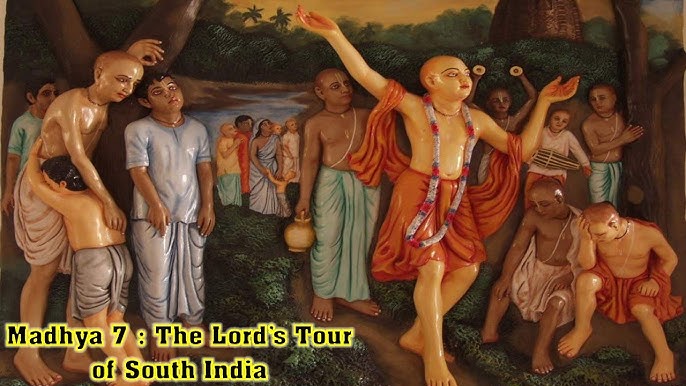
Saying this, Śrī Caitanya Mahāprabhu departed on His tour, and Sārvabhauma Bhaṭṭācārya immediately fainted and fell to the ground. (70) Although Sārvabhauma Bhaṭṭācārya fainted, Śrī Caitanya Mahāprabhu did not take notice of him. Rather, He left quickly. Who can understand the mind and intention of Śrī Caitanya Mahāprabhu? (71) This is the nature of the mind of an uncommon personality. Sometimes it is soft like a flower, but sometimes it is as hard as a thunderbolt. (72) “The hearts of those above common behavior are sometimes harder than a thunderbolt and sometimes softer than a flower. How can one accommodate such contradictions in great personalities?” (73) Lord Nityānanda Prabhu raised Sārvabhauma Bhaṭṭācārya and with the help of His men saw him to his home. (74) Immediately all the devotees came and partook of Śrī Caitanya Mahāprabhu’s company. Afterwards, Gopīnātha Ācārya came with the garments and prasādam. (75) All the devotees followed Śrī Caitanya Mahāprabhu to a place known as Ālālanātha. There they all offered respects and various prayers. (76) In great ecstasy, Śrī Caitanya Mahāprabhu danced and chanted for some time. Indeed, all the neighbors came to see Him. (77)
All around Śrī Caitanya Mahāprabhu, who is also known as Gaurahari, people began to shout the holy name of Hari. Lord Caitanya, immersed in His usual ecstasy of love, danced in the midst of them. (78) The body of Śrī Caitanya Mahāprabhu was naturally very beautiful. It was like molten gold dressed in saffron cloth. Indeed, He was most beautiful for being ornamented with the ecstatic symptoms, which caused His bodily hair to stand on end, tears to well up in His eyes, and His body to tremble and perspire all over. (79) Everyone present was astonished to see Śrī Caitanya Mahāprabhu’s dancing and His bodily transformations. Whoever came did not want to return home. (80) Everyone— including children, old men and women— began to dance and to chant the holy names of Śrī Kṛṣṇa and Gopāla. In this way they all floated in the ocean of love of Godhead. (81) Upon seeing the chanting and dancing of Lord Śrī Caitanya Mahāprabhu, Lord Nityānanda predicted that later there would be dancing and chanting in every village. (82)
Seeing that it was already getting late, Lord Nityānanda Prabhu, the spiritual master, invented a means to disperse the crowd. (83) When Lord Nityānanda Prabhu took Śrī Caitanya Mahāprabhu for lunch at noon, everyone came running around Them. (84) After finishing Their baths, They returned at noon to the temple. Admitting His own men, Śrī Nityānanda Prabhu closed the outside door. (85) Gopīnātha Ācārya then brought prasādam for the two Lords to eat, and after They had eaten, the remnants of the food were distributed to all the devotees. (86) Hearing about this, everyone there came to the outside door and began chanting the holy name, “Hari! Hari!” Thus there was a tumultuous sound. (87)
After lunch, Śrī Caitanya Mahāprabhu made them open the door. In this way everyone received His audience with great pleasure. (88) The people came and went until evening, and all of them became Vaiṣṇava devotees and began to chant and dance. (89) Śrī Caitanya Mahāprabhu then passed the night there and discussed the pastimes of Lord Kṛṣṇa with His devotees with great pleasure. (90) The next morning, after taking His bath, Śrī Caitanya Mahāprabhu started on His South Indian tour. He bade farewell to the devotees by embracing them. (91) Although they all fell to the ground unconscious, the Lord did not turn to see them but proceeded onward. (92) In separation, the Lord became very much perturbed and walked on unhappily. His servant, Kṛṣṇadāsa, who was carrying His waterpot, followed behind. (93) All the devotees remained there and fasted, and the next day they all unhappily returned to Jagannātha Purī. (94)
Almost like a mad lion, Lord Śrī Caitanya Mahāprabhu went on His tour filled with ecstatic love and performing saṅkīrtana, chanting Kṛṣṇa’s names as follows. (95) The Lord chanted: Kṛṣṇa! Kṛṣṇa! Kṛṣṇa! Kṛṣṇa! Kṛṣṇa! Kṛṣṇa! Kṛṣṇa! He – Kṛṣṇa! Kṛṣṇa! Kṛṣṇa! Kṛṣṇa! Kṛṣṇa! Kṛṣṇa! Kṛṣṇa! He – Kṛṣṇa! Kṛṣṇa! Kṛṣṇa! Kṛṣṇa! Kṛṣṇa! Kṛṣṇa! rakṣa mām – Kṛṣṇa! Kṛṣṇa! Kṛṣṇa! Kṛṣṇa! Kṛṣṇa! Kṛṣṇa! pāhi mām – That is, “O Lord Kṛṣṇa, please protect Me and maintain Me.” He also chanted: Rāma! Rāghava! Rāma! Rāghava! Rāma! Rāghava! rakṣa mām – Kṛṣṇa! Keśava! Kṛṣṇa! Keśava! Kṛṣṇa! Keśava! pāhi mām – That is, “O Lord Rāma, descendant of King Raghu, please protect Me. O Kṛṣṇa, O Keśava, killer of the Keśī demon, please maintain Me.” (96) Chanting this verse, Lord Śrī Caitanya Mahāprabhu, known as Gaurahari, went on His way. As soon as He saw someone, He would request him to chant “Hari! Hari!” (97) Whoever heard Lord Caitanya Mahāprabhu chant “Hari! Hari!” also chanted the holy name of Lord Hari and Kṛṣṇa. In this way they all followed the Lord, very eager to see Him. (98)
After some time the Lord would embrace these people and bid them return home, having invested each of them with spiritual potency. (99) Each of these empowered persons would return to his own village, always chanting the holy name of Kṛṣṇa and sometimes laughing, crying and dancing. (100) Such an empowered person would request everyone and anyone— whomever he saw—to chant the holy name of Kṛṣṇa. In this way all the villagers would also become devotees of the Supreme Personality of Godhead. (101) People from different villages who came to see such an empowered individual would become like him simply by seeing him and receiving the mercy of his glance. (102) When each of these newly empowered individuals returned to his own village, he also converted the villagers into devotees. And when others came from different villages to see him, they were also converted. (103) In this way, as empowered men went from one village to another, all the people of South India became devotees. (104) Thus many hundreds of people became Vaiṣṇavas when they passed the Lord on the way and were embraced by Him. (105)
Deepen your Bhakti-yoga practice, harmonize relationships, and receive guided coaching — all at Vedavarsity.com