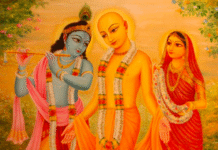
After converting into Vaiṣṇavas all the residents of Vārāṇasī, who were headed by the sannyāsīs, and after completely educating and instructing Sanātana Gosvāmī there, Śrī Caitanya Mahāprabhu returned to Jagannātha Purī. (1) All glories to Lord Caitanya! All glories to Lord Nityānanda! All glories to Advaitacandra! And all glories to all the devotees of Lord Caitanya! (2) Lord Caitanya Mahāprabhu instructed Śrī Sanātana Gosvāmī in all the conclusions of devotional service for two consecutive months. (3) For as long as Śrī Caitanya Mahāprabhu was in Vārāṇasī, Paramānanda Kīrtanīyā, who was a friend of Candraśekhara’s, chanted the Hare Kṛṣṇa mahā- mantra and other songs to Śrī Caitanya Mahāprabhu in a very humorous way. (4) When the Māyāvādī sannyāsīs at Vārāṇasī criticized Śrī Caitanya Mahāprabhu, the Lord’s devotees became very much depressed. To satisfy them, Śrī Caitanya Mahāprabhu showed His mercy to the sannyāsīs. (5)
In the Seventh Chapter of the Ādi- līlā I have already elaborately described Śrī Caitanya Mahāprabhu’s deliverance of the sannyāsīs at Vārāṇasī, but I shall briefly repeat it in this chapter. (6) When the Māyāvādī sannyāsīs were criticizing Śrī Caitanya Mahāprabhu anywhere and everywhere in Vārāṇasī, the Maharashtriyan brāhmaṇa, hearing this blasphemy, began to think about this unhappily. (7) The Maharashtriyan brāhmaṇa thought, “Whoever closely sees the characteristics of Śrī Caitanya Mahāprabhu immediately realizes His personality and accepts Him as the Supreme Lord. (8) “If by some means I can assemble all the sannyāsīs together, they will certainly become His devotees after seeing His personal characteristics. (9) “I shall have to reside at Vārāṇasī the rest of my life. If I do not try to carry out this plan, I shall certainly continue to suffer mental depression.” (10) Thinking like this, the Maharashtriyan brāhmaṇa extended an invitation to all the sannyāsīs of Vārāṇasī. After doing this, he finally approached Śrī Caitanya Mahāprabhu to extend Him an invitation. (11)
At this time, Candraśekhara and Tapana Miśra both heard blasphemous criticism against Śrī Caitanya Mahāprabhu and felt very unhappy. They came to Śrī Caitanya Mahāprabhu’s lotus feet to submit a request. (12) They submitted their request, and Śrī Caitanya Mahāprabhu, seeing His devotees’ unhappiness, decided to turn the minds of the Māyāvādī sannyāsīs. (13) While Śrī Caitanya Mahāprabhu was seriously considering meeting with the Māyāvādī sannyāsīs, the Maharashtriyan brāhmaṇa approached Him and extended an invitation. The brāhmaṇa submitted his invitation with great humility, and he touched the lotus feet of Śrī Caitanya Mahāprabhu. (14) Śrī Caitanya Mahāprabhu accepted his invitation, and the next day, after finishing His noontime activities, He went to the brāhmaṇa’s house. (15) I have already described Śrī Caitanya Mahāprabhu’s deliverance of the Māyāvādī sannyāsīs in the Seventh Chapter of the Ādi- līlā, when I described the glories of the Pañca- tattva—Śrī Caitanya Mahāprabhu, Śrī Nityānanda Prabhu, Advaita Prabhu, Gadādhara Prabhu and Śrīvāsa. (16)
Since I have already described this incident very elaborately in the Seventh Chapter of the Ādi- līlā, I do not wish to increase the size of this book by giving another description. However, I shall try to include in this chapter whatever was not described there. (17) Beginning from the day on which Śrī Caitanya Mahāprabhu showed His mercy to the Māyāvādī sannyāsīs, there were vivid discussions about this conversion among the inhabitants of Vārāṇasī. (18) Crowds of people came to see Śrī Caitanya Mahāprabhu from that day on, and scholars of various scriptures discussed different subject matters with the Lord. (19) When people came to Śrī Caitanya Mahāprabhu to discuss the principles of various scriptures, the Lord defeated their false conclusions and established the predominance of devotional service to the Lord. With logic and argument He very politely changed their minds. (20) As soon as people received instructions from Śrī Caitanya Mahāprabhu, they began to chant the Hare Kṛṣṇa mahā- mantra. Thus everyone laughed, chanted and danced with the Lord. (21)
All the Māyāvādī sannyāsīs offered their obeisances unto Śrī Caitanya Mahāprabhu and then began to discuss His movement, giving up their studies of Vedānta and Māyāvāda philosophy. (22) One of the disciples of Prakāśānanda Sarasvatī, who was as learned as his guru, began to speak in that assembly, offering all respects to Śrī Caitanya Mahāprabhu. (23) He said, “Śrī Caitanya Mahāprabhu is the Supreme Personality of Godhead, Nārāyaṇa Himself. When He explains the Vedānta- sūtra, He does so very nicely. (24) “Śrī Caitanya Mahāprabhu explains the direct meaning of the Upaniṣads. When all learned scholars hear this, their minds and ears are satisfied. (25) “Giving up the direct meaning of the Vedānta- sūtra and the Upaniṣads, Śaṅkarācārya imagines some other interpretation. (26) “All the interpretations of Śaṅkarācārya are imaginary. Such imaginary interpretations are verbally accepted by learned scholars, but they do not appeal to the heart. (27)
“The words of Śrī Kṛṣṇa Caitanya Mahāprabhu are firm and convincing, and I accept them as true. In this Age of Kali, one cannot be delivered from the material clutches simply by formally accepting the renounced order. (28) “Śrī Caitanya Mahāprabhu’s explanation of the verse beginning ‘harer nāma harer nāma’ is not only pleasing to the ear but is strong, factual evidence. (29) “In this Age of Kali, one cannot attain liberation without taking to the devotional service of the Lord. In this age, even if one chants the holy name of Kṛṣṇa imperfectly, he still attains liberation very easily. (30) “‘My dear Lord, devotional service unto You is the only auspicious path. If one gives it up simply for speculative knowledge or the understanding that these living beings are spirit souls and the material world is false, he undergoes a great deal of trouble. He only gains troublesome and inauspicious activities. His actions are like beating a husk that is already devoid of rice. His labor becomes fruitless.’ (31)
“‘O lotus- eyed one, those who think they are liberated in this life but who are devoid of devotional service to You are of impure intelligence. Although they accept severe austerities and penances and rise to the spiritual position, to impersonal Brahman realization, they fall down again because they neglect to worship Your lotus feet.’ (32) “The word ‘Brahman’ [‘the greatest’] indicates the Supreme Personality of Godhead, full in all six opulences. But if we take the onesided impersonalist view, His fullness is diminished. (33) “The Vedas, the Upaniṣads, the Brahma- sūtra and the Purāṇas all describe the activities of the spiritual potency of the Lord. If one cannot accept the personal activities of the Lord, he jokes foolishly and gives an impersonal description. (34) The Māyāvādīs do not recognize the personal form of the Lord as spiritual and full of bliss. This is a great sin. Śrī Caitanya Mahāprabhu’s statements are actually factual. (35)
“‘O supreme one, the transcendental form I am now seeing is full of transcendental bliss. It is not contaminated by the external energy. It is full of effulgence. My Lord, there is no better understanding of You than this. You are the Supreme Soul and the creator of this material world, but You are not connected with this material world. You are completely different from created form and variety. I sincerely take shelter of that form of Yours which I am now seeing. This form is the original source of all living beings and their senses.’ (36) “‘Lord Śrī Kṛṣṇa, the Supreme Personality of Godhead, is the cause of all causes. He is past, present and future, and He is the movable and immovable. He is the greatest and the smallest, and He is visible and directly experienced. He is celebrated in the Vedic literature. Everything is Kṛṣṇa, and without Him there is no existence. He is the root of all understanding, and He is that which is understood by all words.’ (37) “‘O most auspicious one! For our benefit, You enable our worship of You by manifesting Your transcendental form, which You show to us in our meditation. We offer our respectful obeisances unto You, the Supreme Person, and we worship You, whom impersonalists do not accept due to their poor fund of knowledge. Thus they are liable to descend into a hellish condition.’ (38)
“‘Fools disrespect Me because I appear like a human being. They do not know My supreme position as the cause of all causes, the creator of the material energy.’ (39) “‘Those who are envious of My form, who are cruel and mischievous and the lowest among men, are perpetually cast by Me into hellish existence in various demoniac species of life.’ (40) “Not accepting the transformation of energy, Śrīpāda Śaṅkarācārya has tried to establish the theory of illusion under the plea that Vyāsadeva has made a mistake. (41) “Śrīpāda Śaṅkarācārya has given his interpretation and imaginary meaning. It does not actually appeal to the mind of any sane man. He has done this to convince the atheists and bring them under his control. (42) “The atheists, headed by the Māyāvādī philosophers, do not care for liberation or Kṛṣṇa’s mercy. They simply continue to put forward false arguments and countertheories to atheistic philosophy, not considering or engaging in spiritual matters. (43) “The conclusion is that the import of the Vedānta- sūtra is covered by the imaginary explanation of Śaṅkarācārya. Whatever Śrī Kṛṣṇa Caitanya Mahāprabhu has said is perfectly true. (44)
“Whatever meaning Śrī Caitanya Mahāprabhu gives is perfect. Any other interpretation is only a distortion.” (45) After saying this, the disciple of Prakāśānanda Sarasvatī began to chant the holy name of Kṛṣṇa. Hearing this, Prakāśānanda Sarasvatī made the following statement. (46) Prakāśānanda Sarasvatī said, “Śaṅkarācārya was very eager to establish the philosophy of monism. Therefore he explained the Vedānta- sūtra, or Vedānta philosophy, in a different way to support monistic philosophy. (47) “If one accepts the Personality of Godhead, the philosophy that maintains that God and the living entity are one cannot be established. Therefore Śaṅkarācārya argued against and refuted all kinds of revealed scriptures. (48) “Anyone who wants to establish his own opinion or philosophy certainly cannot explain any scripture according to the principle of direct interpretation. (49)
“The Mīmāṁsaka philosophers conclude that if there is a God, He is subject to our fruitive activities. Similarly, the Sāṅkhya philosophers, who analyze the cosmic manifestation, say that the cause of the cosmos is material nature. (50) “The followers of nyāya, the philosophy of logic, maintain that the atom is the cause of the cosmic manifestation, and the Māyāvādī philosophers maintain that the impersonal Brahman effulgence is the cause of the cosmic manifestation. (51) “The Pātañjala philosophers say that when one is self- realized, he understands the Lord. Similarly, according to the Vedas and Vedic principles, the original cause is the Supreme Personality of Godhead. (52) “After studying the six philosophical theses, Vyāsadeva completely summarized them all in the aphorisms of Vedānta philosophy. (53) “According to Vedānta philosophy, the Absolute Truth is a person. When the word ‘nirguṇa’ [‘without qualities’] is used, it is to be understood that the Lord has attributes that are totally spiritual. (54)
“Of the philosophers mentioned, none really cares for the Supreme Personality of Godhead, the cause of all causes. They are always busy refuting the philosophical theories of others and establishing their own. (55) “By studying the six philosophical theories, one cannot reach the Absolute Truth. It is therefore our duty to follow the path of the mahājanas, the authorities. Whatever they say should be accepted as the supreme truth. (56) “‘Dry arguments are inconclusive. A great personality whose opinion does not differ from others is not considered a great sage. Simply by studying the Vedas, which are variegated, one cannot come to the right path by which religious principles are understood. The solid truth of religious principles is hidden in the heart of an unadulterated, self- realized person. Consequently, as the śāstras confirm, one should accept whatever progressive path the mahājanas advocate.’ (57) “The words of Śrī Caitanya Mahāprabhu are a shower of nectar. Whatever He concludes to be the ultimate truth is indeed the summum bonum of all spiritual knowledge.” (58)
Deepen your Bhakti-yoga practice, harmonize relationships, and receive guided coaching — all at Vedavarsity.com