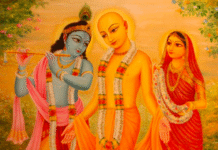




'Sri Chaitanya Mahaprabhu then placed His hand on Sanatana Goswami's head and benedicted him, saying, "Let all these instructions be manifest to you."'
-Excerpt from Chaitanya-caritamrita, Madhya-lila, 23.120-124
Śrī Caitanya Mahāprabhu again entrusted him to Svarūpa Dāmodara. Thus Raghunātha dāsa rendered very confidential service with Svarūpa Dāmodara Gosvāmī. (241) At this time, all the devotees from Bengal arrived, and, as previously, Śrī Caitanya Mahāprabhu met them with great feeling. (242) As He had previously done, He cleansed the Guṇḍicā temple and held a picnic feast in the garden with the devotees. (243) The Lord again danced with the devotees during the Ratha- yātrā festival. Seeing this, Raghunātha dāsa was struck with wonder. (244) When Raghunātha dāsa met all the devotees, Advaita Ācārya showed him great mercy. (245) He also met Śivānanda Sena, who informed him, “Your father sent ten men to take you away. (246)
“He wrote me a letter asking me to send you back, but when those ten men received no information about you, they returned home from Jhāṅkarā.” (247) When all the devotees from Bengal returned home after staying at Jagannātha Purī for four months, Raghunātha dāsa’s father heard about their arrival and therefore sent a man to Śivānanda Sena. (248) That man inquired from Śivānanda Sena, “Did you see anyone in the renounced order at the residence of Śrī Caitanya Mahāprabhu? (249) “That person is Raghunātha dāsa, the son of Govardhana Majumadāra. Did you meet him in Nīlācala?” (250) Śivānanda Sena replied, “Yes, sir. Raghunātha dāsa is with Śrī Caitanya Mahāprabhu and is a very famous man. Who does not know him? (251) “Śrī Caitanya Mahāprabhu has placed him under the charge of Svarūpa Dāmodara. Raghunātha dāsa has become just like the life of all the Lord’s devotees. (252)
“He chants the Hare Kṛṣṇa mahā- mantra all day and night. He never gives up the shelter of Śrī Caitanya Mahāprabhu, not even for a moment. (253) “He is in the supreme order of renounced life. Indeed, he does not care about eating or dressing. Somehow or other he eats and maintains his life. (254) “After ten daṇḍas [four hours] of the night have passed and Raghunātha dāsa has seen the performance of puṣpāñjali, he stands at the Siṁha- dvāra gate to beg some alms to eat. (255) “He eats if someone gives him something to eat. Sometimes he fasts, and sometimes he chews fried grains.” (256) After hearing this, the messenger returned to Govardhana Majumadāra and informed him all about Raghunātha dāsa. (257) Hearing the description of Raghunātha dāsa’s behavior in the renounced order, his father and mother were very unhappy. Therefore they decided to send Raghunātha some men with goods for his comfort. (258)
Raghunātha dāsa’s father immediately sent four hundred coins, two servants and one brāhmaṇa to Śivānanda Sena. (259) Śivānanda Sena informed them, “You cannot go to Jagannātha Purī directly. When I go there, you may accompany me. (260) “Now go home. When all of us go, I shall take all of you with me.” (261) Describing this incident, the great poet Śrī Kavi- karṇapūra has written extensively about the glorious activities of Raghunātha dāsa in his Śrī Caitanya- candrodaya- nāṭaka. (262) “Raghunātha dāsa is a disciple of Yadunandana Ācārya, who is very gentle and is extremely dear to Vāsudeva Datta, a resident of Kāñcanapallī. Because of Raghunātha dāsa’s transcendental qualities, he is always more dear than life for all of us devotees of Śrī Caitanya Mahāprabhu. Since he has been favored by the abundant mercy of Śrī Caitanya Mahāprabhu, he is always pleasing. Vividly providing a superior example for the renounced order, this very dear follower of Svarūpa Dāmodara Gosvāmī is the ocean of renunciation. Who among the residents of Nīlācala [Jagannātha Purī] does not know him very well? (263)
“Because he is very pleasing to all the devotees, Raghunātha dāsa Gosvāmī easily became like the fertile earth of good fortune in which it was suitable for the seed of Lord Caitanya Mahāprabhu to be sown. At the same time that the seed was sown, it grew into a matchless tree of the love of Śrī Caitanya Mahāprabhu and produced fruit.” (264) In these verses, the great poet Kavi- karṇapūra gives the same information that Śivānanda Sena conveyed to the messenger from Raghunātha dāsa’s father. (265) The next year, when Śivānanda Sena was going to Jagannātha Purī as usual, the servants and the brāhmaṇa, who was a cook, went with him. (266) The servants and brāhmaṇa brought four hundred coins to Jagannātha Purī, and there they met Raghunātha dāsa. (267) Raghunātha dāsa did not accept the money and men sent by his father. Therefore the brāhmaṇa and one of the servants stayed there with the money. (268)
At that time, Raghunātha dāsa began inviting Śrī Caitanya Mahāprabhu to his house with great attention for two days every month. (269) The cost for these two occasions was 640 kauḍis. Therefore he would take that much from the servant and the brāhmaṇa. (270) Raghunātha dāsa continued to invite Śrī Caitanya Mahāprabhu in this way for two years, but at the end of the second year he stopped. (271) When Raghunātha dāsa neglected to invite Lord Śrī Caitanya Mahāprabhu for two consecutive months, the Lord, the son of Śacī, questioned Svarūpa Dāmodara. (272) The Lord asked, “Why has Raghunātha dāsa stopped inviting Me?” Svarūpa Dāmodara replied, “He must have reconsidered something in his mind. (273) “‘I invite Śrī Caitanya Mahāprabhu by accepting goods from materialistic people. I know that the Lord’s mind is not satisfied by this. (274) “‘My consciousness is impure because I accept all these goods from people who are interested only in pounds, shillings and pence. Therefore by this kind of invitation I get only some material reputation. (275)
“‘At my request Śrī Caitanya Mahāprabhu accepts the invitations because He knows that a foolish person like me would be unhappy if He did not accept them.’ (276) “Considering all these points,” Svarūpa Dāmodara concluded, “he has stopped inviting You.” Hearing this, Śrī Caitanya Mahāprabhu smiled and spoke as follows. (277) “When one eats food offered by a materialistic man, one’s mind becomes contaminated, and when the mind is contaminated, one is unable to think of Kṛṣṇa properly. (278) “When one accepts an invitation from a person contaminated by the material mode of passion, the person who offers the food and the person who accepts it are both mentally contaminated. (279) “Because of Raghunātha dāsa’s eagerness, I accepted his invitation for many days. It is very good that Raghunātha dāsa, knowing this, has now automatically given up this practice.” (280) After some days, Raghunātha dāsa gave up standing near the Siṁha- dvāra gate and instead began eating by begging alms from a booth for free distribution of food. (281)
When Śrī Caitanya Mahāprabhu heard this news from Govinda, He inquired from Svarūpa Dāmodara, “Why does Raghunātha dāsa no longer stand at the Siṁha- dvāra gate to beg alms?” (282) Svarūpa Dāmodara replied, “Raghunātha dāsa felt unhappy standing at the Siṁha- dvāra. Therefore he is now going at midday to beg alms from the charity booth.” (283) Hearing this news, Śrī Caitanya Mahāprabhu said, “He has done very well by no longer standing at the Siṁha- dvāra gate. Such begging of alms resembles the behavior of a prostitute. (284) “‘Here is a person coming near. He will give me something. This person gave me something last night. Now another person is coming near. He may give me something. The person who just passed did not give me anything, but another person will come, and he will give me something.’ Thus a person in the renounced order gives up his neutrality and depends on the charity of this person or that. Thinking in this way, he adopts the occupation of a prostitute. (285)
“If one goes to the booth where free food is distributed and fills his belly with whatever he obtains, there is no chance of further unwanted talk, and one can very peacefully chant the Hare Kṛṣṇa mahā- mantra.” (286) After saying this, Śrī Caitanya Mahāprabhu again bestowed His mercy upon Raghunātha dāsa by giving him a stone from Govardhana Hill and a garland of small conchshells. (287) Previously, when Śaṅkarānanda Sarasvatī had returned from Vṛndāvana, he had brought the stone from Govardhana Hill and also the garland of conchshells. (288) He presented Śrī Caitanya Mahāprabhu with these two items-the garland of conchshells and the stone from Govardhana Hill. (289) Upon receiving these two uncommon items, Śrī Caitanya Mahāprabhu was extremely happy. While chanting, He would put the garland around His neck. (290) The Lord would put the stone to His heart or sometimes to His eyes. Sometimes He would smell it with His nose and sometimes place it on His head. (291)
The stone from Govardhana was always moist with tears from His eyes. Śrī Caitanya Mahāprabhu would say, “This stone is directly the body of Lord Kṛṣṇa.” (292) For three years He kept the stone and garland. Then, greatly satisfied by the behavior of Raghunātha dāsa, the Lord delivered both of them to him. (293) Śrī Caitanya Mahāprabhu instructed Raghunātha dāsa, “This stone is the transcendental form of Lord Kṛṣṇa. Worship the stone with great eagerness.” (294) Śrī Caitanya Mahāprabhu continued, “Worship this stone in the mode of goodness like a perfect brāhmaṇa, for by such worship you will surely attain ecstatic love of Kṛṣṇa without delay. (295) “For such worship, one needs a jug of water and a few flowers from a tulasī tree. This is worship in complete goodness when performed in complete purity. (296) “With faith and love, you should offer eight soft tulasī flowers, each with two tulasī leaves, one on each side of each flower.” (297)
After thus advising him how to worship, Lord Śrī Caitanya Mahāprabhu personally offered Raghunātha dāsa the govardhana- śilā with His transcendental hand. As advised by the Lord, Raghunātha dāsa worshiped the śilā in great transcendental jubilation. (298) Svarūpa Dāmodara gave Raghunātha dāsa two cloths, each about six inches long, a wooden platform and a jug in which to keep water. (299) Thus Raghunātha dāsa began worshiping the stone from Govardhana, and as he worshiped he saw the Supreme Personality of Godhead, Kṛṣṇa, the son of Nanda Mahārāja, directly in the stone. (300) Thinking of how he had received the govardhana- śilā directly from the hands of Śrī Caitanya Mahāprabhu, Raghunātha dāsa was always overflooded with ecstatic love. (301)
The amount of transcendental bliss that Raghunātha dāsa enjoyed simply by offering water and tulasī is impossible to achieve even if one worships the Deity with sixteen kinds of paraphernalia. (302) After Raghunātha dāsa had thus worshiped the govardhana- śilā for some time, Svarūpa Dāmodara one day spoke to him as follows. (303) “Offer the Govardhana stone eight kauḍis worth of the first- class sweetmeats known as khājā and sandeśa. If you offer them with faith and love, they will be just like nectar.” (304) Raghunātha dāsa then began offering the costly sweetmeats known as khājā, which Govinda, following the order of Svarūpa Dāmodara, would supply. (305) When Raghunātha dāsa received from Śrī Caitanya Mahāprabhu the stone and the garland of conchshells, he could understand the Lord’s intention. Thus he thought as follows. (306)
“By offering me the govardhana- śilā, Śrī Caitanya Mahāprabhu has offered me a place near Govardhana Hill, and by offering me the garland of conchshells, He has offered me shelter at the lotus feet of Śrīmatī Rādhārāṇī.” (307) Raghunātha dāsa’s transcendental bliss was boundless. Forgetting everything external, he served the lotus feet of Śrī Caitanya Mahāprabhu with his body and mind. (308) Who could list the unlimited transcendental attributes of Raghunātha dāsa? His strict regulative principles were exactly like lines on a stone. (309) Raghunātha dāsa spent more than twenty- two hours out of every twenty- four chanting the Hare Kṛṣṇa mahā- mantra and remembering the lotus feet of the Lord. He ate and slept for less than an hour and a half, and on some days that also was impossible. (310) Topics concerning his renunciation are wonderful. Throughout his life he never allowed his tongue sense gratification. (311)
He never touched anything to wear except a small torn cloth and a patchwork wrapper. Thus he very rigidly executed the order of Śrī Caitanya Mahāprabhu. (312) Whatever he ate was only to keep his body and soul together, and when he ate he would reproach himself thus. (313) “‘If one’s heart has been cleansed by perfect knowledge and one has understood Kṛṣṇa, the Supreme Brahman, he then gains everything. Why should such a person act like a debauchee by trying to maintain his material body very carefully?'” (314) Lord Jagannātha’s prasādam is sold by shopkeepers, and that which is not sold decomposes after two or three days. (315) All the decomposed food is thrown before the cows from Tailaṅga at the Siṁha- dvāra gate. Because of its rotten odor, even the cows cannot eat it. (316) At night Raghunātha dāsa would collect that decomposed rice, bring it home and wash it with ample water. (317)
Then he ate the hard inner portion of the rice with salt. (318) One day Svarūpa Dāmodara saw the activities of Raghunātha dāsa. Thus he smiled and asked for a small portion of that food and ate it. (319) Svarūpa Dāmodara said, “You eat such nectar every day, but you never offer it to us. What is your character?” (320) When Śrī Caitanya Mahāprabhu heard news of this from the mouth of Govinda, He went there the next day and spoke as follows. (321) “What nice things are you eating? Why don’t you give anything to Me?” Saying this, He forcibly took a morsel and began to eat. (322) When Śrī Caitanya Mahāprabhu was taking another morsel of food, Svarūpa Dāmodara caught Him by the hand and said, “It is not fit for You.” Thus he forcibly took the food away. (323)
Śrī Caitanya Mahāprabhu said, “Of course, every day I eat varieties of prasādam, but I have never tasted such nice prasādam as that which Raghunātha is eating.” (324) Thus Śrī Caitanya Mahāprabhu performed many pastimes at Jagannātha Purī. Seeing the severe penances performed by Raghunātha dāsa in the renounced order, the Lord was greatly satisfied. (325) In his poem known as the Gaurāṅga- stava- kalpavṛkṣa, Raghunātha dāsa has described his personal deliverance. (326)
“Although I am a fallen soul, the lowest of men, Śrī Caitanya Mahāprabhu delivered me from the blazing forest fire of great material opulence by His mercy. He handed me over in great pleasure to Svarūpa Dāmodara, His personal associate. The Lord also gave me the garland of small conchshells that He wore on His chest and a stone from Govardhana Hill, although they were very dear to Him. That same Lord Śrī Caitanya Mahāprabhu awakens within my heart and makes me mad after Him.” (327) Thus I have described the meeting of Raghunātha dāsa with Śrī Caitanya Mahāprabhu. Anyone who hears about this incident attains the lotus feet of Śrī Caitanya Mahāprabhu. (328) Praying at the lotus feet of Śrī Rūpa and Śrī Raghunātha, always desiring their mercy, I, Kṛṣṇadāsa, narrate Śrī Caitanya- caritāmṛta, following in their footsteps. (329)
Deepen your Bhakti-yoga practice, harmonize relationships, and receive guided coaching — all at Vedavarsity.com