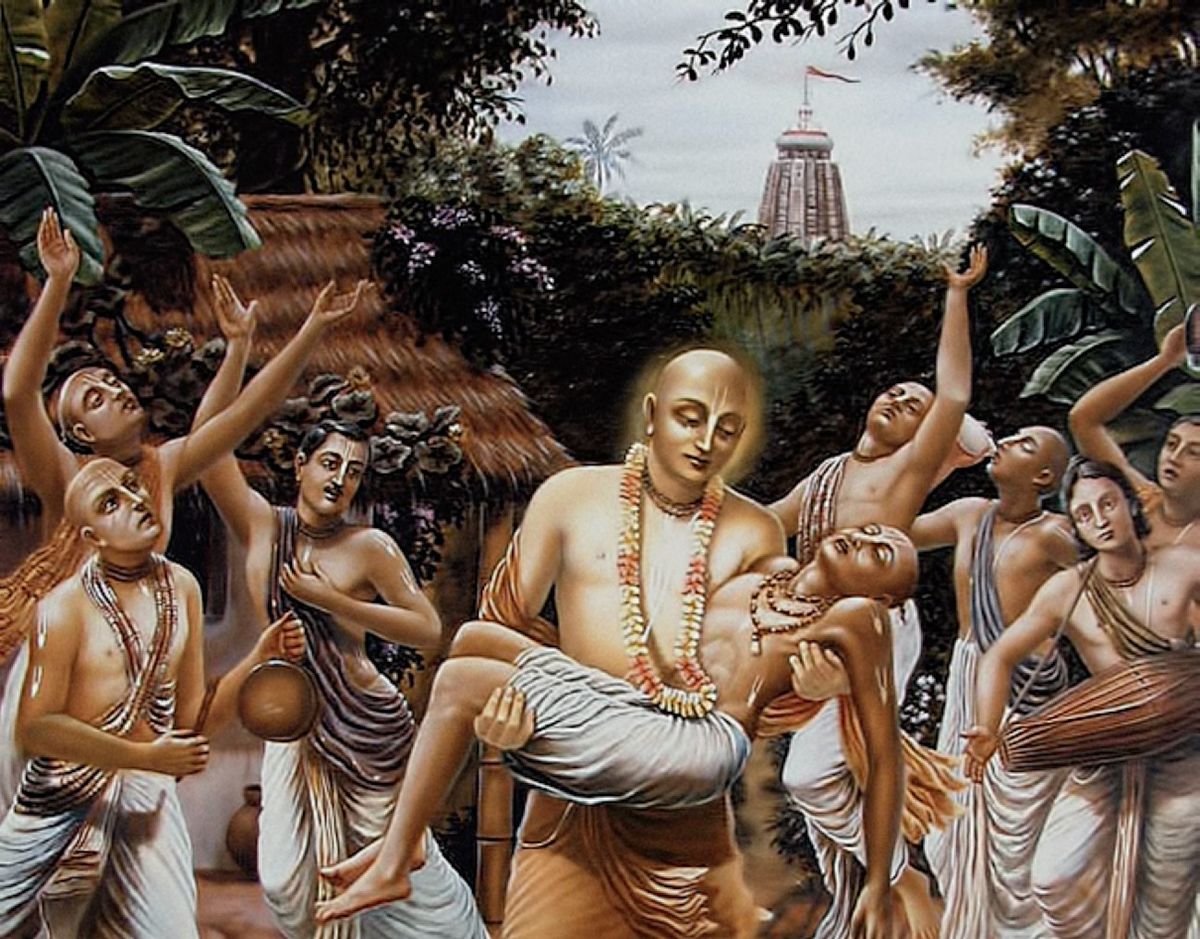
As Śrī Caitanya Mahāprabhu heard this from Haridāsa Ṭhākura, the happiness within His heart increased, but as a matter of course, He still inquired further. (66) “On this earth there are many living entities,” the Lord said, “some moving and some not moving. What will happen to the trees, plants, insects and other living entities? How will they be delivered from material bondage?” (67) Haridāsa Ṭhākura replied, “My dear Lord, the deliverance of all moving and nonmoving living entities takes place only by Your mercy. You have already granted this mercy and delivered them. (68) “You have loudly chanted the Hare Kṛṣṇa mantra, and everyone, moving or not moving, has benefited by hearing it. (69) “My Lord, the moving entities who have heard Your loud saṅkīrtana have already been delivered from bondage to the material world, and after the nonmoving living entities like trees hear it, there is an echo. (70)
“Actually, however, it is not an echo: it is the kīrtana of the nonmoving living entities. All this, although inconceivable, is possible by Your mercy. (71) “When loud chanting of the Hare Kṛṣṇa mantra is performed all over the world by those who follow in Your footsteps, all living entities, moving and nonmoving, dance in ecstatic devotional love. (72) “My dear Lord, all the incidents that took place while You were going to Vṛndāvana through the forest known as Jhārikhaṇḍa have been related to me by Your servant Balabhadra Bhaṭṭācārya. (73) “When Your devotee Vāsudeva Datta submitted his plea at Your lotus feet for the deliverance of all living entities, You accepted that request. (74) “My dear Lord, You have accepted the form of a devotee just to deliver all the fallen souls of this world. (75)
“You have preached the loud chanting of the Hare Kṛṣṇa mahā- mantra and in this way freed all moving and nonmoving living entities from material bondage.” (76) Śrī Caitanya Mahāprabhu replied, “If all living entities are liberated, the entire universe will be devoid of living beings.” (77) Haridāsa said, “My Lord, as long as You are situated within the material world, You will send to the spiritual sky all the developed moving and nonmoving living entities in different species. Then again You will awaken the living entities who are not yet developed and engage them in activities. (78-79) “In this way all moving and nonmoving living entities will come into existence, and the entire universe will be filled as it was previously. (80) “Previously, when Lord Rāmacandra left this world, He took with Him all the living entities of Ayodhyā. Then He filled Ayodhyā again with other living entities. (81)
“My dear Lord, You have set a plan in motion by descending to the material world, but no one can understand how You are acting. (82) “Formerly, when Lord Kṛṣṇa descended in Vṛndāvana, He freed all living entities in the universe from material existence in the same way. (83) “Kṛṣṇa, the unborn Supreme Personality of Godhead, master of all masters of mystic power, delivers all living entities, moving and nonmoving. Nothing is astonishing in the activities of the Lord.’ (84) “‘Although the Supreme Personality of Godhead may be seen, glorified or remembered with an attitude of envy, He nevertheless awards the most confidential liberation, which is rarely achieved by the demigods and demons. What, then, can be said of those who are already fully engaged in devotional service to the Lord?’ (85) “By descending as an incarnation at Navadvīpa, You, just like Kṛṣṇa, have already delivered all the living entities of the universe. (86)
“One may say that he understands the glories of Śrī Caitanya Mahāprabhu. He may know whatever he may know, but as far as I am concerned, this is my conclusion. (87) “My dear Lord, Your pastimes are just like an ocean of nectar. It is not possible for me to conceive how great that ocean is or even to understand a drop of it.” (88) Hearing all this, Śrī Caitanya Mahāprabhu was astonished. “These are actually My confidential pastimes,” He thought. “How could Haridāsa have understood them?” (89) Greatly satisfied by the statements of Haridāsa Ṭhākura, Śrī Caitanya Mahāprabhu embraced him. Outwardly, however, He avoided further discussions of these matters. (90) This is a characteristic of the Supreme Personality of Godhead. Although He wants to cover His opulence, He cannot do so before His devotees. This is well known everywhere. (91)
“O my Lord, everything within material nature is limited by time, space and thought. Your characteristics, however, being unequaled and unsurpassed, are always transcendental to such limitations. You sometimes cover such characteristics by Your own energy, but nevertheless Your unalloyed devotees are always able to see You under all circumstances.” (92) Then Śrī Caitanya Mahāprabhu went to His personal devotees and began speaking about Haridāsa Ṭhākura’s transcendental qualities as if He had hundreds of mouths. (93) Śrī Caitanya Mahāprabhu derives great pleasure from glorifying His devotees, and among the devotees, Haridāsa Ṭhākura is the foremost. (94) The transcendental qualities of Haridāsa Ṭhākura are innumerable and unfathomable. One may describe a portion of them, but to count them all is impossible. (95) In the Caitanya- maṅgala, Śrīla Vṛndāvana dāsa Ṭhākura has described the attributes of Haridāsa Ṭhākura to some extent. (96) No one can describe all the qualities of Haridāsa Ṭhākura. One may say something about them just to purify himself. (97)
O devotees of Śrī Caitanya Mahāprabhu, please hear something about the qualities of Haridāsa Ṭhākura that Śrīla Vṛndāvana dāsa Ṭhākura has not described in detail. (98) After leaving his home, Haridāsa Ṭhākura stayed for some time in the forest of Benāpola. (99) Haridāsa Ṭhākura constructed a cottage in a solitary forest. There he planted a tulasī plant, and in front of the tulasī he would chant the holy name of the Lord 300,000 times daily. He chanted throughout the entire day and night. (100) For his bodily maintenance he would go to a brāhmaṇa’s house and beg some food. He was spiritually so influential that all the neighboring people worshiped him. (101) A landholder named Rāmacandra Khān was the zamindar of that district. He was envious of Vaiṣṇavas and was therefore a great atheist. (102) Unable to tolerate that such respect was being offered to Haridāsa Ṭhākura, Rāmacandra Khān planned in various ways to dishonor him. (103)
By no means could he find any fault in the character of Haridāsa Ṭhākura. Therefore he called for local prostitutes and began a plan to discredit His Holiness. (104) Rāmacandra Khān said to the prostitutes, “There is a mendicant named Haridāsa Ṭhākura. All of you devise a way to deviate him from his vows of austerity.” (105) Among the prostitutes, one attractive young girl was selected. “I shall attract the mind of Haridāsa Ṭhākura,” she promised, “within three days.” (106) Rāmacandra Khān said to the prostitute, “My constable will go with you so that as soon as he sees you with Haridāsa Ṭhākura, immediately he will arrest him and bring both of you to me.” (107) The prostitute replied, “First let me have union with him once; then the second time I shall take your constable with me to arrest him.” (108) At night the prostitute, after dressing herself most attractively, went to the cottage of Haridāsa Ṭhākura with great jubilation. (109)
After offering obeisances to the tulasī plant, she went to the door of Haridāsa Ṭhākura, offered him obeisances and stood there. (110) Exposing part of her body to his view, she sat down on the threshold of the door and spoke to him in very sweet words. (111) “My dear Ṭhākura, O great preacher, great devotee, you are so beautifully built, and your youth is just beginning. Who is the woman who could control her mind after seeing you? (112) “I am eager to be united with you. My mind is greedy for this. If I don’t obtain you, I shall not be able to keep my body and soul together.” (113) Haridāsa Ṭhākura replied, “I shall accept you without fail, but you will have to wait until I have finished chanting my regular rounds on my beads. Until that time, please sit and listen to the chanting of the holy name. As soon as I am finished, I shall fulfill your desire.” (114-115)
Hearing this, the prostitute remained sitting there while Haridāsa Ṭhākura chanted on his beads until the light of morning appeared. (116) When she saw that it was morning, the prostitute stood up and left. Coming before Rāmacandra Khān, she informed him of all the news. (117) “Today Haridāsa Ṭhākura has promised to enjoy with me. Tomorrow certainly I shall have union with him.” (118) The next night, when the prostitute came again, Haridāsa Ṭhākura gave her many assurances. (119) “Last night you were disappointed. Please excuse my offense. I shall certainly accept you. (120) “Please sit down and hear the chanting of the Hare Kṛṣṇa mahā- mantra until my regular chanting is finished. Then your desire will surely be fulfilled.” (121)
After offering her obeisances to the tulasī plant and Haridāsa Ṭhākura, she sat down at the door. Hearing Haridāsa Ṭhākura chanting the Hare Kṛṣṇa mantra, she also chanted, “O my Lord Hari, O my Lord Hari.” (122) When the night came to an end, the prostitute was restless. Seeing this, Haridāsa Ṭhākura spoke to her as follows. (123) “I have vowed to chant ten million names in a month. I have taken this vow, but now it is nearing its end. (124) “I thought that today I would be able to finish my performance of yajña, my chanting of the Hare Kṛṣṇa mantra. I tried my best to chant the holy name all night, but I still did not finish. (125) “Tomorrow I will surely finish, and my vow will be fulfilled. Then it will be possible for me to enjoy with you in full freedom.” (126)
The prostitute returned to Rāmacandra Khān and informed him of what had happened. The next day she came earlier, at the beginning of the evening, and stayed with Haridāsa Ṭhākura. (127) After offering obeisances to the tulasī plant and Haridāsa Ṭhākura, she sat down on the threshold of the room. Thus she began to hear Haridāsa Ṭhākura’s chanting, and she also personally chanted “Hari, Hari,” the holy name of the Lord. (128) “Today it will be possible for me to finish my chanting,” Haridāsa Ṭhākura informed her. “Then I shall satisfy all your desires.” (129) The night ended while Haridāsa Ṭhākura was chanting, but by his association the mind of the prostitute had changed. (130)
Deepen your Bhakti-yoga practice, harmonize relationships, and receive guided coaching — all at Vedavarsity.com