


Therefore, giving up hatred and hesitation, try to eat the remnants of the food of Vaiṣṇavas, for you will thus be able to achieve your desired goal of life. (58) The remnants of food offered to Lord Kṛṣṇa are called mahā- prasādam. After this same mahā- prasādam has been taken by a devotee, the remnants are elevated to mahā- mahā- prasādam. (59) The dust of the feet of a devotee, the water that has washed the feet of a devotee, and the remnants of food left by a devotee are three very powerful substances. (60) By rendering service to these three, one attains the supreme goal of ecstatic love for Kṛṣṇa. In all the revealed scriptures this is loudly declared again and again. (61)
Therefore, my dear devotees, please hear from me, for I insist again and again: please keep faith in these three and render service to them without hesitation. (62) From these three one achieves the highest goal of life-ecstatic love of Kṛṣṇa. This is the greatest mercy of Lord Kṛṣṇa. The evidence is Kālidāsa himself. (63) In this way Śrī Caitanya Mahāprabhu remained at Jagannātha Purī, Nīlācala, and He invisibly bestowed great mercy upon Kālidāsa. (64) That year, Śivānanda Sena brought with him his wife and youngest son, Purī dāsa. (65) Taking his son, Śivānanda Sena went to see Śrī Caitanya Mahāprabhu at His residence. He made his son offer respectful obeisances at the lotus feet of the Lord. (66) Again and again Śrī Caitanya Mahāprabhu asked the boy to chant the name of Kṛṣṇa, but the boy would not utter the holy name. (67) Although Śivānanda Sena tried with much endeavor to get his boy to speak Kṛṣṇa’s holy name, the boy would not utter it. (68) Śrī Caitanya Mahāprabhu said, “I have induced the whole world to take to the holy name of Kṛṣṇa. I have induced even the trees and immovable plants to chant the holy name. (69)
“But I could not induce this boy to chant the holy name of Kṛṣṇa.” Hearing this, Svarūpa Dāmodara Gosvāmī began to speak. (70) “My Lord,” he said, “You have given him initiation into the name of Kṛṣṇa, but after receiving the mantra he will not express it in front of everyone. (71) “This boy chants the mantra within his mind but does not say it aloud. That is his intention, as far as I can guess.” (72) Another day, when Śrī Caitanya Mahāprabhu said to the boy, “Recite, My dear Purī dāsa,” the boy composed the following verse and expressed it before everyone. (73) “Lord Śrī Kṛṣṇa is just like a bluish lotus flower for the ears; He is ointment for the eyes, a necklace of indranīla gems for the chest, and universal ornaments for the gopī damsels of Vṛndāvana. Let that Lord Śrī Hari, Kṛṣṇa, be glorified.” (74) Although the boy was only seven years old and still had no education, he composed such a nice verse. Everyone was struck with wonder. (75) This is the glory of Śrī Caitanya Mahāprabhu’s causeless mercy, which even the demigods, headed by Lord Brahmā, cannot estimate. (76) All the devotees remained with Śrī Caitanya Mahāprabhu continuously for four months. Then the Lord ordered them back to Bengal, and therefore they returned. (77)
As long as the devotees were in Nīlācala, Jagannātha Purī, Śrī Caitanya Mahāprabhu maintained His external consciousness, but after their departure His chief engagement was again the madness of ecstatic love for Kṛṣṇa. (78) Throughout the entire day and night, Śrī Caitanya Mahāprabhu directly relished Kṛṣṇa’s beauty, fragrance and taste as if He were touching Kṛṣṇa hand to hand. (79) One day, when Śrī Caitanya Mahāprabhu went to visit the temple of Lord Jagannātha, the gatekeeper at the Siṁha- dvāra approached Him and offered respectful obeisances. (80) The Lord asked him, “Where is Kṛṣṇa, My life and soul? Please show Me Kṛṣṇa.” Saying this, He caught the doorkeeper’s hand. (81) The doorkeeper replied, “The son of Mahārāja Nanda is here; please come along with me, and I shall show You.” (82) Lord Caitanya said to the doorman, “You are My friend. Please show Me where the Lord of My heart is.” After the Lord said this, they both went to the place known as Jagamohana, where everyone views Lord Jagannātha. (83)
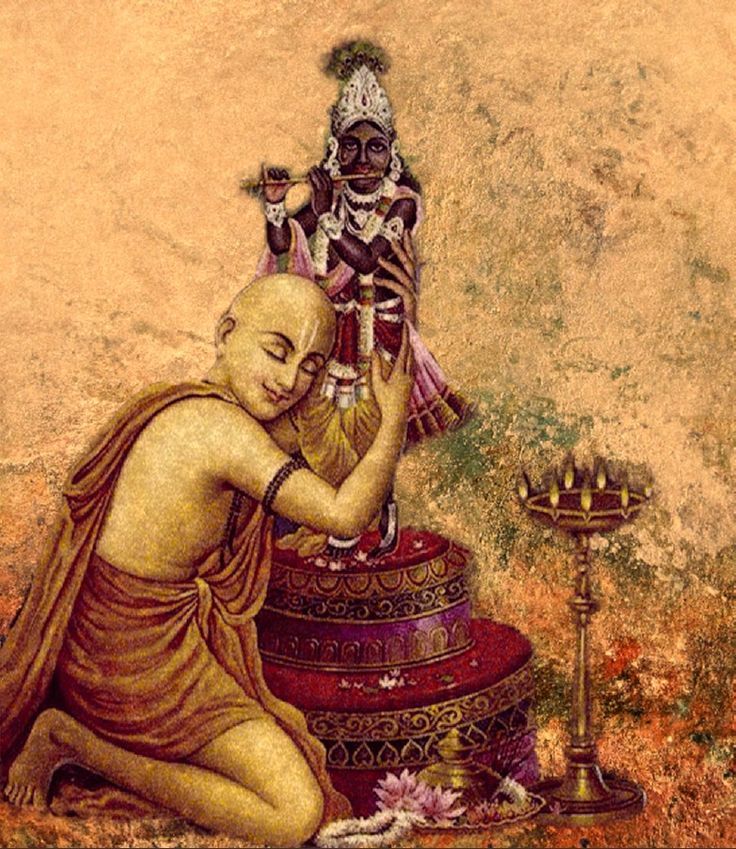
“Just see!” the doorkeeper said. “Here is the best of the Personalities of Godhead. From here You may see the Lord to the full satisfaction of Your eyes.” (84) Śrī Caitanya Mahāprabhu stayed behind the huge column called the Garuḍa- stambha and looked upon Lord Jagannātha, but as He looked He saw that Lord Jagannātha had become Lord Kṛṣṇa, with His flute to His mouth. (85) In his book known as Gaurāṅga- stava- kalpavṛkṣa, Raghunātha dāsa Gosvāmī has described this incident very nicely. (86) “‘My dear friend the doorkeeper, where is Kṛṣṇa, the Lord of My heart? Kindly show Him to Me quickly.’ With these words, Lord Śrī Caitanya Mahāprabhu addressed the doorkeeper like a madman. The doorkeeper grasped His hand and replied very hastily, ‘Come, see Your beloved!’ May that Lord Śrī Caitanya Mahāprabhu rise within my heart and thus make me mad also.” (87) The offering of food known as gopāla- vallabha- bhoga was then given to Lord Jagannātha, and ārati was performed with the sound of the conch and the ringing of bells. (88) When the ārati finished, the prasādam was taken out, and the servants of Lord Jagannātha came to offer some to Śrī Caitanya Mahāprabhu. (89)
The servants of Lord Jagannātha first garlanded Śrī Caitanya Mahāprabhu and then offered Him Lord Jagannātha’s prasādam. The prasādam was so nice that its aroma alone, to say nothing of its taste, would drive the mind mad. (90) The prasādam was made of very valuable ingredients. Therefore the servant wanted to feed Śrī Caitanya Mahāprabhu a portion of it. (91) Śrī Caitanya Mahāprabhu tasted a portion of the prasādam. Govinda took the rest and bound it in the end of his wrapper. (92) To Śrī Caitanya Mahāprabhu the prasādam tasted millions upon millions of times better than nectar, and thus He was fully satisfied. The hair all over His body stood on end, and incessant tears flowed from His eyes. (93) Śrī Caitanya Mahāprabhu considered, “Where has such a taste in this prasādam come from? Certainly it is due to its having been touched by the nectar of Kṛṣṇa’s lips.” (94) Understanding this, Śrī Caitanya Mahāprabhu felt an emotion of ecstatic love for Kṛṣṇa, but upon seeing the servants of Lord Jagannātha, He restrained Himself. (95)
The Lord said again and again, “Only by great fortune may one come by a particle of the remnants of food offered to the Lord.” The servants of the Jagannātha temple inquired, “What is the meaning of this?” (96) Śrī Caitanya Mahāprabhu replied, “These are remnants of food that Kṛṣṇa has eaten and thus turned to nectar with His lips. It surpasses heavenly nectar, and even such demigods as Lord Brahmā find it difficult to obtain. (97) “Remnants left by Kṛṣṇa are called phelā. Anyone who obtains even a small portion must be considered very fortunate. (98) “One who is only ordinarily fortunate cannot obtain such mercy. Only persons who have the full mercy of Kṛṣṇa can receive such remnants.(99) “The word ‘sukṛti’ refers to pious activities performed by the mercy of Kṛṣṇa. One who is fortunate enough to obtain such mercy receives the remnants of the Lord’s food and thus becomes glorious.” (100)
After saying this, Śrī Caitanya Mahāprabhu bade farewell to all the servants. After seeing the next offering of food to Lord Jagannātha, a function known as upala- bhoga, He returned to His own quarters. (101) After finishing His noon duties, Śrī Caitanya Mahāprabhu ate His lunch, but He constantly remembered the remnants of Kṛṣṇa’s food. (102) Śrī Caitanya Mahāprabhu performed His external activities, but His mind was filled with ecstatic love. With great difficulty He tried to restrain His mind, but it would always be overwhelmed by very deep ecstasy. (103) After finishing His evening duties, Śrī Caitanya Mahāprabhu sat down with His personal associates in a secluded place and discussed the pastimes of Kṛṣṇa in great jubilation. (104) Following the indications of Śrī Caitanya Mahāprabhu, Govinda brought the prasādam of Lord Jagannātha. The Lord sent some to Paramānanda Purī and Brahmānanda Bhāratī. (105)
Śrī Caitanya Mahāprabhu then gave shares of the prasādam to Rāmānanda Rāya, Sārvabhauma Bhaṭṭācārya, Svarūpa Dāmodara Gosvāmī and all the other devotees. (106) As they tasted the uncommon sweetness and fragrance of the prasādam, everyone’s mind was struck with wonder. (107) Śrī Caitanya Mahāprabhu said, “These ingredients, such as sugar, camphor, black pepper, cardamom, cloves, butter, spices and licorice, are all material. Everyone has tasted these material substances before. (108-109) “However,” the Lord continued, “in these ingredients there are extraordinary tastes and uncommon fragrances. Just taste them and see the difference in the experience. (110) “Apart from the taste, even the fragrance pleases the mind and makes one forget any other sweetness besides its own. (111)
“Therefore, it is to be understood that the spiritual nectar of Kṛṣṇa’s lips has touched these ordinary ingredients and transferred to them all their spiritual qualities. (112) “A fragrance and taste that are uncommon and greatly enchanting and that make one forget all other experiences are attributes of Kṛṣṇa’s lips. (113) “This prasādam has been made available only as a result of many pious activities. Now taste it with great faith and devotion.” (114) Loudly chanting the holy name of Hari, all of them tasted the prasādam. As they tasted it, their minds became mad in the ecstasy of love. (115) In ecstatic love, Śrī Caitanya Mahāprabhu ordered Rāmānanda Rāya to recite some verses. Thus Rāmānanda Rāya spoke as follows. (116) “‘O hero of charity, please deliver unto us the nectar of Your lips. That nectar increases lusty desires for enjoyment and diminishes lamentation in the material world. Kindly give us the nectar of Your lips, which are touched by Your transcendentally vibrating flute, for that nectar makes all human beings forget all other attachments.'” (117)
Upon hearing Rāmānanda Rāya quote this verse, Śrī Caitanya Mahāprabhu was very satisfied. Then He recited the following verse, which had been spoken by Śrīmatī Rādhārāṇī in great anxiety. (118) “‘My dear friend, the all- surpassing nectar from the lips of the Supreme Personality of Godhead, Kṛṣṇa, can be obtained only after many, many pious activities. For the beautiful gopīs of Vṛndāvana, that nectar vanquishes the desire for all other tastes. Madana- mohana always chews pan that surpasses the nectar of heaven. He is certainly increasing the desires of My tongue.'” (119) After saying this, Śrī Caitanya Mahāprabhu was overwhelmed by ecstatic loving emotions. Talking like a madman, He began to explain the meaning of the two verses. (120) “My dear lover,” Lord Caitanya said in the mood of Śrīmatī Rādhārāṇī, “let Me describe some of the characteristics of Your transcendental lips. They agitate the mind and body of everyone, they increase lusty desires for enjoyment, they destroy the burden of material happiness and lamentation, and they make one forget all material tastes. The whole world falls under their control. They vanquish shame, religion and patience, especially in women. Indeed, they inspire madness in the minds of all women. Your lips increase the greed of the tongue and thus attract it. Considering all this, We see that the activities of Your transcendental lips are always paradoxical. (121-122)
“My dear Kṛṣṇa, since You are a male, it is not very extraordinary that the attraction of Your lips can disturb the minds of women. But I am ashamed to say that Your impudent lips sometimes attract even Your flute, which is also considered a male. It likes to drink the nectar of Your lips, and thus it also forgets all other tastes. (123) “Aside from conscious living beings, even unconscious matter is sometimes made conscious by Your lips. Therefore, Your lips are great magicians. Paradoxically, although Your flute is nothing but dry wood, Your lips constantly make it drink their nectar. They create a mind and senses in the dry wooden flute and give it transcendental bliss. (124) “That flute is a very cunning male who drinks again and again the taste of another male’s lips. It advertises its qualities and says to the gopīs, ‘O gopīs, if you are so proud of being women, come forward and enjoy your property-the nectar of the lips of the Supreme Personality of Godhead.’ (125)
“Thereupon, the flute said angrily to Me, ‘Give up Your shame, fear and religion and come drink the lips of Kṛṣṇa. On that condition, I shall give up my attachment for them. If You do not give up Your shame and fear, however, I shall continuously drink the nectar of Kṛṣṇa’s lips. I am slightly fearful because You also have the right to drink that nectar, but as for the others, I consider them like straw.’ (126) “The nectar of Kṛṣṇa’s lips, combined with the vibration of His flute, attracts all the people of the three worlds. But if we gopīs remain patient out of respect for religious principles, the flute then criticizes us. (127) “The nectar of Your lips and the vibration of Your flute join together to loosen our belts and induce us to give up shame and religion, even before our superiors. As if catching us by our hair, they forcibly take us away and deliver us unto You to become Your maidservants. Hearing of these incidents, people laugh at us. We have thus become completely subordinate to the flute. (128)
“This flute is nothing but a dry stick of bamboo, but it becomes our master and insults us in so many ways that it forces us into a predicament. What can we do but tolerate it? The mother of a thief cannot cry loudly for justice when the thief is punished. Therefore we simply remain silent. (129) “Such is the policy of these lips. Just consider some other injustices. Everything that touches those lips-including food, drink or betel-becomes just like nectar. It is then called kṛṣṇa- phelā, or remnants left by Kṛṣṇa. (130) “Even after much prayer, the demigods themselves cannot obtain even a small portion of the remnants of such food. Just imagine the pride of those remnants! Only a person who has acted piously for many, many births and has thus become a devotee can obtain the remnants of such food. (131) “The betel chewed by Kṛṣṇa is priceless, and the remnants of such chewed betel from His mouth are said to be the essence of nectar. When the gopīs accept these remnants, their mouths become His spittoons. (132)
“Therefore, My dear Kṛṣṇa, please give up all the tricks You have set up so expertly. Do not try to kill the life of the gopīs with the vibration of Your flute. Because of Your joking and laughing, You are becoming responsible for the killing of women. It would be better for You to satisfy us by giving us the charity of the nectar of Your lips.” (133) While Śrī Caitanya Mahāprabhu was talking like this, His mind changed. His anger subsided, but His mental agitation increased. (134) Śrī Caitanya Mahāprabhu continued, “This nectar from Kṛṣṇa’s lips is supremely difficult to obtain, but if one gets some, his life becomes successful. (135) “When a person competent to drink that nectar does not do so, that shameless person continues his life uselessly. (136) “There are persons who are unfit to drink that nectar but who nevertheless drink it continuously, whereas some who are suitable never get it and thus die of greed. (137)
“It is therefore to be understood that such an unfit person must have obtained the nectar of Kṛṣṇa’s lips on the strength of some austerity.” (138) Again Śrī Caitanya Mahāprabhu said to Rāmānanda Rāya, “Please say something. I want to hear.” Understanding the situation, Rāmānanda Rāya recited the following words of the gopīs. (139) “‘My dear gopīs, what auspicious activities must the flute have performed to enjoy the nectar of Kṛṣṇa’s lips independently and leave only a taste for us gopīs, for whom that nectar is actually meant. The forefathers of the flute, the bamboo trees, shed tears of pleasure. His mother, the river on whose bank the bamboo was born, feels jubilation, and therefore her blooming lotus flowers are standing like hair on her body.'” (140)
Upon hearing the recitation of this verse, Śrī Caitanya Mahāprabhu became absorbed in ecstatic love, and with a greatly agitated mind He began to explain its meaning like a madman. (141) “Some gopīs said to other gopīs, ‘Just see the astonishing pastimes of Kṛṣṇa, the son of Vrajendra! He will certainly marry all the gopīs of Vṛndāvana. Therefore, the gopīs know for certain that the nectar of Kṛṣṇa’s lips is their own property and cannot be enjoyed by anyone else. (142) “‘My dear gopīs, fully consider how many pious activities this flute performed in his past life. We do not know what places of pilgrimage he visited, what austerities he performed, or what perfect mantra he chanted. (143) “‘This flute is utterly unfit because it is merely a dead bamboo stick. Moreover, it belongs to the male sex. Yet this flute is always drinking the nectar of Kṛṣṇa’s lips, which surpasses nectarean sweetness of every description. Only by hoping for that nectar do the gopīs continue to live. (144)
“‘Although the nectar of Kṛṣṇa’s lips is the absolute property of the gopīs, the flute, which is just an insignificant stick, is forcibly drinking that nectar and loudly inviting the gopīs to come drink it also. Just imagine the strength of the flute’s austerities and good fortune! Even great devotees drink the nectar of Kṛṣṇa’s lips after the flute has done so. (145) “‘When Kṛṣṇa takes His bath in universally purifying rivers like the Yamunā and the Ganges of the celestial world, the great personalities of those rivers greedily and jubilantly drink the remnants of the nectarean juice from His lips. (146) “‘Aside from the rivers, the trees standing on the banks like great ascetics and engaging in welfare activities for all living entities drink the nectar of Kṛṣṇa’s lips by drawing water from the river with their roots. We cannot understand why they drink like that. (147)
“‘The trees on the bank of the Yamunā and Ganges are always jubilant. They appear to be smiling with their flowers and shedding tears in the form of flowing honey. Just as the forefathers of a Vaiṣṇava son or grandson feel transcendental bliss, the trees feel blissful because the flute is a member of their family.’ (148) “The gopīs considered, ‘The flute is completely unfit for his position. We want to know what kind of austerities the flute executed, so that we may also perform the same austerities. Although the flute is unfit, he is drinking the nectar of Kṛṣṇa’s lips. Seeing this, we qualified gopīs are dying of unhappiness. Therefore, we must consider the austerities the flute underwent in his past life.'” (149)
While thus speaking like a madman, Śrī Caitanya Mahāprabhu became full of ecstatic emotion. In the company of His two friends, Svarūpa Dāmodara Gosvāmī and Rāmānanda Rāya, He sometimes danced, sometimes sang and sometimes became unconscious in ecstatic love. Śrī Caitanya Mahāprabhu passed His days and nights in this way. (150) Expecting the mercy of Svarūpa, Rūpa, Sanātana and Raghunātha dāsa, and taking their lotus feet on my head, I, the most fallen Kṛṣṇadāsa, continue chanting the epic Śrī Caitanya- caritāmṛta, which is sweeter than the nectar of transcendental bliss. (151)
Deepen your Bhakti-yoga practice, harmonize relationships, and receive guided coaching — all at Vedavarsity.com