


When Sanātana Gosvāmī granted permission for Jagadānanda to return to Jagannātha Purī, he gave Jagadānanda some gifts for Lord Caitanya Mahāprabhu. (66) The gifts consisted of some sand from the site of the rāsa- līlā, a stone from Govardhana Hill, dry ripened pīlu fruits and a garland of small conchshells. (67) Thus Jagadānanda Paṇḍita, bearing all these gifts, started on his journey. Sanātana Gosvāmī, however, was very much agitated after bidding him farewell. (68) Soon afterward, Sanātana Gosvāmī selected a place where Śrī Caitanya Mahāprabhu could stay while in Vṛndāvana. It was a temple in the highlands named Dvādaśāditya- ṭilā. (69) Sanātana Gosvāmī kept the temple very clean and in good repair. In front of it he erected a small hut. (70)
Meanwhile, traveling very quickly, Jagadānanda Paṇḍita soon arrived in Jagannātha Purī, much to the joy of Śrī Caitanya Mahāprabhu and His devotees. (71) After offering prayers at the lotus feet of Śrī Caitanya Mahāprabhu, Jagadānanda Paṇḍita greeted everyone. Then the Lord embraced Jagadānanda very strongly. (72) Jagadānanda Paṇḍita offered obeisances to the Lord on behalf of Sanātana Gosvāmī. Then he gave the Lord the dust from the site of the rāsa dance, along with the other gifts. (73) Śrī Caitanya Mahāprabhu kept all the gifts except the pīlu fruits, which He distributed to the devotees. Because the fruits were from Vṛndāvana, everyone ate them with great happiness. (74)
Those devotees who were familiar with pīlu fruits sucked on the seeds, but the Bengali devotees who did not know what they were chewed the seeds and swallowed them. (75) The hot chili- like taste burned the tongues of those who chewed the seeds. Thus the eating of pīlu fruits from Vṛndāvana became a pastime of Śrī Caitanya Mahāprabhu’s. (76) When Jagadānanda Paṇḍita returned from Vṛndāvana, everyone was jubilant. Thus Śrī Caitanya Mahāprabhu enjoyed His pastimes while residing at Jagannātha Purī. (77) One day when the Lord was going to the temple of Yameśvara, a female singer began to sing in the Jagannātha temple. (78) She sang a gujjarī tune in a very sweet voice, and because the subject was Jayadeva Gosvāmī’s Gīta- govinda, the song attracted the attention of the entire world. (79)
Hearing the song from a distance, Śrī Caitanya Mahāprabhu immediately became ecstatic. He did not know whether it was a man or a woman singing. (80) As the Lord ran in ecstasy to meet the singer, thorny hedges pricked His body. (81) Govinda ran very quickly behind the Lord, who did not feel any pain from the pricking of the thorns. (82) Śrī Caitanya Mahāprabhu was running very rapidly, and the girl was only a short distance away. Just then Govinda caught the Lord in his arms and cried, “It is a woman singing!” (83) As soon as He heard the word “woman,” the Lord became externally conscious and turned back. (84) “My dear Govinda,” He said, “you have saved My life. If I had touched the body of a woman, I would certainly have died. (85)
“I shall never be able to repay My debt to you.” Govinda replied, “Lord Jagannātha has saved You. I am insignificant.” (86) Śrī Caitanya Mahāprabhu replied, “My dear Govinda, you should stay with Me always. There is danger anywhere and everywhere; therefore you should protect Me very carefully.” (87) After saying this, Śrī Caitanya Mahāprabhu returned home. When Svarūpa Dāmodara Gosvāmī and His other attendants heard about the incident, they became very much afraid. (88) During this time, Raghunātha Bhaṭṭācārya, the son of Tapana Miśra, gave up all his duties and left home, intending to meet Śrī Caitanya Mahāprabhu. (89) Accompanied by a servant carrying his baggage, Raghunātha Bhaṭṭa started from Vārāṇasī and traveled along the path leading through Bengal. (90) In Bengal he met Rāmadāsa Viśvāsa, who belonged to the kāyastha caste. He was one of the king’s secretaries. (91)
Rāmadāsa Viśvāsa was very learned in all the revealed scriptures. He was a teacher of the famous book Kāvya- prakāśa and was known as an advanced devotee and worshiper of Raghunātha [Lord Rāmacandra]. (92) Rāmadāsa had renounced everything and was going to see Lord Jagannātha. While traveling, he chanted the holy name of Lord Rāma twenty- four hours a day. (93) When he met Raghunātha Bhaṭṭa on the way, he took Raghunātha’s baggage on his head and carried it. (94) Rāmadāsa served Raghunātha Bhaṭṭa in various ways, even massaging his legs. Raghunātha Bhaṭṭa felt some hesitation in accepting all this service. (95) “You are a respectable gentleman, a learned scholar and a great devotee,” Raghunātha Bhaṭṭa said. “Please do not try to serve me. Just come with me in a happy mood.” (96) Rāmadāsa replied, “I am a śūdra, a fallen soul. To serve a brāhmaṇa is my duty and religious principle. (97)
“Therefore please do not be hesitant. I am your servant, and when I serve you my heart becomes jubilant.” (98) Thus Rāmadāsa carried the baggage of Raghunātha Bhaṭṭa and served him sincerely. He constantly chanted the holy name of Lord Rāmacandra day and night. (99) Traveling in this way, Raghunātha Bhaṭṭa soon arrived at Jagannātha Purī. There he met Śrī Caitanya Mahāprabhu with great delight and fell at His lotus feet. (100) Raghunātha Bhaṭṭa fell straight as a rod at the lotus feet of Śrī Caitanya Mahāprabhu. Then the Lord embraced him, knowing well who he was. (101) Raghunātha offered respectful obeisances to Śrī Caitanya Mahāprabhu on behalf of Tapana Miśra and Candraśekhara, and the Lord also inquired about them. (102) “It is very good that you have come here,” the Lord said. “Now go see the lotus- eyed Lord Jagannātha. Today you will accept prasādam here at My place.” (103)
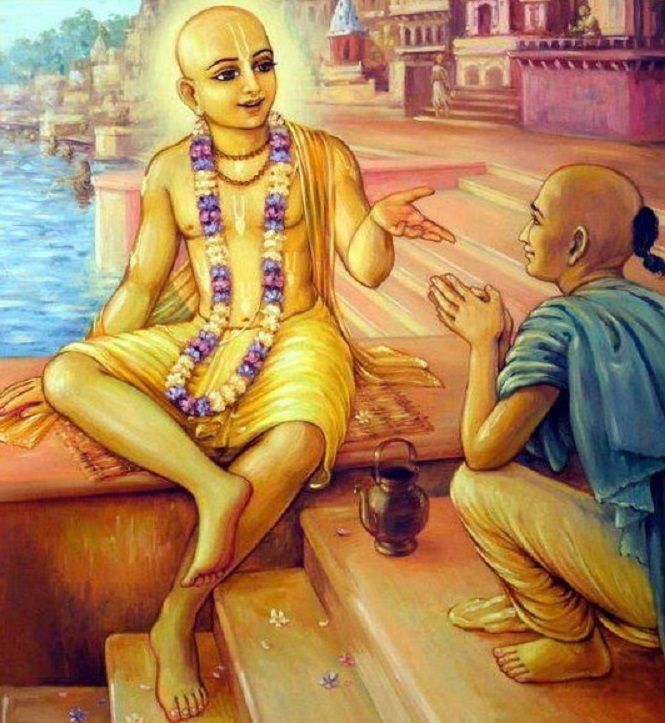
The Lord asked Govinda to arrange for Raghunātha Bhaṭṭa’s accommodations and then introduced him to all the devotees, headed by Svarūpa Dāmodara Gosvāmī. (104) Thus Raghunātha Bhaṭṭa lived with Śrī Caitanya Mahāprabhu continuously for eight months, and by the Lord’s mercy he felt increasing transcendental happiness every day. (105) He would periodically cook rice with various vegetables and invite Śrī Caitanya Mahāprabhu to his home. (106) Raghunātha Bhaṭṭa was an expert cook. Whatever he prepared tasted just like nectar. (107) Śrī Caitanya Mahāprabhu would accept with great satisfaction all the food he prepared. After the Lord was satisfied, Raghunātha Bhaṭṭa would eat His remnants. (108) When Rāmadāsa Viśvāsa met Śrī Caitanya Mahāprabhu, the Lord did not show him any special mercy, although this was their first meeting. (109)
Within his heart, Rāmadāsa Viśvāsa was an impersonalist who desired to merge into the existence of the Lord, and he was very proud of his learning. Since Śrī Caitanya Mahāprabhu is the omniscient Supreme Personality of Godhead, He can understand the heart of everyone, and thus He knew all these things. (110) Rāmadāsa Viśvāsa then took up residence in Jagannātha Purī and taught the Kāvya- prakāśa to the Paṭṭanāyaka family [the descendants of Bhavānanda Rāya]. (111) After eight months, when Śrī Caitanya Mahāprabhu bade farewell to Raghunātha Bhaṭṭa, the Lord flatly forbade him to marry. “Do not marry,” the Lord said. (112) Śrī Caitanya Mahāprabhu said to Raghunātha Bhaṭṭa, “When you return home, serve your aged father and mother, who are devotees, and try to study Śrīmad- Bhāgavatam from a pure Vaiṣṇava who has realized God.” (113) Śrī Caitanya Mahāprabhu concluded, “Come again to Nīlācala [Jagannātha Purī].” After saying this, the Lord put His own neck beads on Raghunātha Bhaṭṭa’s neck. (114)
Then the Lord embraced him and bade him farewell. Overwhelmed with ecstatic love, Raghunātha Bhaṭṭa began to cry due to imminent separation from Śrī Caitanya Mahāprabhu. (115) After taking permission from Śrī Caitanya Mahāprabhu and all the devotees, headed by Svarūpa Dāmodara, Raghunātha Bhaṭṭa returned to Vārāṇasī. (116) In accordance with the instructions of Śrī Caitanya Mahāprabhu, he continuously rendered service to his mother and father for four years. He also regularly studied Śrīmad- Bhāgavatam from a self- realized Vaiṣṇava. (117) Then his parents died at Kāśī [Vārāṇasī], and he became detached. He therefore returned to Śrī Caitanya Mahāprabhu, giving up all relationships with his home. (118) As previously, Raghunātha remained continuously with Śrī Caitanya Mahāprabhu for eight months. Then the Lord gave him the following order. (119)
“My dear Raghunātha, on My order go to Vṛndāvana and live there under the care of Rūpa and Sanātana Gosvāmīs. (120) “In Vṛndāvana you should chant the Hare Kṛṣṇa mantra twenty- four hours a day and read Śrīmad- Bhāgavatam continuously. Kṛṣṇa, the Supreme Personality of Godhead, will very soon bestow His mercy upon you.” (121) After saying this, Śrī Caitanya Mahāprabhu embraced Raghunātha Bhaṭṭa, and by the Lord’s mercy Raghunātha was enlivened with ecstatic love for Kṛṣṇa. (122) At a festival Śrī Caitanya Mahāprabhu had been given some unspiced betel and a garland of tulasī leaves fourteen cubits long. The garland had been worn by Lord Jagannātha. (123) Śrī Caitanya Mahāprabhu gave the garland and betel to Raghunātha Bhaṭṭa, who accepted them as a worshipable Deity and preserved them very carefully. (124) Taking permission from Śrī Caitanya Mahāprabhu, Raghunātha Bhaṭṭa then departed for Vṛndāvana. When he arrived there, he put himself under the care of Rūpa and Sanātana Gosvāmīs. (125)
When reciting Śrīmad- Bhāgavatam in the company of Rūpa and Sanātana, Raghunātha Bhaṭṭa would be overwhelmed with ecstatic love for Kṛṣṇa. (126) By the mercy of Śrī Caitanya Mahāprabhu, he experienced the symptoms of ecstatic love-tears, trembling and faltering of the voice. His eyes filled with tears and his throat became choked, and thus he could not recite Śrīmad- Bhāgavatam. (127) His voice was as sweet as a cuckoo’s, and he would recite each verse of Śrīmad- Bhāgavatam in three or four tunes. Thus his recitations were very sweet to hear. (128) When he recited or heard about the beauty and sweetness of Kṛṣṇa, he would be overwhelmed with ecstatic love and become oblivious to everything. (129) Thus Raghunātha Bhaṭṭa surrendered fully at the lotus feet of Lord Govinda, and those lotus feet became his life and soul. (130) Subsequently Raghunātha Bhaṭṭa ordered his disciples to construct a temple for Govinda. He prepared various ornaments for Govinda, including a flute and shark- shaped earrings. (131)
Raghunātha Bhaṭṭa would neither hear nor speak about anything of the material world. He would simply discuss Kṛṣṇa and worship the Lord day and night. (132) He would not listen to blasphemy of a Vaiṣṇava, nor would he listen to talk of a Vaiṣṇava’s misbehavior. He knew only that everyone was engaged in Kṛṣṇa’s service; he did not understand anything else. (133) When Raghunātha Bhaṭṭa Gosvāmī was absorbed in remembrance of Lord Kṛṣṇa, he would take the tulasī garland and the prasādam of Lord Jagannātha given to him by Śrī Caitanya Mahāprabhu, bind them together and wear them on his neck. (134) Thus I have described the powerful mercy of Śrī Caitanya Mahāprabhu, by which Raghunātha Bhaṭṭa Gosvāmī remained constantly overwhelmed with ecstatic love for Kṛṣṇa. (135)
In this chapter I have spoken about three topics: Jagadānanda Paṇḍita’s visit to Vṛndāvana, Śrī Caitanya Mahāprabhu’s listening to the song of the deva- dāsī at the temple of Jagannātha, and how Raghunātha Bhaṭṭa Gosvāmī achieved ecstatic love of Kṛṣṇa by the mercy of Śrī Caitanya Mahāprabhu. (136-137) Śrī Caitanya Mahāprabhu [Gaurahari] bestows ecstatic love for Kṛṣṇa upon anyone who hears all these topics with faith and love. (138) Praying at the lotus feet of Śrī Rūpa and Śrī Raghunātha, always desiring their mercy, I, Kṛṣṇadāsa, narrate Śrī Caitanya- caritāmṛta, following in their footsteps. (139)
Deepen your Bhakti-yoga practice, harmonize relationships, and receive guided coaching — all at Vedavarsity.com