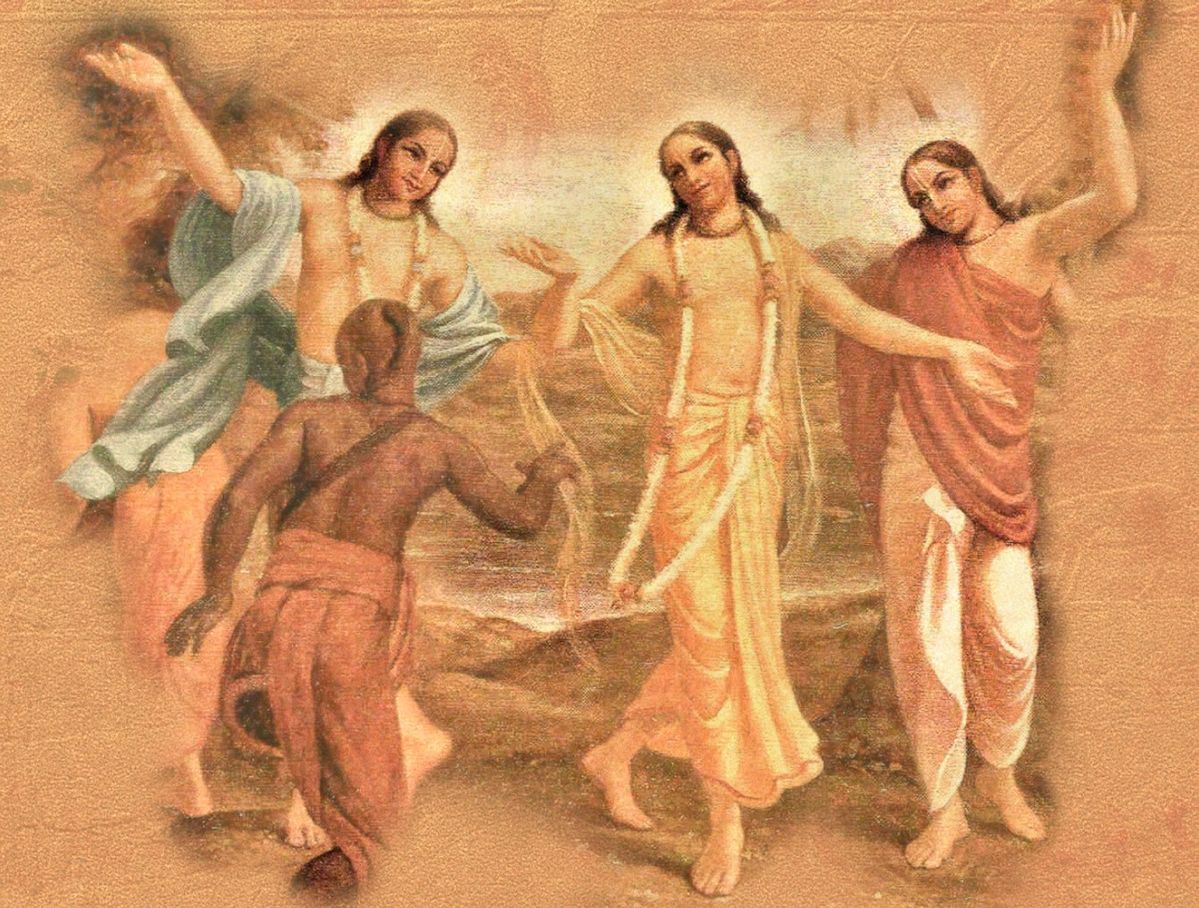
O devotees, may the transcendental life and characteristics of Śrī Caitanya Mahāprabhu always be heard, chanted and meditated upon with great happiness. (1) All glories to Śrī Caitanya Mahāprabhu, who is all- merciful! All glories to Nityānanda Prabhu, who is an ocean of mercy! (2) All glories to Advaita Ācārya, who is also an ocean of mercy! All glories to all the devotees of Śrī Caitanya Mahāprabhu, whose hearts are always filled with mercy! (3) The mind of Śrī Caitanya Mahāprabhu was always morose because of a continuously manifested feeling of separation from Kṛṣṇa. (4) The Lord would cry, “O My Lord Kṛṣṇa, My life and soul! O son of Mahārāja Nanda, where shall I go? Where shall I attain You? O Supreme Personality who play with Your flute to Your mouth!” (5)
This was His situation day and night. Unable to find peace of mind, He passed His nights with great difficulty in the company of Svarūpa Dāmodara and Rāmānanda Rāya. (6) Meanwhile, all the devotees journeyed from their homes in Bengal to see Śrī Caitanya Mahāprabhu. (7) Headed by Śivānanda Sena, Advaita Ācārya and others, all the devotees assembled in Navadvīpa. (8) The inhabitants of Kulīna- grāma and Khaṇḍa village also assembled at Navadvīpa. (9) Because Nityānanda Prabhu was preaching in Bengal, Śrī Caitanya Mahāprabhu had ordered Him not to come to Jagannātha Purī. That year, however, He went with the rest of the party to see the Lord. (10) Śrīvāsa Ṭhākura was also there with his three brothers and his wife, Mālinī. Ācāryaratna was similarly accompanied by his wife. (11) The wife of Śivānanda Sena also came, along with their three sons. Rāghava Paṇḍita joined them, carrying his famous bags of food. (12)
Vāsudeva Datta, Murāri Gupta, Vidyānidhi and many other devotees went to see Śrī Caitanya Mahāprabhu. All together, they numbered two or three hundred. (13) The devotees first saw Śacīmātā and took her permission. Then in great happiness they started for Jagannātha Purī, congregationally chanting the holy name of the Lord. (14) Śivānanda Sena managed the payment of tolls at different places. Maintaining everyone, he guided all the devotees in great happiness. (15) Śivānanda Sena took care of everyone and gave each devotee places to stay. He knew all the paths leading to Orissa. (16) One day when the party was being checked by a toll collector, the devotees were allowed to pass, and Śivānanda Sena remained behind alone to pay the taxes. (17) The party went into a village and waited beneath a tree because no one but Śivānanda Sena could arrange for their residential quarters. (18) Nityānanda Prabhu meanwhile became very hungry and upset. Because He had not yet obtained a suitable residence, He began calling Śivānanda Sena ill names. (19)
“Śivānanda Sena has not arranged for My residence,” He complained, “and I am so hungry I could die. Because he has not come, I curse his three sons to die.” (20) Hearing this curse, Śivānanda Sena’s wife began to cry. Just then, Śivānanda returned from the toll station. (21) Crying, his wife informed him, “Lord Nityānanda has cursed our sons to die because His quarters have not been provided.” (22) Śivānanda Sena replied, “You crazy woman! Why are you needlessly crying? Let my three sons die for all the inconvenience we have caused Nityānanda Prabhu.” (23) After saying this, Śivānanda Sena went to Nityānanda Prabhu, who then stood up and kicked him. (24) Very pleased at being kicked, Śivānanda Sena quickly arranged for a milkman’s house to be the Lord’s residence. (25) Śivānanda Sena touched the lotus feet of Nityānanda Prabhu and led Him to His residence. After giving the Lord His quarters, Śivānanda Sena, being very pleased, spoke as follows. (26) “Today You have accepted me as Your servant and have properly punished me for my offense. (27)
“My dear Lord, Your chastising me is Your causeless mercy. Who within the three worlds can understand Your real character? (28) “The dust of Your lotus feet is not attainable even by Lord Brahmā, yet Your lotus feet have touched my wretched body. (29) “Today my birth, my family and my activities have all become successful. Today I have achieved the fulfillment of religious principles, economic development, satisfaction of the senses and ultimately devotional service to Lord Kṛṣṇa.” (30) When Lord Nityānanda heard this, He was very happy. He rose and embraced Śivānanda Sena in great love. (31) Being very much pleased by Nityānanda Prabhu’s behavior, Śivānanda Sena began to arrange residential quarters for all the Vaiṣṇavas, headed by Advaita Ācārya. (32)
One of Śrī Nityānanda Prabhu’s characteristics is His contradictory nature. When He becomes angry and kicks someone, it is actually for his benefit. (33) Śivānanda Sena’s nephew, Śrīkānta, the son of his sister, felt offended, and he commented on the matter when his uncle was absent. (34) “My uncle is well known as one of the associates of Śrī Caitanya Mahāprabhu, but Lord Nityānanda Prabhu asserts His superiority by kicking him.” (35) After saying this, Śrīkānta, who was only a boy, left the group and traveled on alone to the residence of Śrī Caitanya Mahāprabhu. (36) When Śrīkānta offered obeisances to the Lord, he was still wearing his shirt and coat. Therefore Govinda told him, “My dear Śrīkānta, first take off these garments.” (37) As Govinda was warning Śrīkānta, Śrī Caitanya Mahāprabhu said, “Don’t bother him. Let Śrīkānta do whatever he likes, for he has come here in a distressed state of mind.” (38)
Śrī Caitanya Mahāprabhu inquired from Śrīkānta about all the Vaiṣṇavas, and the boy informed the Lord about them, naming them one after another. (39) When Śrīkānta Sena heard the Lord say “He is distressed,” he could understand that the Lord is omniscient. (40) As he described the Vaiṣṇavas, therefore, he did not mention Lord Nityānanda’s kicking Śivānanda Sena. Meanwhile, all the devotees arrived and went to meet the Lord. (41) Śrī Caitanya Mahāprabhu received them all, just as He had in previous years. The women, however, saw the Lord from a distance. (42) The Lord again arranged for the residential quarters of all the devotees and thereafter called them to partake of the remnants of food offered to Lord Jagannātha. (43) Śivānanda Sena introduced his three sons to Śrī Caitanya Mahāprabhu. Because they were his sons, the Lord showed the boys great mercy. (44)
Lord Caitanya asked the youngest son’s name, and Śivānanda Sena informed the Lord that his name was Paramānanda dāsa. (45) Once before when Śivānanda Sena had visited Śrī Caitanya Mahāprabhu at His residence, the Lord had told him, “When this son is born, give him the name Purī dāsa.” (46-47) The son was in the womb of Śivānanda’s wife, and when Śivānanda returned home the son was born. (48) The child was named Paramānanda dāsa in accordance with the Lord’s order, and the Lord jokingly called him Purī dāsa. (49) When Śivānanda Sena introduced the child to Śrī Caitanya Mahāprabhu, the Lord put His toe in the child’s mouth. (50) No one can cross over the ocean of Śivānanda Sena’s good fortune, for the Lord considered Śivānanda’s whole family His own. (51) The Lord ate lunch in the company of all the devotees, and after washing His hands and mouth He gave an order to Govinda. (52)
“As long as Śivānanda Sena’s wife and children stay in Jagannātha Purī,” He said, “they must be given the remnants of My food.” (5 his shirt and coat. Therefore Govinda told him, “My dear Śrīkānta, first take off these garments.” (37) As Govinda was warning Śrīkānta, Śrī Caitanya Mahāprabhu said, “Don’t bother him. Let Śrīkānta do whatever he likes, for he has come here in a distressed state of mind.” (38) Śrī Caitanya Mahāprabhu inquired from Śrīkānta about all the Vaiṣṇavas, and the boy informed the Lord about them, naming them one after another. (39) When Śrīkānta Sena heard the Lord say “He is distressed,” he could understand that the Lord is omniscient. (40)
As he described the Vaiṣṇavas, therefore, he did not mention Lord Nityānanda’s kicking Śivānanda Sena. Meanwhile, all the devotees arrived and went to meet the Lord. (41) Śrī Caitanya Mahāprabhu received them all, just as He had in previous years. The women, however, saw the Lord from a distance. (42) The Lord again arranged for the residential quarters of all the devotees and thereafter called them to partake of the remnants of food offered to Lord Jagannātha. (43) Śivānanda Sena introduced his three sons to Śrī Caitanya Mahāprabhu. Because they were his sons, the Lord showed the boys great mercy. (44) Lord Caitanya asked the youngest son’s name, and Śivānanda Sena informed the Lord that his name was Paramānanda dāsa. (45)
Once before when Śivānanda Sena had visited Śrī Caitanya Mahāprabhu at His residence, the Lord had told him, “When this son is born, give him the name Purī dāsa.” (46-47) The son was in the womb of Śivānanda’s wife, and when Śivānanda returned home the son was born. (48) The child was named Paramānanda dāsa in accordance with the Lord’s order, and the Lord jokingly called him Purī dāsa. (49) When Śivānanda Sena introduced the child to Śrī Caitanya Mahāprabhu, the Lord put His toe in the child’s mouth. (50) No one can cross over the ocean of Śivānanda Sena’s good fortune, for the Lord considered Śivānanda’s whole family His own. (51) The Lord ate lunch in the company of all the devotees, and after washing His hands and mouth He gave an order to Govinda. (52) “As long as Śivānanda Sena’s wife and children stay in Jagannātha Purī,” He said, “they must be given the remnants of My food.” (53)
Deepen your Bhakti-yoga practice, harmonize relationships, and receive guided coaching — all at Vedavarsity.com