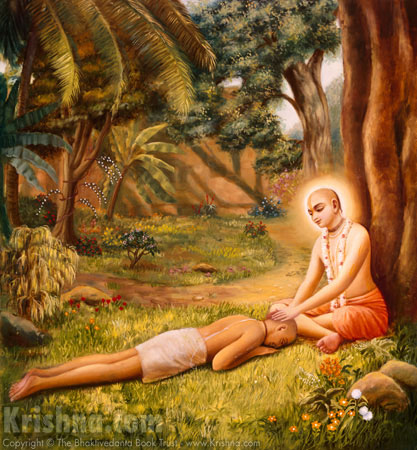
'Sri Chaitanya Mahaprabhu then placed His hand on Sanatana Goswami's head and benedicted him, saying, "Let all these instructions be manifest to you."'
-Excerpt from Chaitanya-caritamrita, Madhya-lila, 23.120-124
When the Lord persisted in asking this again and again, Rūpa Gosvāmī recited that verse [as follows]. (119) “‘I do not know how much nectar the two syllables “Kṛṣ- ṇa” have produced. When the holy name of Kṛṣṇa is chanted, it appears to dance within the mouth. We then desire many, many mouths. When that name enters the holes of the ears, we desire many millions of ears. And when the holy name dances in the courtyard of the heart, it conquers the activities of the mind, and therefore all the senses become inert.'” (120) When all the devotees of Śrī Caitanya Mahāprabhu, especially Śrī Rāmānanda Rāya, heard this verse, they were all filled with transcendental bliss and were struck with wonder. (121) Everyone admitted that although they had heard many statements glorifying the holy name of the Lord, they had never heard such sweet descriptions as those of Rūpa Gosvāmī. (122)
Rāmānanda Rāya inquired, “What kind of drama are you writing? We can understand that it is a mine of conclusive statements.” (123) Svarūpa Dāmodara replied for Śrīla Rūpa Gosvāmī: “He wanted to compose a drama about the pastimes of Lord Kṛṣṇa. He planned to describe in one book both the pastimes of Vṛndāvana and those of Dvārakā and Mathurā. (124) “He began it in that way, but now, following the order of Śrī Caitanya Mahāprabhu, he has divided it in two and is writing two plays, one concerning the pastimes of Mathurā and Dvārakā and the other concerning the pastimes of Vṛndāvana. (125) “The two plays are called Vidagdha- mādhava and Lalita- mādhava. Both of them wonderfully describe ecstatic emotional love of God.” (126)
Rāmānanda Rāya said, “Please recite the introductory verse of the Vidagdha- mādhava so that I can hear and examine it.” Thus Śrī Rūpa Gosvāmī, being ordered by Śrī Caitanya Mahāprabhu, recited the verse (1.1). (127) “‘May the pastimes of Śrī Kṛṣṇa reduce the miseries existing in the material world and nullify all unwanted desires. The pastimes of the Supreme Personality of Godhead are like śikhariṇī, a blend of yogurt and sugar candy. They overpower the pride of even the nectar produced on the moon, for they distribute the sweet fragrance of the concentrated loving affairs of Śrīmatī Rādhārāṇī and the gopīs.'” (128) Rāmānanda Rāya said, “Now please recite the description of the glories of your worshipable Deity.” Rūpa Gosvāmī, however, hesitated due to embarrassment because Śrī Caitanya Mahāprabhu was present. (129) The Lord, however, encouraged Rūpa Gosvāmī, saying, “Why are you embarrassed? You should recite it so the devotees can hear the good fruit of your writing.” (130)
When Rūpa Gosvāmī thus recited his verse, Caitanya Mahāprabhu disapproved of it because it described His personal glories. He expressed the opinion that it was an exaggerated explanation. (131) “‘May the Supreme Lord who is known as the son of Śrīmatī Śacīdevī be transcendentally situated in the innermost core of your heart. Resplendent with the radiance of molten gold, He has descended in the Age of Kali by His causeless mercy to bestow what no incarnation has ever offered before: the most elevated mellow of devotional service, the mellow of conjugal love.'” (132) All the devotees present so greatly appreciated this verse that they expressed their gratitude to Śrī Rūpa Gosvāmī for his transcendental recitation. (133) Rāmānanda Rāya inquired, “How have you introduced the assembly of the players?” Rūpa Gosvāmī replied, “The players assemble at a suitable time under the heading of pravartaka. (134) “‘When the entrance of the actors is set in motion by the arrival of a suitable time, the entrance is called pravartaka.’ (135)
“‘Springtime had arrived, and the full moon of that season inspired the Supreme Personality of Godhead, who is complete in everything, with new attraction to meet the beautiful Śrīmatī Rādhārāṇī at night to increase the beauty of Their pastimes.'” (136) Rāmānanda Rāya said, “Please recite the prarocanā portion so that I may hear and examine it.” Śrī Rūpa replied, “I think that Śrī Caitanya Mahāprabhu’s desire to hear is prarocanā. (137) “‘The devotees now present are constantly thinking of the Supreme Lord and are therefore highly advanced. This work named Vidagdha- mādhava depicts the characteristic pastimes of Lord Kṛṣṇa with decorations of poetic ornaments. And the inner grounds of the forest of Vṛndāvana provide a suitable platform for the dancing of Kṛṣṇa with the gopīs. Therefore I think that the pious activities of persons like us, who have tried to advance in devotional service, have now attained maturity.’ (138)
“‘O learned devotees, I am by nature ignorant and low, yet even though it is from me that the Vidagdha- mādhava has come, it is filled with descriptions of the transcendental attributes of the Supreme Personality of Godhead. Therefore, will not such a literature bring about the attainment of the highest goal of life? Although its wood may be ignited by a low- class man, fire can nevertheless purify gold. Similarly, although I am very low by nature, this book may help cleanse the dirt from within the hearts of the golden devotees.'” (139) Then Rāmānanda Rāya inquired from Rūpa Gosvāmī about the causes of the loving affairs between Kṛṣṇa and the gopīs, such as previous attachment, transformations of love, endeavors for love, and exchanges of letters disclosing the gopīs’ awakening love for Kṛṣṇa. (140) Śrīla Rūpa Gosvāmī gradually informed Rāmānanda Rāya about everything he asked. Hearing his explanations, all the devotees of Śrī Caitanya Mahāprabhu were struck with wonder. (141)
“[Experiencing previous attachment to Kṛṣṇa (pūrva- rāga), Śrīmatī Rādhārāṇī thought:] ‘Since I have heard the name of a person called Kṛṣṇa, I have practically lost My good sense. Then, there is another person who plays His flute in such a way that after I hear the vibration, intense madness arises in My heart. And again there is still another person to whom My mind becomes attached when I see His beautiful lightninglike effulgence in His picture. Therefore I think that I am greatly condemned, for I have become simultaneously attached to three persons. It would be better for Me to die because of this.’ (142) “‘My dear friend, these palpitations of Śrīmatī Rādhārāṇī’s heart are extremely difficult to cure. Even if one applied some medical treatment, it would only end in defamation.’ (143) “‘”O dearly beautiful one, the artistic loveliness of Your picture is now impressed within My mind. Since You are now living within My mind, wherever I wish to run because I am agitated by impressions of You, I find that You, O My friend, are blocking My way.”‘ (144)
“‘Upon seeing peacock feathers in front of Her, this girl suddenly begins trembling. When She sometimes sees a necklace of guñjā [small conchshells], She sheds tears and cries loudly. I do not know what kind of new ecstatic influence has entered the heart of this poor girl. It has imbued Her with the dancing attitude of a player creating wonderful, unprecedented dances on a stage.’ (145) “[Śrīmatī Rādhārāṇī said to Her constant companion Viśākhā:] ‘My dear friend, if Kṛṣṇa is unkind to Me, there will be no need for you to cry, for it will not be due to any fault of yours. I shall then have to die, but afterwards please do one thing for Me: to observe My funeral ceremony, place My body with its arms embracing a tamāla tree like creepers so that I may remain forever in Vṛndāvana undisturbed. That is My last request.'” (146)
Rāmānanda Rāya inquired, “What are the characteristics of emotional love?” Rūpa Gosvāmī replied, “This is the nature of emotional love for Kṛṣṇa: (147) “‘My dear beautiful friend, if one develops love of Godhead, love of Kṛṣṇa, the son of Nanda Mahārāja, all the bitter and sweet influences of this love will manifest in one’s heart. Such love of Godhead acts in two ways. The poisonous effects of love of Godhead defeat the severe and fresh poison of the serpent. Yet there is simultaneously transcendental bliss, which pours down and defeats the poisonous effects of a snake, as well as the happiness derived from pouring nectar on one’s head. It is perceived as doubly effective, simultaneously poisonous and nectarean.'” (148) Rāmānanda Rāya further inquired, “What are the natural characteristics of awakening love of Godhead?” Rūpa Gosvāmī replied, “These are the natural characteristics of love of God: (149)
“‘When one hears praise from his beloved, he outwardly remains neutral but feels pain within his heart. When he hears his beloved making accusations about him, he takes them to be jokes and enjoys pleasure. When he finds faults in his beloved, they do not diminish his love, nor do the beloved’s good qualities increase his spontaneous affection. Thus spontaneous love continues under all circumstances. That is how spontaneous love of Godhead acts within the heart.’ (150) “‘Upon hearing of My cruelty, moon- faced Rādhārāṇī may establish some kind of tolerance in Her aggrieved heart. But then She might turn against Me. Or, indeed, being fearful of the lusty desires invoked by the bow of formidable Cupid, She might even give up Her life. Alas! I have foolishly uprooted the soft creeper of Her desire just when it was ready to bear fruit.’ (151)
“‘Desiring the happiness of His association and embraces, My dear friend, I disregarded even My superiors and relaxed My shyness and gravity before them. Furthermore, although you are My best friend, more dear to Me than My own life, I have given you so much trouble. Indeed, I even put aside the vow of dedication to My husband, a vow kept by the most elevated women. Oh, alas! Although He is now neglecting Me, I am so sinful that I am still living. Therefore I must condemn My so- called patience.’ (152) “‘I was engaged in My own playful activities in My home, and because of My childish innocence I did not know right from wrong. Therefore, is it good for You to have forced Us into being so much attracted to You and then to have neglected Us? Now You are indifferent to Us. Do You think this is right?’ (153) “‘Our hearts are so polluted by miserable conditions that we are certainly going to Pluto’s kingdom. Nevertheless, Kṛṣṇa does not give up His beautiful loving smiling, which is full of cheating tricks. O Śrīmatī Rādhārāṇī, You are very intelligent. How could You have developed such great loving affection for this deceitful debauchee from the neighborhood of the cowherds?’ (154)
“‘O Lord Kṛṣṇa, You are just like an ocean. The river of Śrīmatī Rādhārāṇī has reached You from a long distance-leaving far behind the tree of Her husband, breaking through the bridge of social convention, and forcibly crossing the hills of elder relatives. Coming here because of fresh feelings of love for You, that river has now received Your shelter, but now You are trying to turn Her back by the waves of unfavorable words. How is it that You are spreading this attitude?'” (155) Śrīla Rāmānanda Rāya further inquired, “How have you described Vṛndāvana, the vibration of the transcendental flute, and the relationship between Kṛṣṇa and Rādhikā? (156) “Please tell me all this, for your poetic ability is wonderful.” After offering obeisances to Rāmānanda Rāya, Rūpa Gosvāmī gradually began answering his inquiries. (157)
“‘The sweet, fragrant honey oozing from newly grown mango buds is again and again attracting groups of bumblebees, and this forest is trembling in the softly moving breezes from the Malaya Hills, which are full of sandalwood trees. Thus the forest of Vṛndāvana is increasing My transcendental pleasure.’ (158) “‘My dear friend, see how this forest of Vṛndāvana is full of transcendental creepers and trees. The tops of the creepers are full of flowers, and intoxicated bumblebees are buzzing around them, humming songs that please the ear and surpass even the Vedic hymns.’ (159) “‘My dear friend, this forest of Vṛndāvana is giving great pleasure to our senses in various ways. Somewhere bumblebees are singing in groups, and in some places mild breezes are cooling the entire atmosphere. Somewhere the creepers and tree twigs are dancing, the mallikā flowers are expanding their fragrance, and an overabundance of juice is constantly flowing in showers from pomegranate fruits.’ (160)
“‘The flute of Kṛṣṇa’s pastimes measures three fingers in length, and it is bedecked with indranīla gems. At the ends of the flute are aruṇa gems [rubies], glittering beautifully, and between its ends the flute is plated with gold set ablaze by diamonds. This auspicious flute, pleasing to Kṛṣṇa, is glittering in His hand with transcendental brilliance.’ (161) “‘My dear friend the flute, it appears that you have been born of a very good family, for your residence is in the hands of Śrī Kṛṣṇa. By birth you are simple and are not at all crooked. Why then have you taken initiation into this dangerous mantra that enchants the assembled gopīs?’ (162) “‘My dear friend the flute, you are actually full of many holes or faults. You are light, hard, juiceless and full of knots. But what kind of pious activities have engaged you in the service of being kissed by the Lord and embraced by His hands?’ (163)
“‘The transcendental vibration of Kṛṣṇa’s flute blocked the movements of the rain clouds, struck the Gandharvas full of wonder, and agitated the meditation of great saintly persons like Sanaka and Sanandana. It created wonder in Lord Brahmā, wrought intense curiosity that agitated the mind of Bali Mahārāja, who was otherwise firmly fixed, made Mahārāja Ananta, the carrier of the planets, whirl around, and penetrated the strong coverings of the universe. Thus the sound of the flute in the hands of Kṛṣṇa created a wonderful situation.’ (164) “‘The beauty of Kṛṣṇa’s eyes surpasses the beauty of white lotus flowers, His yellow garments surpass the brilliance of fresh decorations of kuṅkuma, His ornaments of selected forest flowers subdue the hankering for the best of garments, and His bodily beauty possesses mind- attracting splendor greater than the jewels known as marakata- maṇi [emeralds].’ (165)
“‘O most beautiful friend, please accept the Supreme Personality of Godhead, who is standing before You full of transcendental bliss. The borders of His eyes roam from side to side, and His eyebrows move slowly like bumblebees on His lotuslike face. Standing with His right foot placed below the knee of His left leg, the middle of His body curved in three places, and His neck gracefully tilted to the side, He takes His flute to His pursed lips and moves His fingers upon it here and there.’ (166) “‘O beautiful- faced one, who is this creative person standing before us? With the sharp chisels of His loving glances, He is splitting the hard stones of many women’s devotion to their husbands. And with the luster of His body, surpassing the brilliance of countless emeralds, He is simultaneously constructing private meeting places for His pastimes.’ (167)
“‘My dear friend, this newly youthful Lord Śrī Kṛṣṇa, the moon in the family of Nanda Mahārāja, is so beautiful that He defies the beauty of clusters of valuable jewels. All glories to the vibration of His flute, for it is cunningly breaking the patience of chaste ladies by loosening their belts and tight dresses.’ (168) “‘The beauty of Śrīmatī Rādhārāṇī’s eyes forcibly devours the beauty of newly grown blue lotus flowers, and the beauty of Her face surpasses that of an entire forest of fully blossomed lotuses. Her bodily luster seems to place even gold into a painful situation. Thus the wonderful, unprecedented beauty of Śrīmatī Rādhārāṇī is awakening in Vṛndāvana.’ (169)
“‘Although the effulgence of the moon is brilliant initially at night, in the daytime it fades away. Similarly, although the lotus is beautiful during the daytime, at night it closes. But, O My friend, the face of My most dear Śrīmatī Rādhārāṇī is always bright and beautiful, both day and night. Therefore, to what can Her face be compared?’ (170) “‘When Śrīmatī Rādhārāṇī smiles, waves of joy flow over Her cheeks, and Her arched eyebrows dance like the bow of Cupid. Her glance is so enchanting that it is like a dancing bumblebee moving unsteadily due to intoxication. That bee has bitten the whorl of My heart.'” (171)
Deepen your Bhakti-yoga practice, harmonize relationships, and receive guided coaching — all at Vedavarsity.com