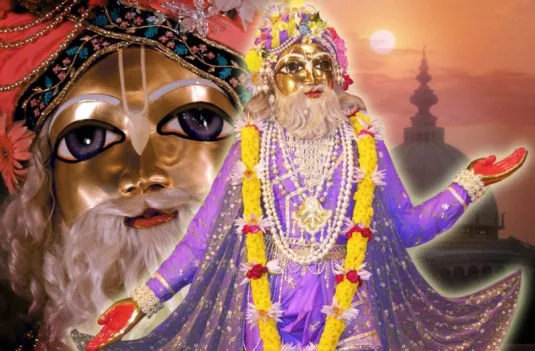
I offer my respectful obeisances to Śrī Advaita Ācārya, whose activities are all wonderful. By His mercy, even a foolish person can describe His characteristics. (1) All glories to Lord Śrī Caitanya Mahāprabhu! All glories to Lord Nityānanda! All glories to Advaita Ācārya! And all glories to all the devotees of Lord Śrī Caitanya Mahāprabhu! (2) In five verses I have described the principle of Lord Nityānanda. Then in the following two verses I describe the glories of Śrī Advaita Ācārya. (3)
Lord Advaita Ācārya is the incarnation of Mahā- Viṣṇu, whose main function is to create the cosmic world through the actions of māyā. (4) Because He is nondifferent from Hari, the Supreme Lord, He is called Advaita, and because He propagates the cult of devotion, He is called Ācārya. He is the Lord and the incarnation of the Lord’s devotee. Therefore I take shelter of Him. (5) Śrī Advaita Ācārya is indeed directly the Supreme Personality of Godhead Himself. His glory is beyond the conception of ordinary living beings. (6) Mahā- Viṣṇu performs all the functions for the creation of the universes. Śrī Advaita Ācārya is His direct incarnation. (7) That puruṣa creates and maintains with His external energy. He creates innumerable universes in His pastimes. (8)
By His will He manifests Himself in unlimited forms, in which He enters each and every universe. (9) Śrī Advaita Ācārya is a plenary part of that puruṣa and so is not different from Him. Indeed, Śrī Advaita Ācārya is not separate but is another form of that puruṣa. (10) He [Advaita Ācārya] helps in the pastimes of the puruṣa, with whose material energy and by whose will He creates innumerable universes. (11) Being a reservoir of all auspicious attributes, Śrī Advaita Ācārya is all- auspicious for the world. His characteristics, activities and name are always auspicious. (12) Mahā- Viṣṇu creates the entire material world with millions of His parts, energies and incarnations. (13)
Just as the external energy consists of two parts-the efficient cause [nimitta] and the material cause [upādāna], māyā being the efficient cause and pradhāna the material cause so Lord Viṣṇu, the Supreme Personality of Godhead, assumes two forms to create the material world with the efficient and material causes. (14-15) Lord Viṣṇu Himself is the efficient [nimitta] cause of the material world, and Nārāyaṇa in the form of Śrī Advaita is the material cause [upādāna]. (16) Lord Viṣṇu, in His efficient aspect, glances over the material energy, and Śrī Advaita, as the material cause, creates the material world. (17) Although the Sāṅkhya philosophy accepts that the material ingredients are the cause, the creation of the world never arises from dead matter. (18)
The Lord infuses the material ingredients with His own creative potency. Then, by the power of the Lord, creation takes place. (19) In the form of Advaita He infuses the material ingredients with creative energy. Therefore, Advaita is the original cause of creation. (20) Śrī Advaita Ācārya is the creator of millions and millions of universes, and by His expansions [as Garbhodakaśāyī Viṣṇu] He maintains each and every universe. (21) Śrī Advaita is the principal limb [aṅga] of Nārāyaṇa. Śrīmad- Bhāgavatam speaks of “limb” [aṅga] as “a plenary portion” [aṁśa] of the Lord. (22) “O Lord of lords, You are the seer of all creation. You are indeed everyone’s dearest life. Are You not, therefore, my father, Nārāyaṇa? ‘Nārāyaṇa’ refers to one whose abode is in the water born from Nara [Garbhodakaśāyī Viṣṇu], and that Nārāyaṇa is Your plenary portion. All Your plenary portions are transcendental. They are absolute and are not creations of māyā.” (23)
This verse describes that the limbs and plenary portions of the Lord are all spiritual; They have no relationship with the material energy. (24) Why has Śrī Advaita been called a limb and not a part? The reason is that “limb” implies greater intimacy. (25) Śrī Advaita, who is a reservoir of virtues, is the main limb of Mahā- Viṣṇu. His full name is Advaita, for He is identical in all respects with that Lord. (26) As He had formerly created all the universes, now He descended to introduce the path of bhakti. (27) He delivered all living beings by offering the gift of kṛṣṇa- bhakti. He explained the Bhagavad- gītā and Śrīmad- Bhāgavatam in the light of devotional service. (28)
Since He has no other occupation than to teach devotional service, His name is Advaita Ācārya. (29) He is the spiritual master of all devotees and is the most revered personality in the world. By a combination of these two names, His name is Advaita Ācārya. (30) Since He is a limb or part of the lotus- eyed Supreme Lord, He also bears the name Kamalākṣa. (31) His associates have the same bodily features as the Lord. They all have four arms and are dressed in yellow garments like Nārāyaṇa. (32) Śrī Advaita Ācārya is the principal limb of the Supreme Lord. His truths, names and attributes are all wonderful. (33)
He worshiped Kṛṣṇa with tulasī leaves and water of the Ganges and called for Him in a loud voice. Thus Lord Caitanya Mahāprabhu appeared on earth, accompanied by His personal associates. (34) It is through Him [Advaita Ācārya] that Lord Caitanya spread the saṅkīrtana movement and through Him that He delivered the world. (35) The glory and attributes of Advaita Ācārya are unlimited. How can the insignificant living entities fathom them? (36) Śrī Advaita Ācārya is a principal limb of Lord Caitanya. Another limb of the Lord is Nityānanda Prabhu. (37)
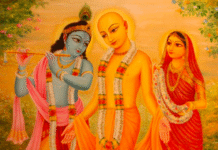
The devotees headed by Śrīvāsa are His smaller limbs. They are like His hands, face and eyes and His disc and other weapons. (38) With all of them Lord Caitanya performed His pastimes, and with them He spread His mission. (39) Thinking “He [Śrī Advaita Ācārya] is a disciple of Śrī Mādhavendra Purī,” Lord Caitanya obeys Him, respecting Him as His spiritual master. (40) To maintain the proper etiquette for the principles of religion, Lord Caitanya bows down at the lotus feet of Śrī Advaita Ācārya with reverential prayers and devotion. (41) Śrī Advaita Ācārya, however, considers Lord Caitanya Mahāprabhu His master, and He thinks of Himself as a servant of Lord Caitanya Mahāprabhu. (42)
He forgets Himself in the joy of that conception and teaches all living entities, “You are servants of Śrī Caitanya Mahāprabhu.” (43) The conception of servitude to Śrī Kṛṣṇa generates such an ocean of joy in the soul that even the joy of oneness with the Absolute, if multiplied ten million times, could not compare to a drop of it. (44) He says, “Nityānanda and I are servants of Lord Caitanya.” Nowhere else is there such joy as that which is tasted in this emotion of servitude. (45) The most beloved goddess of fortune resides on the chest of Śrī Kṛṣṇa, yet she too, earnestly praying, begs for the joy of service at His feet. (46) All the associates of Lord Kṛṣṇa, such as Brahmā, Śiva, Nārada, Śuka and Sanātana Kumāra, are very pleased in the sentiment of servitude. (47)
Śrī Nityānanda, the wandering mendicant, is the foremost of all the associates of Lord Caitanya. He became mad in the ecstasy of service to Lord Caitanya. (48) Śrīvāsa, Haridāsa, Rāmadāsa, Gadādhara, Murāri, Mukunda, Candraśekhara and Vakreśvara are all glorious and are all learned scholars, but the sentiment of servitude to Lord Caitanya makes them mad in ecstasy. (49 50) Thus they dance, sing and laugh like madmen, and they instruct everyone, “Just be loving servants of Lord Caitanya.” (51) Śrī Advaita Ācārya thinks, “Lord Caitanya considers Me His spiritual master, yet I feel Myself to be only His servant.” (52)
Deepen your Bhakti-yoga practice, harmonize relationships, and receive guided coaching — all at Vedavarsity.com