


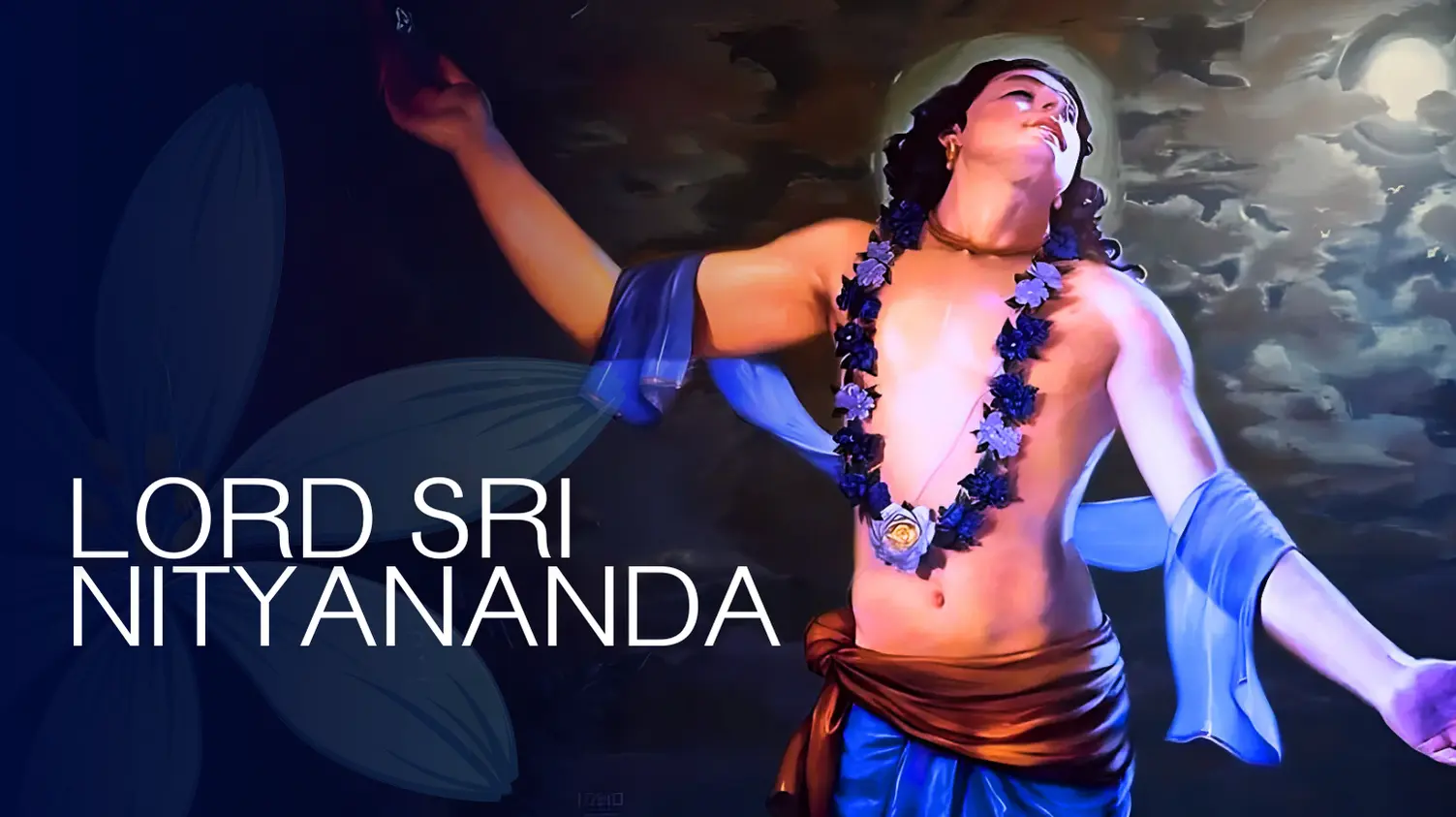
Let me offer my obeisances to Lord Śrī Nityānanda, the Supreme Personality of Godhead, whose opulence is wonderful and unlimited. By His will, even a fool can understand His identity. (1) All glories to Śrī Caitanya Mahāprabhu! All glories to Lord Nityānanda! All glories to Advaita Ācārya! And all glories to all the devotees of Lord Caitanya Mahāprabhu! (2) I have described the glory of Śrī Kṛṣṇa Caitanya in six verses. Now, in five verses I shall describe the glory of Lord Nityānanda. (3) The Supreme Personality of Godhead, Kṛṣṇa, is the fountainhead of all incarnations. Lord Balarāma is His second body. (4)
These two are one and the same identity. They differ only in form. Lord Balarāma is the first bodily expansion of Kṛṣṇa, and He assists in Lord Kṛṣṇa’s transcendental pastimes. (5) That original Lord Kṛṣṇa appeared in Navadvīpa as Lord Caitanya, and Balarāma appeared with Him as Lord Nityānanda. (6) May Śrī Nityānanda Rāma be the object of my constant remembrance. Saṅkarṣaṇa, Śeṣa Nāga and the Viṣṇus who lie on the Kāraṇa Ocean, Garbha Ocean and ocean of milk are His plenary portions and the portions of His plenary portions. (7) Lord Balarāma is the original Saṅkarṣaṇa. He assumes five other forms to serve Lord Kṛṣṇa. (8) He Himself helps in the pastimes of Lord Kṛṣṇa, and He does the work of creation in four other forms.(9) He executes the orders of Lord Kṛṣṇa in the work of creation, and in the form of Lord Śeṣa He serves Kṛṣṇa in various ways.(10)
In all the forms He tastes the transcendental bliss of serving Kṛṣṇa. That same Balarāma is Lord Nityānanda, the companion of Lord Gaurasundara. (11) I have explained the seventh verse in four subsequent verses. By these verses all the world can know the truth about Lord Nityānanda. (12) I surrender unto the lotus feet of Śrī Nityānanda Rāma, who is known as Saṅkarṣaṇa in the midst of the catur- vyūha [consisting of Vāsudeva, Saṅkarṣaṇa, Pradyumna and Aniruddha]. He possesses full opulences and resides in Vaikuṇṭhaloka, far beyond the material creation. (13) Beyond the material nature lies the realm known as paravyoma, the spiritual sky. Like Lord Kṛṣṇa Himself, it possesses all transcendental attributes, such as the six opulences.(14) That Vaikuṇṭha region is all- pervading, infinite and supreme. It is the residence of Lord Kṛṣṇa and His incarnations. (15)
In the highest region of that spiritual sky is the spiritual planet called Kṛṣṇaloka. It has three divisions Dvārakā, Mathurā and Gokula. (16) Śrī Gokula, the highest of all, is also called Vraja, Goloka, Śvetadvīpa and Vṛndāvana. (17) Like the transcendental body of Lord Kṛṣṇa, Gokula is all- pervading, infinite and supreme. It expands both above and below, without any restriction.(18) That abode is manifested within the material world by the will of Lord Kṛṣṇa. It is identical to that original Gokula; they are not two different bodies. (19) The land there is touchstone [cintāmaṇi], and the forests abound with desire trees. Material eyes see it as an ordinary place. (20) But with the eyes of love of Godhead one can see its real identity as the place where Lord Kṛṣṇa performs His pastimes with the cowherd boys and cowherd girls. (21) “I worship Govinda, the primeval Lord, the first progenitor, who is tending cows yielding all desires in abodes built with spiritual gems and surrounded by millions of purpose trees. He is always served with great reverence and affection by hundreds and thousands of goddesses of fortune.” (22)
Lord Kṛṣṇa manifests His own form in Mathurā and Dvārakā. He enjoys pastimes in various ways by expanding into the quadruple forms. (23) Vāsudeva, Saṅkarṣaṇa, Pradyumna and Aniruddha are the primary quadruple forms, from whom all other quadruple forms are manifested. They are all purely transcendental. (24) Only in these three places [Dvārakā, Mathurā and Gokula] does the all- sporting Lord Kṛṣṇa perform His endless pastimes with His personal associates. (25) In the Vaikuṇṭha planets of the spiritual sky the Lord manifests His identity as Nārāyaṇa and performs pastimes in various ways. (26) Kṛṣṇa’s own form has only two hands, but in the form of Lord Nārāyaṇa He has four hands. Lord Nārāyaṇa holds a conchshell, disc, club and lotus flower, and He is full of great opulence. The śrī, bhū and nīlā energies serve at His lotus feet. (27-28) Although His pastimes are His only characteristic functions, by His causeless mercy He performs one activity for the fallen souls. (29) He delivers the fallen living entities by offering them the four kinds of liberation-sālokya, sāmīpya, sārṣṭi and sārūpya. (30)
Those who attain brahma- sāyujya liberation cannot gain entrance into Vaikuṇṭha; their residence is outside the Vaikuṇṭha planets. (31) Outside the Vaikuṇṭha planets is the atmosphere of the glowing effulgence, which consists of the supremely bright rays of the body of Lord Kṛṣṇa.(32) That region is called Siddhaloka, and it is beyond the material nature. Its essence is spiritual, but it does not have spiritual varieties. (33) It is like the homogeneous effulgence around the sun. But inside the sun are the chariots, horses and other opulences of the sun- god. (34) “As through devotion to the Lord one can attain His abode, many have attained that goal by abandoning their sinful activities and absorbing their minds in the Lord through lust, envy, fear or affection.” (35)”Where it has been stated that the Lord’s enemies and devotees attain the same destination, this refers to the ultimate oneness of Brahman and Lord Kṛṣṇa. This may be understood by the analogy of the sun and the sunshine, in which Brahman is like the sunshine and Kṛṣṇa Himself is like the sun.” (36)
Thus in the spiritual sky there are varieties of pastimes within the spiritual energy. Outside the Vaikuṇṭha planets appears the impersonal reflection of light. (37) That impersonal Brahman effulgence consists only of the effulgent rays of the Lord. Those fit for sāyujya liberation merge into that effulgence. (38) “Beyond the region of ignorance [the material cosmic manifestation] lies the realm of Siddhaloka. The Siddhas reside there, absorbed in the bliss of Brahman. Demons killed by the Lord also attain that realm.” (39) In that spiritual sky, on the four sides of Nārāyaṇa, are the second expansions of the quadruple expansions of Dvārakā. (40) Vāsudeva, Saṅkarṣaṇa, Pradyumna and Aniruddha constitute this second quadruple. They are purely transcendental. (41) There [in the spiritual sky] the personal feature of Balarāma called Mahā- saṅkarṣaṇa is the shelter of the spiritual energy. He is the primary cause, the cause of all causes.(42)
One variety of the pastimes of the spiritual energy is described as pure goodness [viśuddha- sattva]. It comprises all the abodes of Vaikuṇṭha. (43) The six attributes are all spiritual. Know for certain that they are all manifestations of the opulence of Saṅkarṣaṇan. (44) There is one marginal potency, known as the jīva. Mahā- saṅkarṣaṇa is the shelter of all jīvas. (45) Saṅkarṣaṇa is the original shelter of the puruṣa, from whom this world is created and in whom it is dissolved. (46) He [Saṅkarṣaṇa] is the shelter of everything. He is wonderful in every respect, and His opulences are infinite. Even Ananta cannot describe His glory. (47) That Saṅkarṣaṇa, who is transcendental pure goodness, is a partial expansion of Nityānanda Balarāma. (48)
Deepen your Bhakti-yoga practice, harmonize relationships, and receive guided coaching — all at Vedavarsity.com