To explain the sixth verse, I shall first give a hint of its meaning. (101) The Lord came to propagate saṅkīrtana. That is an external purpose, as I have already indicated. (102) There is a principal cause for Lord Kṛṣṇa’s appearance. It grows from His own engagements as the foremost enjoyer of loving exchanges. (103) That most confidential cause is threefold. Svarūpa Dāmodara has revealed it. (104) Svarūpa Gosāñi is the most intimate associate of the Lord. He therefore knows all these topics well. (105)
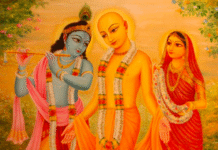
The heart of Lord Caitanya is the image of Śrī Rādhikā’s emotions. Thus feelings of pleasure and pain arise constantly therein. (106) In the final portion of His pastimes, Lord Caitanya was obsessed with the madness of separation from Lord Kṛṣṇa. He acted in erroneous ways and talked deliriously. (107) Just as Rādhikā went mad at the sight of Uddhava, so Lord Caitanya was obsessed day and night with the madness of separation. (108) At night He talked incoherently in grief with His arms around Svarūpa Dāmodara’s neck. He spoke out His heart in ecstatic inspiration. (109) Whenever a particular sentiment arose in His heart, Svarūpa Dāmodara satisfied Him by singing songs or reciting verses of the same nature. (110)
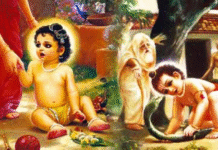
To analyze these pastimes is not necessary now. Later I shall describe them in detail. (111) Formerly in Vraja Lord Kṛṣṇa displayed three ages, namely childhood, boyhood and adolescence. His adolescence is especially significant. (112) Parental affection made His childhood fruitful. His boyhood was successful with His friends. (113) In youth He tasted the essence of rasa, fulfilling His desires in pastimes like the rāsa dance with Śrīmatī Rādhikā and the other gopīs. ( 114) In His youth Lord Kṛṣṇa made all three of His ages, and the entire universe, successful by His pastimes of amorous love like the rāsa dance. (115)
“Lord Madhusūdana enjoyed His youth with pastimes on autumn nights in the midst of the jewellike milkmaids. Thus He dispelled all the misfortunes of the world.” (116) “Lord Kṛṣṇa made Śrīmatī Rādhārāṇī close Her eyes in shame before Her friends by His words relating Their amorous activities on the previous night. Then He showed the highest limit of cleverness in drawing pictures of dolphins in various playful sports on Her breasts. In this way Lord Hari made His youth successful by performing pastimes in the bushes with Śrī Rādhā and Her friends.” (117) “O Paurṇamāsī, if Lord Hari had not descended in Mathurā with Śrīmatī Rādhārāṇī, this entire creation-and especially Cupid, the demigod of love would have been useless.” (118)
Even though Lord Kṛṣṇa, the abode of all mellows, had previously in this way chewed the essence of the mellows of love, still He was unable to fulfill three desires, although He made efforts to taste them. (119-120) I shall explain His first desire. Kṛṣṇa says, “I am the primary cause of all rasas. (121) “I am the full spiritual truth and am made of full joy, but the love of Śrīmatī Rādhārāṇī drives Me mad. (122) “I do not know the strength of Rādhā’s love, with which She always overwhelms Me. (123) “The love of Rādhikā is My teacher, and I am Her dancing pupil. Her prema makes Me dance various novel dances.” (124)
“O my beloved friend Vṛndā, where are you coming from?” “I am coming from the feet of Śrī Hari.” “Where is He?” “In the forest on the bank of Rādhā- kuṇḍa.” “What is He doing there?” “He is learning dancing.” “Who is His master?” “Your image, Rādhā, revealing itself in every tree and creeper in every direction, is roaming like a skillful dancer, making Him dance behind.” (125) “Whatever pleasure I get from tasting My love for Śrīmatī Rādhārāṇī, She tastes ten million times more than Me by Her love. (126) “Just as I am the abode of all mutually contradictory characteristics, so Rādhā’s love is always full of similar contradictions. (127) “Rādhā’s love is all- pervading, leaving no room for expansion. But still it is expanding constantly. (128)
“There is certainly nothing greater than Her love. But Her love is devoid of pride. That is the sign of its greatness. (129) “Nothing is purer than Her love. But its behavior is always perverse and crooked.” (130) “All glories to Rādhā’s love for Kṛṣṇa, the enemy of the demon Mura! Although it is all- pervading, it tends to increase at every moment. Although it is important, it is devoid of pride. And although it is pure, it is always beset with duplicity.” (131) “Śrī Rādhikā is the highest abode of that love, and I am its only object. (132) “I taste the bliss to which the object of love is entitled. But the pleasure of Rādhā, the abode of that love, is ten million times greater. (133) “My mind races to taste the pleasure experienced by the abode, but I cannot taste it, even by My best efforts. How may I taste it? (134) “If sometime I can be the abode of that love, only then may I taste its joy.” (135)
Thinking in this way, Lord Kṛṣṇa was curious to taste that love. His eager desire for that love increasingly blazed in His heart. (136) That is one desire. Now please hear of another. Seeing His own beauty, Lord Kṛṣṇa began to consider. (137) “My sweetness is wonderful, infinite and full. No one in the three worlds can find its limit. (138) “Only Rādhikā, by the strength of Her love, tastes all the nectar of My sweetness. (139) “Although Rādhā’s love is pure like a mirror, its purity increases at every moment. (140) “My sweetness also has no room for expansion, yet it shines before that mirror in newer and newer beauty. (141) “There is constant competition between My sweetness and the mirror of Rādhā’s love. They both go on increasing, but neither knows defeat. (142)
“My sweetness is always newer and newer. Devotees taste it according to their own respective love. (143) “If I see My sweetness in a mirror, I am tempted to taste it, but nevertheless I cannot. (144) “If I deliberate on a way to taste it, I find that I hanker for the position of Rādhikā.” (145) “Who manifests an abundance of sweetness greater than Mine, which has never been experienced before and which causes wonder to all? Alas, I Myself, My mind bewildered upon seeing this beauty, impetuously desire to enjoy it like Śrīmatī Rādhārāṇī.” (146) The beauty of Kṛṣṇa has one natural strength: it thrills the hearts of all men and women, beginning with Lord Kṛṣṇa Himself. (147) All minds are attracted by hearing His sweet voice and flute, or by seeing His beauty. Even Lord Kṛṣṇa Himself makes efforts to taste that sweetness. (148)
The thirst of one who always drinks the nectar of that sweetness is never satisfied. Rather, that thirst increases constantly. (149) Such a person, being unsatisfied, begins to blaspheme Lord Brahmā, saying that he does not know the art of creating well and is simply inexperienced. (150) He has not given millions of eyes to see the beauty of Kṛṣṇa. He has given only two eyes, and even those eyes blink. How then shall I see the lovely face of Kṛṣṇa? (151) [The gopīs said:] “O Kṛṣṇa, when You go to the forest during the day and we do not see Your sweet face, which is surrounded by beautiful curling hair, half a second becomes as long as an entire age for us. And we consider the creator, who has put eyelids on the eyes we use for seeing You, to be simply a fool.” “The gopīs saw their beloved Kṛṣṇa at Kurukṣetra after a long separation. They secured and embraced Him in their hearts through their eyes, and they attained a joy so intense that not even perfect yogīs can attain it. The gopīs cursed the creator for creating eyelids that interfered with their vision.” (153)
There is no consummation for the eyes other than the sight of Kṛṣṇa. Whoever sees Him is most fortunate indeed. (154) [The gopīs said:] “O friends, those eyes that see the beautiful faces of the sons of Mahārāja Nanda are certainly fortunate. As these two sons enter the forest, surrounded by Their friends, driving the cows before Them, They hold Their flutes to Their mouths and glance lovingly upon the residents of Vṛndāvana. For those who have eyes, we think there is no greater object of vision.” (155)
[The women of Mathurā said:] “What austerities must the gopīs have performed? With their eyes they always drink the nectar of the form of Lord Kṛṣṇa, which is the essence of loveliness and is not to be equaled or surpassed. That loveliness is the only abode of beauty, fame and opulence. It is self- perfect, ever fresh and extremely rare.” (156) The sweetness of Lord Kṛṣṇa is unprecedented, and its strength is also unprecedented. Simply by one’s hearing of such beauty, the mind becomes unsteady. (157) Lord Kṛṣṇa’s own beauty attracts Lord Kṛṣṇa Himself. But because He cannot fully enjoy it, His mind remains full of sorrow. (158)
Deepen your Bhakti-yoga practice, harmonize relationships, and receive guided coaching — all at Vedavarsity.com