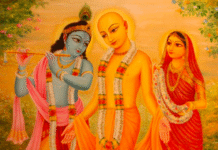




To accept ecstatic love is the main reason He appeared and reestablished the religious system for this age. I shall now explain that reason. Everyone please listen. (53) Having first given hints about the verse describing the principal reason why the Lord appeared, now I shall manifest its full meaning. (54) “The loving affairs of Śrī Rādhā and Kṛṣṇa are transcendental manifestations of the Lord’s internal pleasure- giving potency. Although Rādhā and Kṛṣṇa are one in Their identity, They separated Themselves eternally. Now these two transcendental identities have again united, in the form of Śrī Kṛṣṇa Caitanya. I bow down to Him, who has manifested Himself with the sentiment and complexion of Śrīmatī Rādhārāṇī although He is Kṛṣṇa Himself.” (55)
Rādhā and Kṛṣṇa are one and the same, but They have assumed two bodies. Thus They enjoy each other, tasting the mellows of love. (56) Now, to enjoy rasa, They have appeared in one body as Lord Caitanya Mahāprabhu. (57) Therefore I shall first delineate the position of Rādhā and Kṛṣṇa. From that description the glory of Lord Caitanya will be known. (58) Śrīmatī Rādhikā is the transformation of Kṛṣṇa’s love. She is His internal energy called hlādinī. (59) That hlādinī energy gives Kṛṣṇa pleasure and nourishes His devotees. (60) Lord Kṛṣṇa’s body is eternal [sat], full of knowledge [cit] and full of bliss [ānanda]. His one spiritual energy manifests three forms. (61) Hlādinī is His aspect of bliss; sandhinī, of eternal existence; and samvit, of cognizance, which is also accepted as knowledge. (62) “O Lord, You are the support of everything. The three attributes modes, which cause happiness, misery and mixtures of the two, do not exist in You, hlādinī, sandhinī and samvit exist in You as one spiritual energy. But the material – for You have no material qualities.” (63)
The essential portion of the sandhinī potency is śuddha- sattva. Lord Kṛṣṇa’s existence rests upon it. (64) Kṛṣṇa’s mother, father, abode, house, bedding, seats and so on are all transformations of śuddha- sattva. (65) “The condition of pure goodness [śuddha- sattva], in which the Supreme Personality of Godhead is revealed without any covering, is called vasudeva. In that pure state the Supreme vasudeva. In that pure state the Supreme Rādhārāṇī to assist in the Lord’s pastimes. (80) Among them are various groups of consorts in Vraja who have varieties of sentiments and mellows. They help Lord Kṛṣṇa taste all the sweetness of the rāsa dance and other pastimes. (81) Rādhā is the one who gives pleasure to Govinda, and She is also the enchantress of Govinda. She is the be- all and end- all of Govinda, and the crest jewel of all His consorts. (82)
“The transcendental goddess Śrīmatī Rādhārāṇī is the direct counterpart of Lord Śrī Kṛṣṇa. She is the central figure for all the goddesses of fortune. She possesses all the attractiveness to attract the all- attractive Personality of Godhead. She is the primeval internal potency of the Lord.” (83) “Devī” means “resplendent and most beautiful.” Or else it means “the lovely abode of the worship and love sports of Lord Kṛṣṇa.” (84) “Kṛṣṇa- mayī” means “one whose within and without are Lord Kṛṣṇa.” She sees Lord Kṛṣṇa wherever She casts Her glance. (85) Or “kṛṣṇa- mayī” means that She is identical with Lord Kṛṣṇa, for She embodies the mellows of love. The energy of Lord Kṛṣṇa is identical with Him. (86) Her worship [ārādhana] consists of fulfilling the desires of Lord Kṛṣṇa. Therefore the Purāṇas call Her Rādhikā. (87) “Truly the Personality of Godhead has been worshiped by Her. Therefore Lord Govinda, being pleased, has brought Her to a lonely spot, leaving us all behind.” (88)
Therefore Rādhā is parama- devatā, the supreme goddess, and She is worshipable for everyone. She is the protectress of all, and She is the mother of the entire universe. (89) I have already explained the meaning of “sarva- lakṣmī.” Rādhā is the original source of all the goddesses of fortune. (90) Or “sarva- lakṣmī” indicates that She fully represents the six opulences of Kṛṣṇa. Therefore She is the supreme energy of Lord Kṛṣṇa. (91) The word “sarva- kānti” indicates that all beauty and luster rest in Her body. All the lakṣmīs derive their beauty from Her. (92) “Kānti” may also mean “all the desires of Lord Kṛṣṇa.” All the desires of Lord Kṛṣṇa rest in Śrīmatī Rādhārāṇī. (93) Śrīmatī Rādhikā fulfills all the desires of Lord Kṛṣṇa. This is the meaning of “sarva- kānti.” (94)
Lord Kṛṣṇa enchants the world, but Śrī Rādhā enchants even Him. Therefore She is the supreme goddess of all. (95) Śrī Rādhā is the full power, and Lord Kṛṣṇa is the possessor of full power. The two are not different, as evidenced by the revealed scriptures. (96) They are indeed the same, just as musk and its scent are inseparable, or as fire and its heat are nondifferent. (97) Thus Rādhā and Lord Kṛṣṇa are one, yet They have taken two forms to enjoy the mellows of pastimes. (98) To promulgate prema- bhakti [devotional service in love of Godhead], Kṛṣṇa appeared as Śrī Kṛṣṇa Caitanya with the mood and complexion of Śrī Rādhā. Thus I have explained the meaning of the fifth verse. (99-100)
Deepen your Bhakti-yoga practice, harmonize relationships, and receive guided coaching — all at Vedavarsity.com