



“Kṛṣṇa manifests His eternal humanlike form and performs His pastimes to show mercy to the devotees. Having heard such pastimes, one should engage in service to Him.” (34) Here the use of the verb “bhavet,” which is in the imperative mood, tells us that this certainly must be done. Noncompliance would be abandonment of duty. (35) Just as these desires are the fundamental reason for Kṛṣṇa’s appearance whereas destroying the demons is only an incidental necessity, so for Śrī Kṛṣṇa Caitanya, the Supreme Personality of Godhead, promulgating the dharma of the age is incidental. (36- 37)
When the Lord desired to appear for another reason, the time for promulgating the religion of the age also arose. (38) Thus with two intentions the Lord appeared with His devotees and tasted the nectar of prema with the congregational chanting of the holy name. (39) Thus He spread kīrtana even among the untouchables. He wove a wreath of the holy name and prema, with which He garlanded the entire material world. (40) In this way, assuming the sentiment of a devotee, He preached devotional service while practicing it Himself. (41) Four kinds of devotees are the receptacles of the four kinds of mellows in love of God, namely servitude, friendship, parental affection and conjugal love. (42) Each kind of devotee feels that his sentiment is the most excellent, and thus in that mood he tastes great happiness with Lord Kṛṣṇa. (43)
But if we compare the sentiments in an impartial mood, we find that the conjugal sentiment is superior to all others in sweetness. (44) “Increasing love is experienced in various tastes, one above another. But that love which has the highest taste in the gradual succession of desire manifests itself in the form of conjugal love.” (45) Therefore I call it madhura- rasa. It has two further divisions, namely wedded and unwedded love. (46) There is a great increase of mellow in the unwedded conjugal mood. Such love is found nowhere but in Vraja. (47) This mood is unbounded in the damsels of Vraja, but among them it finds its perfection in Śrī Rādhā. (48)
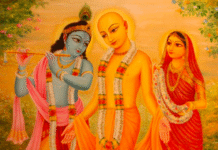
Her pure, mature love surpasses that of all others. Her love is the cause of Lord Kṛṣṇa’s tasting the sweetness of the conjugal relationship. (49) Therefore Lord Gaurāṅga, who is Śrī Hari Himself, accepted the sentiments of Rādhā and thus fulfilled His own desires. (50) “Lord Caitanya is the shelter of the demigods, the goal of the Upaniṣads, the be- all and end- all of the great sages, the beautiful shelter of His devotees, and the essence of the love of the lotus- eyed gopīs. Will He again be the object of my vision?” (51) “Lord Kṛṣṇa desired to taste the limitless nectarean mellows of the love of one of His multitude of loving damsels [Śrī Rādhā], and so He has assumed the form of Lord Caitanya. He has tasted that love while hiding His own dark complexion with Her effulgent yellow color. May that Lord Caitanya confer upon us His grace.” (52)
Deepen your Bhakti-yoga practice, harmonize relationships, and receive guided coaching — all at Vedavarsity.com