


One who measures four cubits in height and in breadth by his own hand is celebrated as a great personality. (42) Such a person is called nyagrodha- parimaṇḍala. Śrī Caitanya Mahāprabhu, who personifies all good qualities, has the body of a nyagrodha- parimaṇḍala. (43)His arms are long enough to reach His knees, His eyes are just like lotus flowers, His nose is like a sesame flower, and His face is as beautiful as the moon. (44) He is peaceful, self- controlled and fully devoted to the transcendental service of Lord Śrī Kṛṣṇa. He is affectionate toward His devotees, He is gentle, and He is equally disposed toward all living beings. (45)
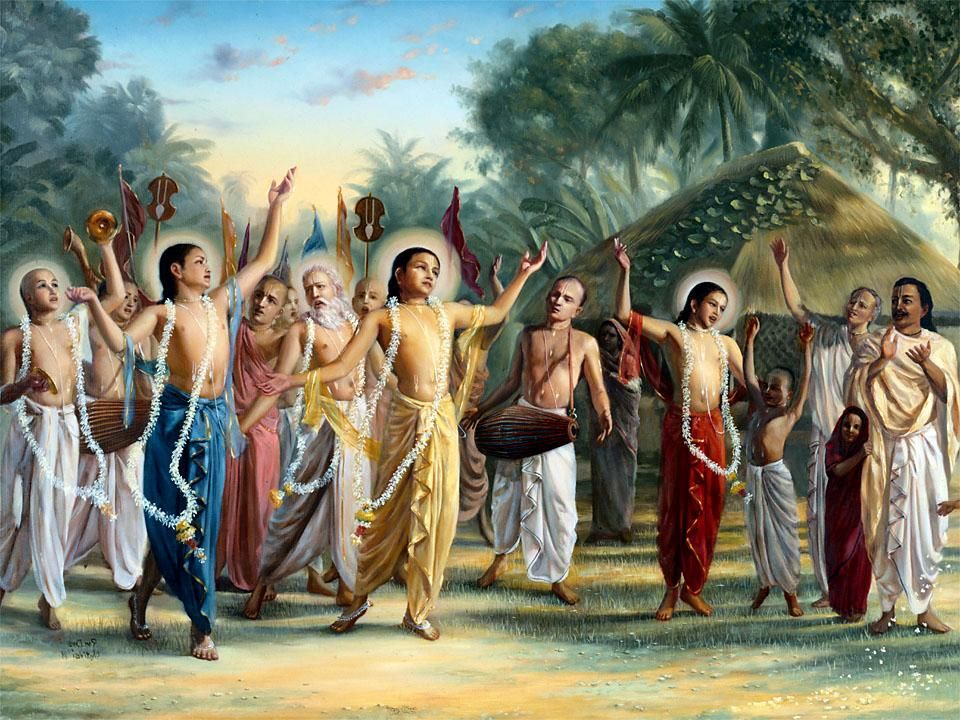
He is decorated with sandalwood bangles and armlets and anointed with the pulp of sandalwood. He especially wears these decorations to dance in śrī- kṛṣṇa- saṅkīrtana. (46) Recording all these qualities of Lord Caitanya, the sage Vaiśampāyana included His name in the Viṣṇu- sahasra- nāma. (47) The pastimes of Lord Caitanya have two divisions-the early pastimes līlās.[ādi- līlā] and the later pastimes [śeṣa- līlā]. He has four names in each of these two. (48) “In His early pastimes He appears as a householder with a golden complexion. His limbs are beautiful, and His body, smeared with the pulp of sandalwood, seems like molten gold. In His later pastimes He accepts the sannyāsa order, and He is equipoised and peaceful. He is the highest abode of peace and devotion, for He silences the impersonalist nondevotees.” (49)
In Śrīmad- Bhāgavatam it is repeatedly and clearly said that the essence of religion in the Age of Kali is the chanting of the holy name of Kṛṣṇa. (50) “O King, in this way people in Dvāpara- yuga worshiped the Lord of the universe. In Kali- yuga they also worship the Supreme Personality of Godhead by the regulations of the revealed scriptures. Kindly now hear of that from me. (51) “In the Age of Kali, intelligent persons perform congregational chanting to worship the incarnation of Godhead who constantly sings the name of Kṛṣṇa. Although His complexion is not blackish, He is Kṛṣṇa Himself. He is accompanied by His associates, servants, weapons and confidential companions.” (52) My dear brothers, please hear all these glories of Lord Caitanya. This verse clearly summarizes His activities and characteristics. (53) The two syllables “kṛṣ- ṇa” are always in His mouth; or, He constantly describes Kṛṣṇa with great pleasure. (54)
These are two meanings of the word “kṛṣṇa- varṇa.” Indeed, nothing else but Kṛṣṇa issues from His mouth. If someone tries to describe Him as being of blackish complexion, the next adjective [tviṣā akṛṣṇam] immediately restricts him. (56) His complexion is certainly not blackish. Indeed, His not being blackish indicates that His complexion is yellow. (57) “By performing the sacrifice of congregational chanting of the holy name, learned scholars in the Age of Kali worship Lord Kṛṣṇa, who is now nonblackish because of the great upsurge of the feelings of Śrīmatī Rādhārāṇī. He is the only worshipable Deity for the paramahaṁsas, who have attained the highest stage of the fourth order [sannyāsa]. May that Supreme Personality of Godhead, Lord Caitanya, show us His great causeless mercy.” (58)
One can vividly see His glowing complexion of molten gold, which dispels the darkness of ignorance. (59) The sinful life of the living beings results from ignorance. To destroy that ignorance, He has brought various weapons, such as His plenary associates, His devotees and the holy name. (60) The greatest ignorance consists of activities, whether religious or irreligious, that are opposed to devotional service. They are to be known as sins [kalmaṣa]. (61) Raising His arms, chanting the holy name and looking upon all with deep love, He drives away all sins and floods everyone with love of Godhead. (62) “May the Supreme Personality of Godhead in the form of Lord Śrī Caitanya bestow His causeless mercy upon us. His smiling glance at once drives away all the bereavements of the world, and His very words enliven the auspicious creepers of devotion by expanding their leaves. Taking shelter of His lotus feet invokes transcendental love of God at once.” (63)
Anyone who looks upon His beautiful body or beautiful face becomes freed from all sins and obtains the wealth of love of Godhead. (64) In other incarnations the Lord descended with armies and weapons, but in this incarnation His soldiers are His plenary parts and associates. (65) “Lord Śrī Caitanya Mahāprabhu is always the most worshipable Deity of the demigods, including Lord Śiva and Lord Brahmā, who came in the garb of ordinary men, bearing love for Him. He instructs His own pure devotional service to His own devotees. Will He again be the object of my vision?” (66) His plenary parts and associates perform the work of weapons as their own specific duties. Please hear from me another meaning of the word “aṅga.” (67) According to the evidence of the revealed scriptures, a bodily limb [aṅga] is also called a part [aṁśa], and a part of a limb is called a partial part [upāṅga]. (68)
“O Lord of lords, You are the seer of all creation. You are indeed everyone’s dearest life. Are You not, therefore, my father, Nārāyaṇa? ‘Nārāyaṇa’ refers to one whose abode is in the water born from Nara [Garbhodakaśāyī Viṣṇu], and that Nārāyaṇa is Your plenary portion. All Your plenary portions are transcendental. They are absolute and are not creations of māyā.” (69) The manifestation of the Nārāyaṇa who predominates in everyone’s heart, as well as the Nārāyaṇa who lives in the waters [Kāraṇa, Garbha and Kṣīra], is Your plenary portion. You are therefore the original Nārāyaṇa. (70) The word “aṅga” indeed refers to plenary portions. Such manifestations should never be considered products of material nature, for they are all transcendental, full of knowledge and full of bliss. (71) Śrī Advaita Prabhu and Śrī Nityānanda Prabhu are both plenary portions of Lord Caitanya. Thus They are the limbs [aṅgas] of His body. The parts of these two limbs are called the upāṅgas. (72)
Thus the Lord is equipped with sharp weapons in the form of His parts and plenary portions. All these weapons are competent enough to crush the faithless atheists. (73) Śrī Nityānanda Gosāñi is directly Haladhara [Lord Balarāma], and Advaita Ācārya is the Personality of Godhead Himself. (74) These two captains, with Their soldiers such as Śrīvāsa Ṭhākura, travel everywhere, chanting the holy name of the Lord. (75) Lord Nityānanda’s very features indicate that He is the subduer of the unbelievers. All sins and unbelievers flee from the loud shouts of Advaita Ācārya. (76)
Deepen your Bhakti-yoga practice, harmonize relationships, and receive guided coaching — all at Vedavarsity.com