I offer my respectful obeisances to Śrī Caitanya Mahāprabhu. By the potency of the shelter of His lotus feet, even a fool can collect the valuable jewels of conclusive truth from the mines of the revealed scriptures. (1) to All glories to Lord Caitanya! All glories Lord Nityānanda! All glories to Advaitacandra! And all glories to all the devotees of Lord Caitanya! (2) I have given the purport of the third verse. Now, O devotees, please listen to the meaning of the fourth with full attention. (3)
“May the Supreme Lord who is known as the son of Śrīmatī Śacī- devī be transcendentally situated in the innermost core of your heart. Resplendent with the radiance of molten gold, He has descended in the Age of Kali by His causeless mercy to bestow what no incarnation has ever offered before: the most elevated mellow of devotional service, the mellow of conjugal love.” (4) Lord Kṛṣṇa, the son of the King of Vraja, is the Supreme Lord. He eternally enjoys transcendental pastimes in His eternal abode, Goloka, which includes Vrajadhāma. (5) Once in a day of Brahmā, He descends to this world to manifest His transcendental pastimes. (6)
We know that there are four ages [yugas], namely Satya, Tretā, Dvāpara and Kali. These four together constitute one divya- yuga. (7) Seventy- one divya- yugas constitute one manv- antara. There are fourteen manv- antaras in one day of Brahmā. (8) The present Manu, who is the seventh, is called Vaivasvata [the son of Vivasvān]. Twenty- seven divya- yugas [27 x 4,320,000 solar years] of his age have now passed. (9) At the end of the Dvāpara- yuga of the twenty- eighth divya- yuga, Lord Kṛṣṇa appears on earth with the full paraphernalia of His eternal Vraja- dhāma. (10) Servitude [dāsya], friendship [sakhya], parental affection [vātsalya] and conjugal love [śṛṅgāra] are the four transcendental mellows [rasas]. By the devotees who cherish these four mellows, Lord Kṛṣṇa is subdued. (11) Absorbed in such transcendental love, Lord Śrī Kṛṣṇa enjoys in Vraja with His devoted servants, friends, parents and conjugal lovers. (12)
Lord Kṛṣṇa enjoys His transcendental pastimes as long as He wishes, and then He disappears. After disappearing, however, He thinks thus:(13) “For a long time I have not bestowed unalloyed loving service to Me upon the inhabitants of the world. Without such loving attachment, the existence of the material world is useless. (14) “Everywhere in the world people worship Me according to scriptural injunctions. But simply by following such regulative principles one cannot attain the loving sentiments of the devotees in Vrajabhūmi. (15) “Knowing My opulences, the whole world looks upon Me with awe and veneration. But devotion made feeble by such reverence does not attract Me. (16) “By performing such regulated devotional service in awe and veneration, one may go to Vaikuṇṭha and attain the four kinds of liberation. (17)
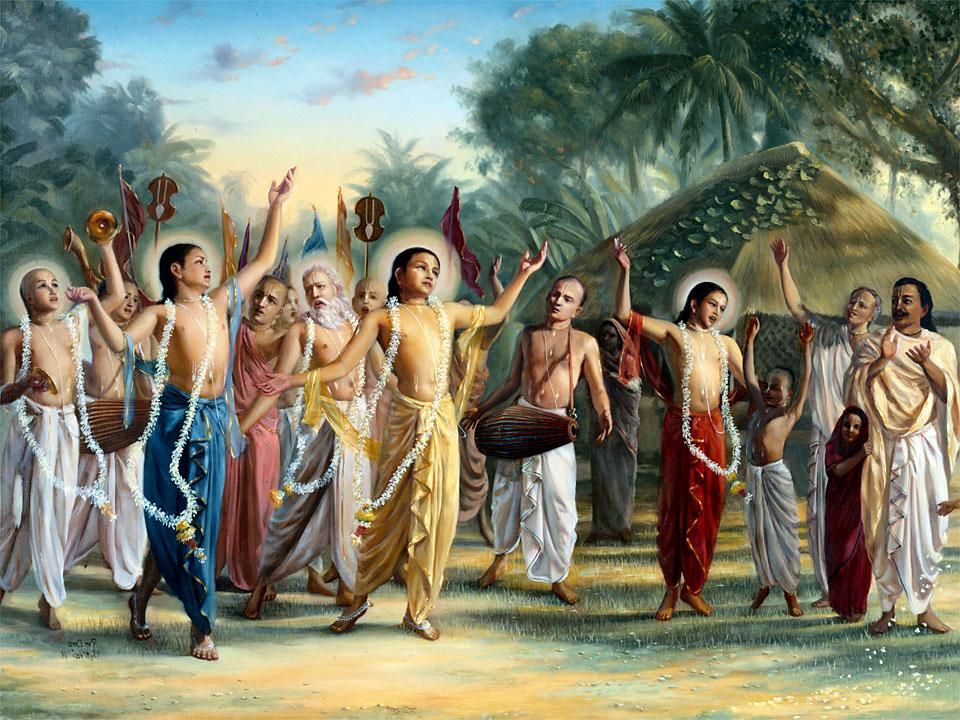
“These liberations are sārṣṭi [achieving opulences equal to those of the Lord], sārūpya [having a form the same as the Lord’s], sāmīpya [living as a personal associate of the Lord] and sālokya [living on a Vaikuṇṭha planet]. Devotees never accept sāyujya, however, since that is oneness with Brahman. (18) “I shall personally inaugurate the religion of the age-nāma- saṅkīrtana, the congregational chanting of the holy name. I shall make the world dance in ecstasy, realizing the four mellows of loving devotional service. (19) “I shall accept the role of a devotee, and I shall teach devotional service by practicing it Myself. (20) “Unless one practices devotional service himself, he cannot teach it to others. This conclusion is indeed confirmed throughout the Gītā and Bhāgavatam. (21)
“‘Whenever and wherever there is a decline in religious practice, O descendant of Bharata, and a predominant rise of irreligion-at that time I descend Myself. (22) “‘To deliver the pious and to annihilate the miscreants, as well as to reestablish the principles of religion, I Myself appear, millennium after millennium.’ (23) “‘If I did not show the proper principles of religion, all these worlds would fall into ruin. I would be the cause of unwanted population and would spoil all these living beings.’ (24) “‘Whatever actions a great man performs, common people follow. And whatever standards he sets by exemplary acts, all the world pursues.’ (25) “My plenary portions can establish the principles of religion for each age. No one but Me, however, can bestow the kind of loving service performed by the residents of Vraja. (26)
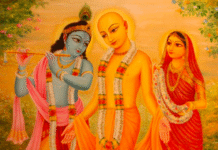
“‘There may be many all- auspicious incarnations of the Personality of Godhead, but who other than Lord Śrī Kṛṣṇa can bestow love of God upon the surrendered souls?’ (27) “Therefore in the company of My devotees I shall appear on earth and perform various colorful pastimes.” (28) Thinking thus, the Personality of Godhead, Śrī Kṛṣṇa Himself, descended at Nadia early in the Age of Kali. (29) Thus the lionlike Lord Caitanya has appeared in Navadvīpa. He has the shoulders of a lion, the powers of a lion, and the loud voice of a lion. (30) May that lion be seated in the core of the heart of every living being. Thus with His resounding roar may He drive away one’s elephantine vices. (31) In His early pastimes He is known as Viśvambhara because He floods the world with the nectar of devotion and thus saves the living beings. (32)
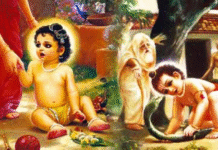
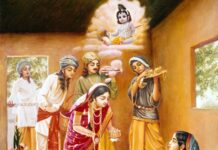
The verbal root “ḍubhṛñ” [which is the root of the word “viśvambhara”] indicates nourishing and maintaining. He [Lord Caitanya] nourishes and maintains the three worlds by distributing love of God. (33) In His later pastimes He is known as Lord Śrī Kṛṣṇa Caitanya. He blesses the whole world by teaching about the name and fame of Lord Śrī Kṛṣṇa. (34) Knowing Him [Lord Caitanya] to be the incarnation for Kali- yuga, Garga Muni, during the naming ceremony of Kṛṣṇa, predicted His appearance. (35) “This boy [Kṛṣṇa] has three other colors-white, red and yellow-as He appears in different ages. Now He has appeared in a transcendental blackish color.” (36) White, red and yellow-these are the three bodily lusters that the Lord, the husband of the goddess of fortune, assumes in the ages of Satya, Tretā and Kali respectively. (37)
Now, in the Dvāpara- yuga, the Lord had descended in a blackish hue. This is the essence of the statements in the Purāṇas and other Vedic literatures with reference to the context. (38) “In the Dvāpara- yuga the Personality of Godhead appears in a blackish hue. He is dressed in yellow, He holds His own weapons, and He is decorated with the Kaustubha jewel and marks of Śrīvatsa. This is how His symptoms are described.” (39) The religious practice for the Age of Kali is to broadcast the glories of the holy name. Only for this purpose has the Lord, in a yellow color, descended as Lord Caitanya. (40) The luster of His expansive body resembles molten gold. The deep sound of His voice conquers the thundering of newly assembled clouds. (41)
Deepen your Bhakti-yoga practice, harmonize relationships, and receive guided coaching — all at Vedavarsity.com