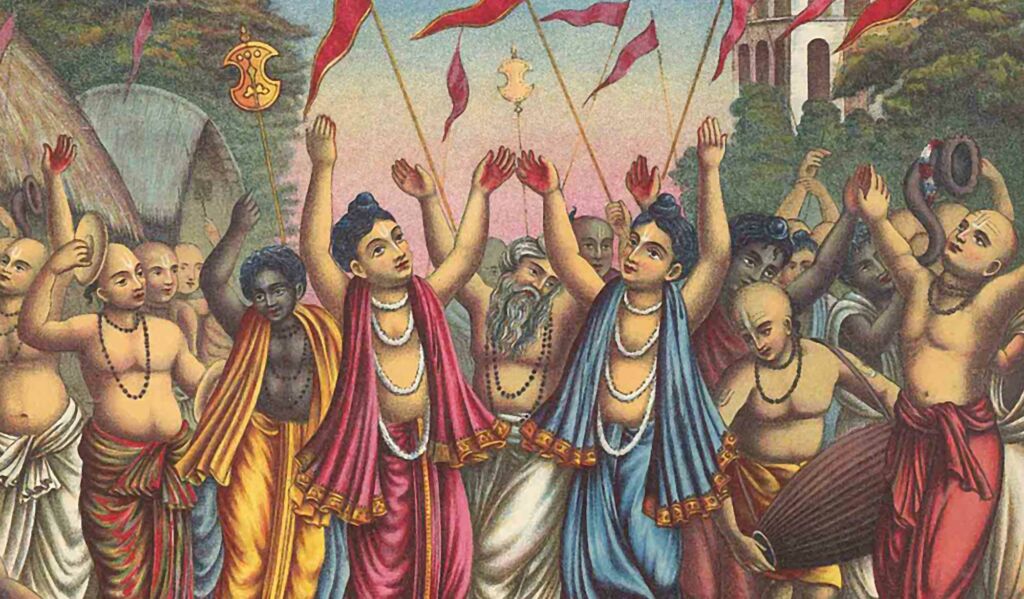
One day the two brothers Lord Nityānanda Prabhu and Śrī Caitanya Mahāprabhu were dancing in the holy house of Śrīvāsa Ṭhākura. (227) At that time a calamity took place — Śrīvāsa Ṭhākura’s son died. Yet Śrīvāsa Ṭhākura was not at all sorry. (228) Śrī Caitanya Mahāprabhu caused the dead son to speak about knowledge, and then the two brothers personally became the sons of Śrīvāsa Ṭhākura. (229) Thereafter the Lord charitably bestowed His benediction upon all His devotees. He gave the remnants of His food to Nārāyaṇī, showing her special respect. (230) There was a tailor who was a meat-eater but was sewing garments for Śrīvāsa Ṭhākura. The Lord, being merciful to him, showed him His own form. (231)
Saying “I have seen! I have seen!” and dancing in ecstatic love as though mad, he became a first-class Vaiṣṇava. (232) In ecstasy the Lord asked Śrīvāsa Ṭhākura to deliver His flute, but Śrīvāsa Ṭhākura replied, “Your flute has been stolen away by the gopīs.” (233) Hearing this reply, the Lord said in ecstasy, “Go on talking! Go on talking!” Thus Śrīvāsa described the transcendental mellows of the pastimes of Śrī Vṛndāvana. (234) In the beginning Śrīvāsa Ṭhākura described the transcendental sweetness of Vṛndāvana’s pastimes. Hearing this, the Lord felt great and increasing jubilation in His heart. (235) Thereafter the Lord again and again asked him, “Speak on! Speak on!” Thus Śrīvāsa again and again described the pastimes of Vṛndāvana, vividly expanding them. (236)
Śrīvāsa Ṭhākura extensively explained how the gopīs were attracted to the forests of Vṛndāvana by the vibration of Kṛṣṇa’s flute and how they wandered together in the forest. (237) Śrīvāsa Paṇḍita narrated all the pastimes enacted during the six changing seasons. He described the drinking of honey, the celebration of the rāsa dance, the swimming in the Yamunā and other such incidents. (238) When the Lord, hearing with great pleasure, said, “Go on speaking! Go on speaking!” Śrīvāsa Ṭhākura described the rāsa-līlā dance, which is filled with transcendental mellows. (239) As the Lord thus requested and Śrīvāsa Ṭhākura spoke, the morning appeared, and the Lord embraced Śrīvāsa Ṭhākura and satisfied him. (240)
Thereafter a dramatization of Kṛṣṇa’s pastimes was performed in the house of Śrī Candraśekhara Ācārya. The Lord personally took the part of Rukmiṇī, the foremost of Kṛṣṇa’s queens. (241) The Lord sometimes took the part of Goddess Durgā, Lakṣmī [the goddess of fortune] or the chief potency, Yogamāyā. Sitting on a cot, He delivered love of Godhead to all the devotees present. (242) One day when Śrī Caitanya Mahāprabhu had finished His dancing, a woman, the wife of a brāhmaṇa, came there and caught hold of His lotus feet. (243)As she took the dust of His lotus feet again and again, the Lord became unlimitedly unhappy. (244) Immediately He ran to the river Ganges and jumped in to counteract the sinful activities of that woman. Lord Nityānanda and Haridāsa Ṭhākura caught Him and raised Him from the river. (245)
That night the Lord stayed at the house of Vijaya Ācārya. In the morning the Lord took all His devotees and returned home.(246) One day the Lord, in the ecstasy of the gopīs, was sitting in His house. Very morose in separation, He was calling, “Gopī! Gopī!”(247) A student who came to see the Lord was astonished that the Lord was chanting “Gopī! Gopī!” Thus he spoke as follows.(248) “Why are You chanting the names ‘gopī gopī’ instead of the holy name of Lord Kṛṣṇa, which is so glorious? What pious result will You achieve by such chanting?”(249) Hearing the foolish student, the Lord became greatly angry and rebuked Lord Kṛṣṇa in various ways. Taking up a stick, He rose to strike the student.(250) The student ran away in fear, and the Lord followed him. But somehow or other the devotees checked the Lord. (251) The devotees pacified the Lord and brought Him home, and the student ran away to an assembly of other students.(252)
The brāhmaṇa student ran to a place where a thousand students were studying together. There he described the incident to them. (253) Hearing of the incident, all the students became greatly angry and joined together in criticizing the Lord.(254) “Nimāi Paṇḍita alone has spoiled the entire country,” they accused. “He wants to strike a caste brāhmaṇa. He has no fear of religious principles. (255) “If He again performs such an atrocious act, certainly we shall retaliate and strike Him in turn. What kind of important person is He, that He can check us in this way?”(256) When all the students thus resolved, criticizing Śrī Caitanya Mahāprabhu, their intelligence was spoiled. Thus although they were learned scholars, because of this offense the essence of knowledge was not manifested in them. (257) But the proud student community did not become submissive. On the contrary, the students spoke of the incident anywhere and everywhere. In a laughing manner they criticized the Lord. (258)
Lord Śrī Caitanya Mahāprabhu, being omniscient, could understand the degradation of these students. Thus He sat at home, contemplating how to rescue them. (259) “All the so-called professors and scientists and their students generally follow the regulative principles of religion, fruitive activities and austerities,” the Lord thought, “yet at the same time they are blasphemers and rogues. (260) “If I do not induce them to take to devotional service, because of committing the offense of blasphemy none of these people will be able to take to it. (261) “I have come to deliver all the fallen souls, but now just the opposite has happened. How can these rogues be delivered? How may they be benefited? (262) “If these rogues offer Me obeisances, the reactions of their sinful activities will be nullified. Then, if I induce them, they will take to devotional service. (263)
“I must certainly deliver all these fallen souls who blaspheme Me and do not offer Me obeisances. (264) “I shall accept the sannyāsa order of life, for thus people will offer Me their obeisances, thinking of Me as a member of the renounced order. (265) “Offering obeisances will relieve them of all the reactions to their offenses. Then, by My grace, devotional service [bhakti] will awaken in their pure hearts. (266) “All the unfaithful rogues of this world can be delivered by this process. There is no alternative. This is the essence of the argument.”(267) After coming to this firm conclusion, the Lord continued to stay at home. In the meantime Keśava Bhāratī came to the town of Nadia.(268) The Lord offered him respectful obeisances and invited him to His house. After feeding him sumptuously, He submitted to him His petition. (269)
“Sir, you are directly Nārāyaṇa. Therefore please be merciful unto Me. Deliver Me from this material bondage.”(270) Keśava Bhāratī replied to the Lord, “You are the Supreme Personality of Godhead, the Supersoul. I must do whatever You cause me to do. I am not independent of You.”(271) After saying this, Keśava Bhāratī, the spiritual master, went back to his village, Katwa. Lord Caitanya Mahāprabhu went there and accepted the renounced order of life [sannyāsa].(272) When Śrī Caitanya Mahāprabhu accepted sannyāsa, three personalities were with Him to perform all the necessary activities. They were Nityānanda Prabhu, Candraśekhara Ācārya and Mukunda Datta.(273) Thus I have summarized the incidents of the ādi-līlā. Śrīla Vṛndāvana dāsa Ṭhākura has described them elaborately [in his Caitanya-bhāgavata]. (274)
Deepen your Bhakti-yoga practice, harmonize relationships, and receive guided coaching — all at Vedavarsity.com