


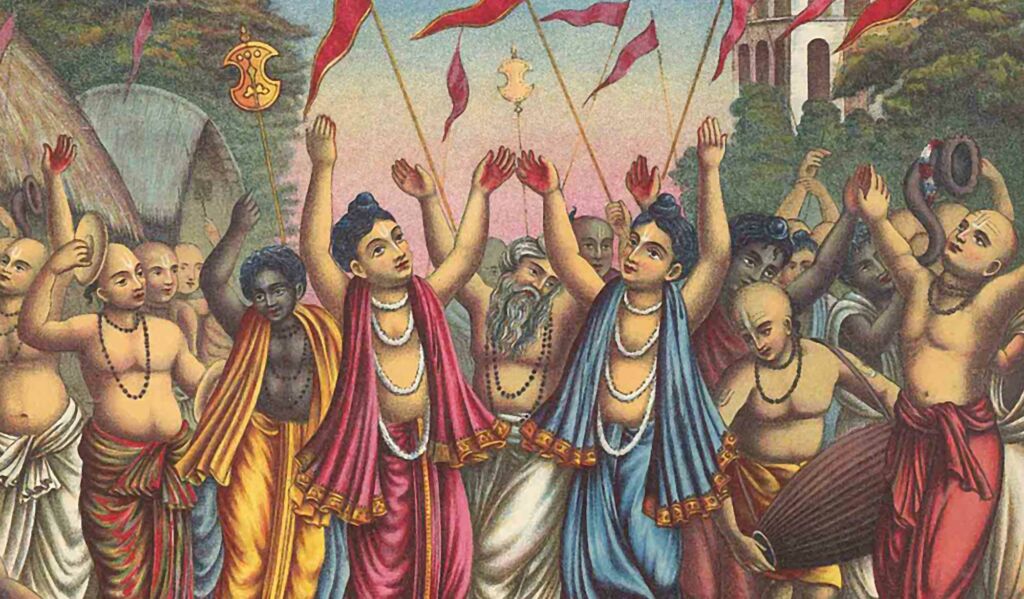
One day the Lord performed saṅkīrtana with all His devotees, and when they were greatly fatigued they sat down.(79) The Lord then sowed a mango seed in the yard, and immediately the seed fructified into a tree and began to grow. (80) As people looked on, the tree became fully grown, with fruits that fully ripened. Thus everyone was struck with wonder. (81) The Lord immediately picked about two hundred fruits, and after washing them He offered them to Kṛṣṇa to eat. (82) The fruits were all red and yellow, with no seed inside and no skin outside, and eating one fruit would immediately fill a man’s belly. (83)
Seeing the quality of the mangoes, the Lord was greatly satisfied, and thus after eating first, He fed all the other devotees. (84) The fruits had no seeds or skins. They were full of nectarean juice and were so sweet that a man would be fully satisfied by eating only one. (85) In this way, fruits grew on the tree every day throughout the twelve months of the year, and the Vaiṣṇavas used to eat them, to the Lord’s great satisfaction. (86) These are confidential pastimes of the son of Śacī. Other than devotees, no one knows of this incident. (87) In this way the Lord performed saṅkīrtana every day, and at the end of saṅkīrtana there was a mango eating festival every day for twelve months. (88) Once while Caitanya Mahāprabhu was performing kīrtana, clouds assembled in the sky, and the Lord, by His own will, immediately stopped them from pouring rain. (89)
One day the Lord ordered Śrīvāsa Ṭhākura to read the Bṛhat-sahasra-nāma [the thousand names of Lord Viṣṇu], for He wanted to hear them at that time. (90) As he read the thousand names of the Lord, in due course the holy name of Lord Nṛsiṁha appeared. When Caitanya Mahāprabhu heard the holy name of Lord Nṛsiṁha, He became fully absorbed in thought. (91) In the mood of Lord Nṛsiṁhadeva, Lord Caitanya ran through the city streets, club in hand, ready to kill all the atheists. (92) Seeing Him appearing very f ierce in the ecstasy of Lord Nṛsiṁha, people ran from the street and fled here and there, afraid of His anger. (93) Seeing the people so afraid, the Lord came to His external senses and thus returned to the house of Śrīvāsa Ṭhākura and threw away the club. (94) The Lord became morose and said to Śrīvāsa Ṭhākura, “When I adopted the mood of Lord Nṛsiṁhadeva, people were greatly afraid. Therefore I stopped, since causing fear among people is an offense.”(95)
Śrīvāsa Ṭhākura replied, “Anyone who takes Your holy name vanquishes ten million of his offenses immediately. (96) “There was no offense in Your appearing as Nṛsiṁhadeva. Rather, any man who saw You in that mood was immediately liberated from the bondage of material existence.” (97) After saying this, Śrīvāsa Ṭhākura worshiped the Lord, who was then greatly satisfied and returned to His own home. (98) On another day a great devotee of Lord Śiva, chanting of Lord Śiva’s qualities, came to Lord Caitanya’s house, where he began dancing in the courtyard and playing his ḍamaru [a musical instrument].(99) Then Lord Caitanya, adopting the mood of Lord Śiva, got on the man’s shoulders, and thus they danced together for a long time. (100) On another day a mendicant came to beg alms from the Lord’s house, but when he saw the Lord dancing, he also began to dance.(101)
He danced with the Lord because he was favored by love of Kṛṣṇa. Thus he flowed in the mellows of love of Godhead. (102) On another day an astrologer came who was said to know everything — past, present and future. Thus Śrī Caitanya Mahāprabhu received him with all honor and put this question before him. (103) “Please tell Me who I was in My previous birth,” the Lord said. “Please tell Me by your astrological computations.” Hearing the words of the Lord, the astrologer immediately began to calculate. (104) Through calculation and meditation, the all knowing astrologer saw the greatly effulgent body of the Lord, which is the resting place of all the unlimited Vaikuṇṭha planets. (105) Seeing Lord Caitanya Mahāprabhu to be the same Absolute Truth, the Supreme Brahman, the Personality of Godhead, the astrologer was confused. (106)
Struck with wonder, the astrologer remained silent, unable to speak. But when the Lord again put the question before him, he replied as follows. (107) “My dear sir, in Your previous birth You were the shelter of all creation, the Supreme Personality of Godhead, full of all opulences. (108) “You are now the same Personality of Godhead that You were in Your previous birth. Your identity is inconceivable eternal happiness.” (109) When the astrologer was speaking so highly of Him, Śrī Caitanya Mahāprabhu stopped him and began to smile. “My dear sir,” He said, “I think you do not know very clearly what I was, for I know that in My previous birth I was a cowherd boy. (110) “In My last birth I was born in the family of cowherd men, and I gave protection to the calves and cows. Because of such pious activities, I have now become the son of a brāhmaṇa.” (111)
The astrologer said, “What I saw in meditation was full of opulence, and therefore I was confused. (112) “I am certain that Your form and the form I saw in my meditation are one and the same. If I see any difference, this is an act of Your illusory energy.” (113) The all-knowing astrologer concluded, “Whatever You may be or whoever You may be, I offer my respectful obeisances unto You!” By His causeless mercy, the Lord then gave him love of Godhead, thus rewarding him for his service.(114) One day the Lord sat down in the corridor of a Viṣṇu temple and began calling very loudly, “Bring some honey! Bring some honey!” (115) Nityānanda Prabhu Gosāñi, understanding the ecstatic mood of Śrī Caitanya Mahāprabhu, brought a pot of Ganges water as a token and put it before Him. (116) After drinking the water, Lord Caitanya became so ecstatic that He began to dance. Thus everyone saw the pastime of attracting the river Yamunā.(117)
When the Lord, in His ecstasy of Baladeva, was moving as if intoxicated by the beverage, Advaita Ācārya, the chief of the ācāryas [ācārya śekhara], saw Him in the form of Balarāma.(118) Vanamālī Ācārya saw a golden plow in the hand of Balarāma, and the devotees all assembled together and danced, overwhelmed by ecstasy.(119) In this way they danced continuously for twelve hours, and in the evening they all took a bath in the Ganges and then returned to their homes.(120) The Lord ordered all the citizens of Navadvīpa to chant the Hare Kṛṣṇa mantra, and in each and every home they began performing saṅkīrtana regularly. (121) [All the devotees sang this popular song along with the Hare Kṛṣṇa mahā-mantra.] “Haraye namaḥ, kṛṣṇa yādavāya namaḥ/ gopāla govinda rāma śrī madhusūdana.” (122) When the saṅkīrtana movement thus started, no one in Navadvīpa could hear any sound other than the words “Hari! Hari!” and the beating of the mṛdaṅga and clashing of hand bells.(123)
Deepen your Bhakti-yoga practice, harmonize relationships, and receive guided coaching — all at Vedavarsity.com