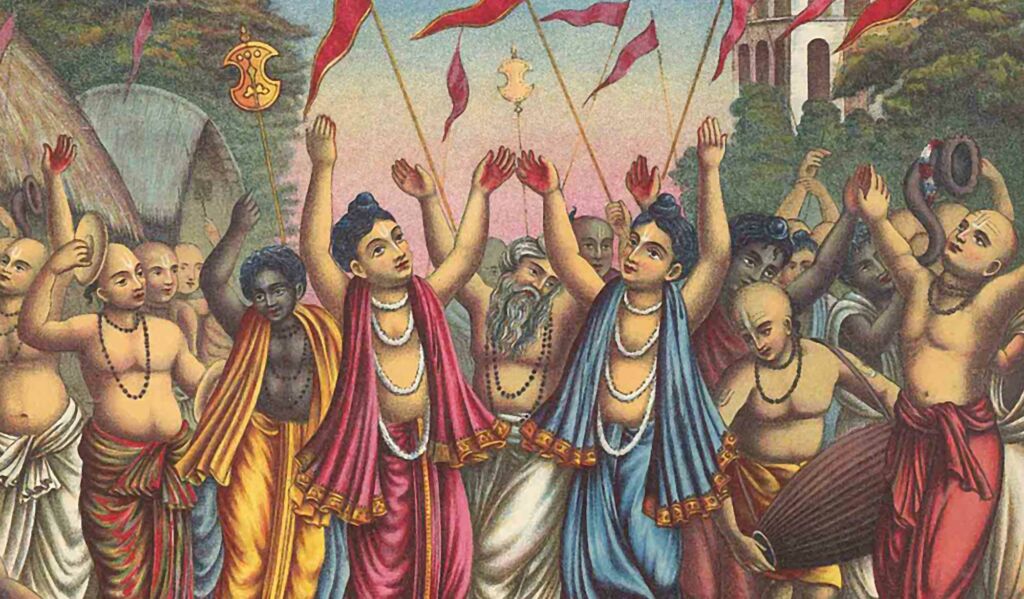
Śrī Caitanya Mahāprabhu regularly led congregational chanting of the Hare Kṛṣṇa mahā-mantra in the house of Śrīvāsa Ṭhākura every night for one full year. (34) This ecstatic chanting was performed with the doors closed so that nonbelievers who came to make fun could not gain entrance. (35) Thus the nonbelievers almost burned to ashes and died out of envy. To retaliate, they planned various ways to give trouble to Śrīvāsa Ṭhākura. (36) One night while kīrtana was going on inside Śrīvāsa Ṭhākura’s house, a brāhmaṇa named Gopāla Cāpāla, the chief of the nonbelievers, who was talkative and very rough in his speech, placed all the paraphernalia for worshiping the goddess Durgā outside Śrīvāsa Ṭhākura’s door. (37 38) On the upper portion of a plantain leaf he placed such paraphernalia for worship as oḍa-phula, turmeric, vermilion, red sandalwood and rice. (39)
He placed a pot of wine beside all this, and in the morning when Śrīvāsa Ṭhākura opened his door he saw this paraphernalia.(40) Śrīvāsa Ṭhākura called for all the respectable gentlemen of the neighborhood and smilingly addressed them as follows. (41) “Gentlemen, every night I worship the goddess Bhavānī. Since the paraphernalia for the worship is present here, now all you respectable brāhmaṇas and members of the higher castes can understand my position.”(42) Then all the assembled gentlemen exclaimed, “What is this? What is this? Who has performed such mischievous activities? Who is that sinful man?”(43) They called for a sweeper [hāḍi], who threw all the items of worship far away and cleansed the place by mopping it with a mixture of water and cow dung.(44) After three days, leprosy attacked Gopāla Cāpāla, and blood oozed from sores all over his body.(45)
Incessantly covered with germs and insects biting him all over his body, Gopāla Cāpāla felt unbearable pain. His entire body burned in distress.(46) Since leprosy is an infectious disease, Gopāla Cāpāla left the village to sit down on the bank of the Ganges underneath a tree. One day, however, he saw Caitanya Mahāprabhu passing by and spoke to Him as follows.(47) “My dear nephew, I am Your maternal uncle in our village relationship. Please see how greatly this attack of leprosy has afflicted me.(48) “As an incarnation of God, You are delivering so many fallen souls. I am also a greatly unhappy fallen soul. Kindly deliver me by Your mercy.” (49) Hearing this, Caitanya Mahāprabhu appeared greatly angry, and in that angry mood He spoke some words chastising him. (50)
“O sinful person, envious of pure devotees, I shall not deliver you! Rather, I shall have you bitten by these germs for many millions of years. (51) “You have made Śrīvāsa Ṭhākura appear to have been worshiping the goddess Bhavānī. Simply for this offense, you will have to fall down into hellish life for ten million births. (52) “I have appeared in this incarnation to kill the demons [pāṣaṇḍīs] and, after killing them, to preach the cult of devotional service.” (53) After saying this, the Lord left to take His bath in the Ganges, and that sinful man did not give up his life but continued to suffer. (54) When Śrī Caitanya, after accepting the renounced order of life, went to Jagannātha Purī and then came back to the village of Kuliyā, upon His return that sinful man took shelter at the Lord’s lotus feet. The Lord, being merciful to him, gave him instructions for his benefit. (55-56)
“You have committed an offense at the lotus feet of Śrīvāsa Ṭhākura,” the Lord said. “First you must go there and beg for his mercy, and then if he gives you his blessings and you do not commit such sins again, you will be freed from these reactions.”(57-58) Then the brāhmaṇa, Gopāla Cāpāla, went to Śrīvāsa Ṭhākura and took shelter of his lotus feet, and by Śrīvāsa Ṭhākura’s mercy he was freed from all sinful reactions. (59) Another brāhmaṇa came to see the kīrtana performance, but the door was closed, and he could not enter the hall.(60) He returned home with an unhappy mind, but on the next day he met Lord Caitanya on the bank of the Ganges and spoke to Him. (61) That brāhmaṇa was expert in talking harshly and cursing others. Thus he broke his sacred thread and declared, “I shall now curse You, for Your behavior has greatly aggrieved me.”(62)
The brāhmaṇa cursed the Lord, “You shall be bereft of all material happiness!” When the Lord heard this, He felt great jubilation within Himself.(63) Any faithful person who hears of this brāhmaṇa’s cursing Lord Caitanya is delivered from all brahminical curses. (64) Lord Śrī Caitanya Mahāprabhu blessed Mukunda Datta with punishment and in that way vanquished all his mental depression. (65) Lord Caitanya respected Advaita Ācārya as His spiritual master, but Advaita Ācārya Prabhu was greatly aggrieved by such behavior. (66) Thus He whimsically began to explain the path of philosophical speculation, and the Lord, in His anger, seemingly disrespected Him. (67) At that time Advaita Ācārya was greatly pleased. The Lord understood this, and He was somewhat ashamed, but He offered Advaita Ācārya His benediction. (68)
Murāri Gupta was a great devotee of Lord Rāmacandra. When Lord Caitanya heard Lord Rāmacandra’s glories from his mouth, He immediately wrote on his forehead “rāmadāsa” [the eternal servant of Lord Rāmacandra]. (69) Once Lord Caitanya Mahāprabhu went to the house of Śrīdhara after kīrtana and drank water from his damaged iron pot. Then He bestowed His benediction upon all the devotees according to their desires. (70) After this incident the Lord blessed Haridāsa Ṭhākura and vanquished the offense of His mother at the home of Advaita Ācārya. (71) Once when the Lord explained the glories of the holy name to the devotees, some ordinary students who heard Him fashioned their own interpretation. (72) When a student interpreted the glories of the holy name as a prayer of exaggeration, Śrī Caitanya Mahāprabhu, greatly unhappy, immediately warned everyone not to see the student’s face henceforward. (73) Without even removing His garments, Lord Caitanya took a bath in the Ganges with His companions. There He explained the glories of devotional service. (74)
“By following the paths of speculative philosophical knowledge, fruitive activity or mystic yoga to control the senses, one cannot satisfy Kṛṣṇa, the Supreme Lord. Unalloyed devotional love for Kṛṣṇa is the only cause for the Lord’s satisfaction.(75) “[The Supreme Personality of Godhead, Kṛṣṇa, said:] ‘My dear Uddhava, neither through aṣṭāṅga-yoga [the mystic yoga system to control the senses], nor through impersonal monism or an analytical study of the Absolute Truth, nor through study of the Vedas, nor through austerities, charity or acceptance of sannyāsa can one satisfy Me as much as by developing unalloyed devotional service unto Me.’ ” (76) Lord Caitanya then praised Murāri Gupta, saying, “You have satisfied Lord Kṛṣṇa.” Hearing this, Murāri Gupta quoted a verse from Śrīmad-Bhāgavatam. (77) “ ‘Since I am but a poor, sinful brahma-bandhu, not brahminically qualified although born in a brāhmaṇa family, and You, Lord Kṛṣṇa, are the shelter of the goddess of fortune, it is simply wonderful, my dear Lord Kṛṣṇa, that You have embraced me with Your arms.’ ”(78)
Deepen your Bhakti-yoga practice, harmonize relationships, and receive guided coaching — all at Vedavarsity.com