


Let me offer my respectful obeisances to Śrī Caitanya Mahāprabhu, by whose mercy even unclean yavanas become perfectly well bred gentlemen by chanting the holy name of the Lord. Such is the power of Lord Śrī Caitanya Mahāprabhu. (1) All glories to Lord Caitanya Mahāprabhu! All glories to Lord Nityānanda Prabhu! All glories to Advaita Ācārya! And all glories to all the devotees of Lord Caitanya! (2) I have already given a synopsis of the kaiśora- līlā of Śrī Caitanya Mahāprabhu. Now let me enumerate His youthful pastimes in chronological order. (3)
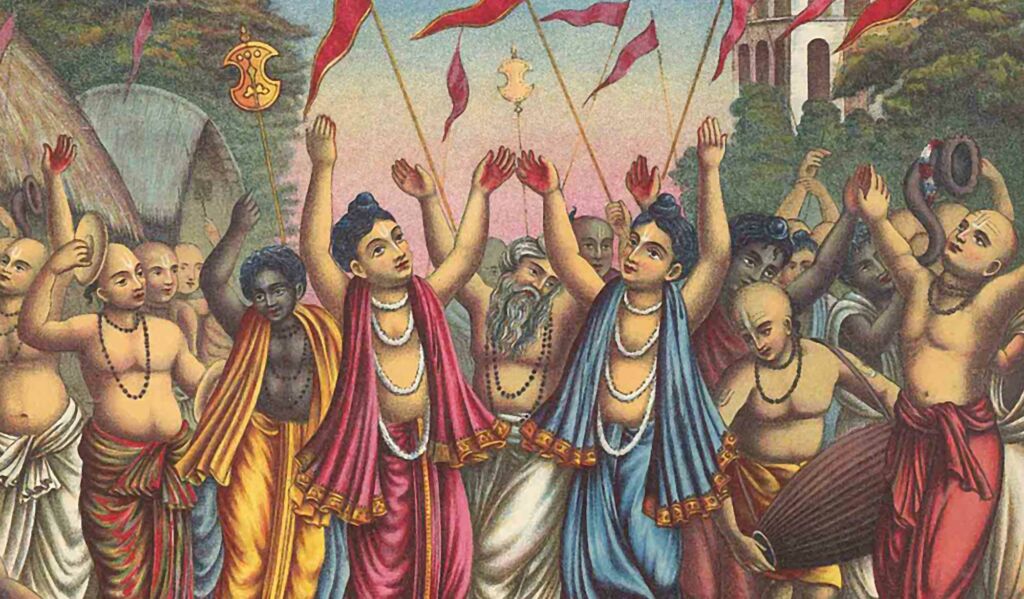
Exhibiting His scholarship, beauty and fine dress, Lord Caitanya danced and chanted as He distributed the holy name of the Lord to awaken dormant love of Kṛṣṇa. Thus Lord Śrī Gaurasundara shone in His youthful pastimes. (4) As He entered His youth, the Lord decorated Himself with ornaments, dressed Himself in fine cloth, garlanded Himself with flowers and smeared Himself with sandalwood. (5) By dint of pride in His education, Śrī Caitanya Mahāprabhu, not caring for anyone else, defeated all kinds of learned scholars while executing His studies. (6) In His youth the Lord exhibited His ecstatic love of Kṛṣṇa on the plea of disturbances of the bodily airs. Accompanied by His confidential devotees, He enjoyed various pastimes in this way. (7)
Thereafter the Lord went to Gayā. There He met Śrīla Īśvara Purī. (8) In Gayā, Śrī Caitanya Mahāprabhu was initiated by Īśvara Purī, and immediately afterwards He exhibited signs of love of Godhead. He again displayed such symptoms after returning home. (9) Thereafter the Lord delivered love of Kṛṣṇa to His mother, Śacīdevī, nullifying her offense at the feet of Advaita Ācārya. Thus there was a meeting with Advaita Ācārya, who later had a vision of the Lord’s universal form. (10) Śrīvāsa Ṭhākura then worshiped Lord Caitanya Mahāprabhu by the process of abhiṣeka. Sitting on a cot, the Lord exhibited transcendental opulence. (11) After this function at the house of Śrīvāsa Ṭhākura, Nityānanda Prabhu appeared, and when He met with Lord Caitanya He got the opportunity to see Him in His six- armed form. (12) One day Lord Caitanya Mahāprabhu exhibited to Lord Nityānanda Prabhu a six- armed form bearing a conchshell, disc, club, lotus flower, bow and flute. (13)
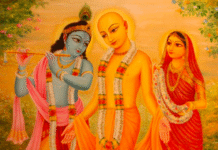
Thereafter the Lord showed Him His four- armed form, standing in a three- curved posture. With two hands He played upon a flute, and in the other two He carried a conchshell and disc. (14) Finally the Lord showed Nityānanda Prabhu His two- armed form of Kṛṣṇa, the son of Mahārāja Nanda, simply playing on His flute, His bluish body dressed in yellow garments. (15) Nityānanda Prabhu then arranged to offer Vyāsa- pūjā, or worship of the spiritual master, to Lord Śrī Gaurasundara. But Lord Caitanya carried the plowlike weapon called muṣala in the ecstasy of being Nityānanda Prabhu. (16) Thereafter mother Śacīdevī saw the brothers Kṛṣṇa and Balarāma in Their manifestation of Lord Caitanya and Nityānanda. Then the Lord delivered the two brothers Jagāi and Mādhāi. (17)
After this incident, the Lord remained in an ecstatic position for twenty- one hours, and all the devotees saw His specific pastimes. (18) One day Śrī Caitanya Mahāprabhu felt the ecstasy of the boar incarnation and got up on the shoulders of Murāri Gupta. Thus they both danced in Murāri Gupta’s courtyard. (19) After this incident the Lord ate raw rice given by Śuklāmbara Brahmacārī and explained very elaborately the import of the “harer nāma” śloka mentioned in the Bṛhan- nāradīya Purāṇa. (20) “‘In this Age of Kali there is no other means, no other means, no other means for self- realization than chanting the holy name, chanting the holy name, chanting the holy name of Lord Hari.’ (21) “In this Age of Kali, the holy name of the Lord, the Hare Kṛṣṇa mahā- mantra, is the incarnation of Lord Kṛṣṇa. Simply by chanting the holy name, one associates with the Lord directly. Anyone who does this is certainly delivered. (22)
“This verse repeats the word ‘eva’ [‘certainly’] three times for emphasis, and it also three times repeats ‘harer nāma’ [‘the holy name of the Lord’], just to make common people understand. (23) “The use of the word ‘kevala’ [‘only’] prohibits all other processes, such as the cultivation of knowledge, practice of mystic yoga, or performance of austerities and fruitive activities. (24) “This verse clearly states that anyone who accepts any other path cannot be delivered. This is the reason for the triple repetition ‘nothing else, nothing else, nothing else,’ which emphasizes the real process of self- realization. (25) “To chant the holy name always, one should be humbler than the grass in the street and devoid of all desire for personal honor, but one should offer others all respectful obeisances. (26)
“A devotee engaged in chanting the holy name of the Lord should practice forbearance like that of a tree. Even if rebuked or chastised, he should not say anything to others to retaliate. (27) “For even if one cuts a tree, it never protests, and even if it is drying up and dying, it does not ask anyone for water. (28) “Thus a Vaiṣṇava should not ask anything from anyone else. If someone gives him something without being asked, he should accept it, but if nothing comes, a Vaiṣṇava should be satisfied to eat whatever vegetables and fruits are easily available. (29) “One should strictly follow the principle of always chanting the holy name, and one should be satisfied with whatever he gets easily. Such devotional behavior solidly maintains one’s devotional service. (30)
“One who thinks himself lower than the grass, who is more tolerant than a tree, and who does not expect personal honor yet is always prepared to give all respect to others can very easily always chant the holy name of the Lord.” (31) Raising my hands, I declare, “Everyone please hear me! String this verse on the thread of the holy name and wear it on your neck for continuous remembrance.” (32) One must strictly follow the principles given by Lord Caitanya Mahāprabhu in this verse. If one simply follows in the footsteps of Lord Caitanya and the Gosvāmīs, certainly he will achieve the ultimate goal of life, the lotus feet of Śrī Kṛṣṇa. (33)
Deepen your Bhakti-yoga practice, harmonize relationships, and receive guided coaching — all at Vedavarsity.com