


Things that are very difficult to do become easy to execute if one somehow or other simply remembers Lord Caitanya Mahāprabhu. But if one does not remember Him, even easy things become very difficult. To this Lord Caitanya Mahāprabhu I offer my respectful obeisances. (1) All glories to Lord Caitanya Mahāprabhu, Nityānanda Prabhu, Advaita Prabhu and all the devotees of Lord Caitanya! (2) I have thus described in brief the advent of Śrī Caitanya Mahāprabhu, who appeared as the son of mother Śacī exactly as Kṛṣṇa appeared as the son of mother Yaśodā. (3) I have already briefly spoken about the pastimes of His birth in chronological order. Now I shall give a synopsis of His childhood pastimes. (4)
Let me offer my respectful obeisances unto the childhood pastimes of Lord Śrī Caitanya Mahāprabhu, who is Lord Kṛṣṇa Himself. Although such pastimes appear exactly like those of an ordinary child, they should be understood as various pastimes of the Supreme Personality of Godhead. (5) In His first childhood pastimes the Lord turned upside down while lying on His bed, and thus He showed His parents the marks of His lotus feet. (6) When the Lord tried to walk, in His small footprints the specific marks of Lord Viṣṇu were visible, namely the flag, thunderbolt, conchshell, disc and fish. (7) Seeing all these marks, neither His father nor His mother could understand whose footprints they were. Thus struck with wonder, they could not understand how those marks could be possible in their home. (8) Jagannātha Miśra said, “Certainly child Kṛṣṇa is with the śālagrāma- śilā. Taking His childhood form, He is playing within the room.” (9)
While mother Śacī and Jagannātha Miśra were talking, child Nimāi woke up and began to cry, and mother Śacī took Him on her lap and allowed Him to suck her breast. (10) While mother Śacī was feeding the child from her breast, she saw on His lotus feet all the marks that were visible on the floor of the room, and she called for Jagannātha Miśra. (11) When Jagannātha Miśra saw the wonderful marks on the sole of his son, he became very joyful and privately called for Nīlāmbara Cakravartī. (12) When Nīlāmbara Cakravartī saw those marks, he smilingly said, “Formerly I ascertained all this by astrological calculation and noted it in writing. (13) “There are thirty-two bodily marks that symptomize a great personality, and I see all those marks on the body of this child. (14)
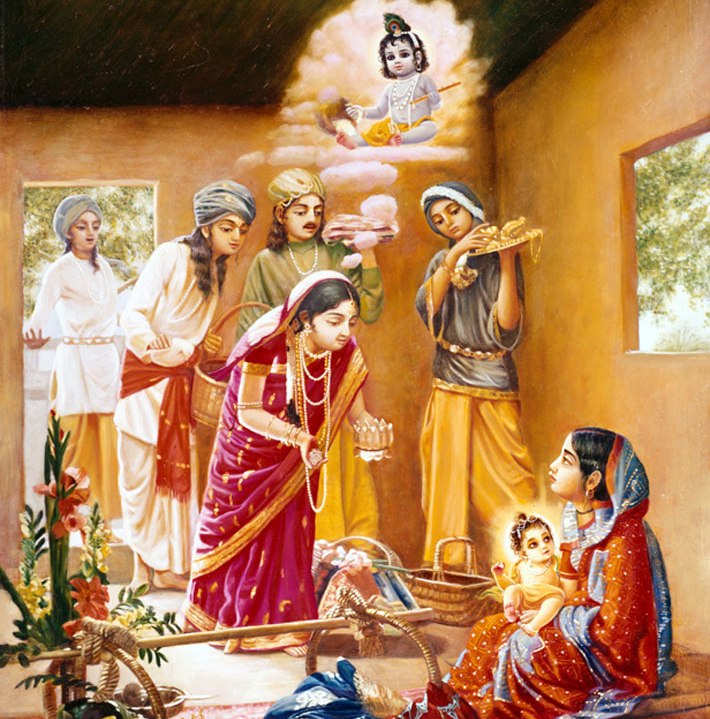
“‘There are thirty- two bodily symptoms of a great personality: five of his bodily parts are large, five fine, seven reddish, six raised, three small, three broad and three grave.’ (15) “This baby has all the symptoms of Lord Nārāyaṇa on His palms and soles. He will be able to deliver all the three worlds. (16) “This child will preach the Vaiṣṇava cult and deliver both His maternal and paternal families. (17) “I propose to perform a name- giving ceremony. We should observe a festival and call for the brāhmaṇas because today is very auspicious. (18) “In the future this child will protect and maintain all the world. For this reason He is to be called Viśvambhara.” (19) After hearing Nīlāmbara Cakravartī’s prediction, Śacīmātā and Jagannātha Miśra observed the name- giving festival in great joy, inviting all the brāhmaṇas and their wives. (20)
After some days the Lord began to crawl on His knees, and He caused various wonderful things to be seen. (21) The Lord caused all the ladies to chant the holy names of the Hare Kṛṣṇa mahā- mantra on the plea of His crying, and while they chanted the Lord would smile. (22) After some days the Lord began to move His legs and walk. He mixed with other children and exhibited various sports. (23) One day while the Lord was enjoying His playful sports with the other little children, mother Śacī brought a dish filled with fused rice and sweetmeats and asked the child to sit down and eat them. (24) But when she returned to her household duties, the child hid from His mother and began to eat dirt. (25) Seeing this, mother Śacī hastily returned and exclaimed, “What is this! What is this!” She snatched the dirt from the hands of the Lord and inquired why He was eating it. (26)
Crying, the child inquired from His mother, “Why are you angry? You have already given Me dirt to eat. What is My fault? (27) “Fused rice, sweetmeats and all other eatables are but transformations of dirt. This is dirt, that is dirt. Please consider. What is the difference between them? (28) “This body is a transformation of dirt, and the eatables are also a transformation of dirt. Please reflect upon this. You are blaming Me without consideration. What can I say?” (29) Astonished that the child was speaking Māyāvāda philosophy, mother Śacī replied, “Who has taught You this philosophical speculation that justifies eating dirt?” (30) Replying to the Māyāvāda idea of the child philosopher, mother Śacī said, “My dear boy, if we eat earth transformed into grain, our body is nourished, and it becomes strong. But if we eat dirt in its crude state, the body becomes diseased instead of nourished, and thus it is destroyed. (31) “In a waterpot, which is a transformation of dirt, I can bring water very easily. But if I poured water on a lump of dirt, the lump would soak up the water, and my labor would be useless.” (32)
The Lord replied to His mother, “Why did you conceal self- realization by not teaching Me this practical philosophy in the beginning? (33) “Now that I can understand this philosophy, no more shall I eat dirt. Whenever I am hungry I shall suck your breast and drink your breast milk.” (34) After saying this, the Lord, smiling slightly, climbed on the lap of His mother and sucked her breast. (35) Thus under various excuses the Lord exhibited His opulences as much as possible in His childhood, and later, after exhibiting such opulences, He hid Himself. (36) On one occasion the Lord ate the food of a brāhmaṇa guest three times, and later, in confidence, the Lord delivered that brāhmaṇa from material engagement. (37) In His childhood the Lord was taken away by two thieves outside His home. The Lord, however, got up on the shoulders of the thieves, and while they were thinking they were safely carrying the child to rob His ornaments, the Lord misled them, and thus instead of going to their own home the thieves came back to the home of Jagannātha Miśra. (38)
Pretending to be sick, the Lord asked some food from the house of Hiraṇya and Jagadīśa on the Ekādaśī day. (39) As usual for small children, He learned to play, and with His playmates He went to the houses of neighboring friends, stealing their eatables and eating them. Sometimes the children fought among themselves. (40) All the children lodged complaints with Śacīmātā about the Lord’s fighting with them and stealing from the neighbors’ houses. Therefore sometimes she used to chastise or rebuke her son. (41) Śacīmātā said, “Why do You steal others’ things? Why do You beat the other children? And why do You go inside others’ houses? What do You not have in Your own house?” (42) Thus rebuked by His mother, he Lord would go in anger to a room and break all the pots within it. (43) Then Śacīmātā would take her son on her lap and pacify Him, and the Lord would be very much ashamed, admitting His faults. (44)
Deepen your Bhakti-yoga practice, harmonize relationships, and receive guided coaching — all at Vedavarsity.com