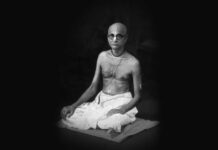
Bhaktiprasada Puri, originally named Ananta, was born on the sixth lunar day of the bright fortnight in the month of Bhadra, 1302 (August 25, 1895), in Sandvipa Hatiya village, Noakhali District (now Bangladesh). He was one of five sons of Bidhumukhi and Rajanikanta Vasu. His elder brother, Yogindra, later became well known as Bhaktipradipa Tirtha Maharaja.
From early childhood, Ananta exhibited a deep love for kirtana and great reverence for the Bhagavata-sastra. By the age of eight, he could recite from memory portions of the Ramayana, Mahabharata, and Bhagavad-gita. His melodious voice and expert handling of the mrdanga revealed his nitya-siddha Bhagavata-svabhava. At sixteen, he visited Bhaktibhavana, Ramabagan, Calcutta, with his father and Yogindra, where he received the blessings of Bhaktivinoda Thakura, Bhaktisiddhanta Sarasvati, and Krsnadasa Babaji.
Ananta completed his Intermediate course at Krsnanatha College, Baharampur, and graduated first class from Calcutta University. After the disappearance of Bhaktivinoda Thakura, he visited Ramabagan in 1918 with Yogindra to meet Bhaktisiddhanta Sarasvati. Concerned about arguments raised by critics of Vaisnavism, he inquired whether it was possible to demonstrate through sound logic that the conclusions of the Srimad-Bhagavatam represent the philosophy enjoined in the Vedanta.
In 1918, on the appearance day of Lord Caitanya, Bhaktisiddhanta Sarasvati took sannyasa and established the Sri Caitanya Matha. The deity of Sri Sri Vinodapran was installed, and the following day he gave mantra-diksha to Ananta, Haripada Vidyaratna, and Dhirendra Natha Bandopadhayaya. Ananta received the name Ananta Vasudeva Brahmacari and was later conferred the title Paravidyabhusana by the Navadvipa Pracarini Sabha.
From 1925 onwards, Ananta fully engaged in the service of Bhaktisiddhanta Sarasvati, taking notes of his lectures, performing secretarial work, and traveling with him to East Bengal. A srutidhara, Ananta could recall every explanation of Bhagavata slokas and assist his spiritual master instantly. Fully surrendered, he would not eat without being asked, sometimes going without food for extended periods.
After the establishment of Sri Caitanya Matha, Ananta helped manage the household and selected a house at 1 Ultadingi Road, Calcutta, to establish a center for bhakti propagation. In 1919, a seat in memory of Bhaktivinoda Thakura was installed, and the international court for Vaisnavas was re-established there. During this period, he managed the Sri Bhagavata Press, publishing numerous Vaisnava books, and assisted in composing Vyasa Puja offerings for Bhaktisiddhanta Sarasvati.
After the disappearance of Bhaktisiddhanta Sarasvati on December 31, 1936, Ananta was unanimously elected President-Acarya of the Gaudiya Matha and Mission, under the chairmanship of Kunjavihari Vidyabhusan. On the same day, he initiated over one hundred disciples and came to be addressed as Acaryadeva.
In 1937, Acaryadeva traveled extensively, preaching in Dhaka and later in Rangoon, Hardwar, and other places, opening exhibitions, giving lectures, and organizing kirtana festivals. On February 22, 1938, he left for Rangoon with a group of sannyasis, continuing vigorous preaching activities. In 1938, he commemorated the appearance of Bhaktivinoda Thakura in Calcutta with a two-month celebration, delivering lectures throughout the city.
Ananta Vasudeva accepted tridanda sannyasa at Gayadhama in 1939 on the fifth day of the dark fortnight in Asada (1346), receiving the name Bhaktiprasada Puri. After sannyasa, he fully renounced worldly life, wearing only a kaupina, walking barefoot, avoiding metal utensils, sleeping on the floor, and remaining awake on Ekadasi nights. He served Isana Thakura, caretaker of the Jagannatha temple garden, watering and clearing weeds regularly.
Following the Haribhaktivilasa, Bhaktiprasada Puri strictly observed the rituals of the month of Vaisaka (April-May) and introduced observances for Harivasara, Lord Gauranga’s appearance day, Nityananda Prabhu’s appearance, Advaita Acarya’s vrata, and Radhastami. Between 1942–1945, he lectured on Sri Bhakti Sandarbha, and from 1945 onwards published the works of the Gosvamis. In 1954, he appointed Bhaktikevala Audulomi Maharaja as President-Acarya of the Gaudiya Mission and retired to Vrndavana as a complete renunciate.
During his preaching years, he engaged in profound discussions on Daiva Varnasrama Dharma, countering the Sahajiyavada, and highlighting the principles of suddha Bhagavata dharma. In Vrndavana, he was surrounded by devotees such as Bhakti Srirupa Bhagavata Maharaja, Sivadavastava Prabhu, and Vrajasundara Dasa.
On the morning of March 8, 1958, at the Kunjavati of Sri Radharamanadeva, Bhaktiprasada Puri delivered his parting advice:
“Try to be in touch with the Inner Self. Preoccupation with the external world is of no use. Give up egoism and surrender to Krsna. Krsna is the creator, sustainer, and controller. There is no alternative for survival other than self-surrender.”
After instructing the devotees to continuously chant:
“Sri Krsna Caitanya Sacisuta Gaura Gunadhama”
Bhaktiprasada Puri passed away, leaving a legacy of strict adherence to devotional principles, preaching, and publication of the Gosvamis’ works.
Deepen your Bhakti-yoga practice, harmonize relationships, and receive guided coaching — all at Vedavarsity.com