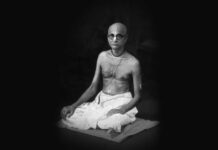



He became a disciple of Siddha Krsnadasa babaji of Govardhana. It is said that Bhagavandasa was originally from Orissa, but he always conversed in Bengali. He introduced the worship of the Deity of Nama-Brahmah at Kalana, which is still going on.
Bhagavandasa was a reserved person who rarely discussed Raganuga bhajana with anyone. Even with his disciple, Jagadisadasa, he only spoke on the subject matter in brief. He did not approve of the emotional behavior of Caitanyadasa babaji of Navadvipa (during his bhava state), referring to him as a `facke’ (frivolous).
On one occasion when the pujari of Nama-Brahmah ran away with the ornaments of the deity, close associates of Bhagavandasa suggested that the theft be reported to the police. Bhagavandasa did not agree and explained to his devotees that Nama-Brahmah had allowed the pujari to take the ornaments away because Nama-Brahmah did not wish to wear them any longer.
After a few months the pujari suddenly appeared one day with all the ornaments. He admitted to stealing out of greed, but said that his conscience would not allow him to sell the ornaments, and begged Bhagavandasa to forgive him. The pujari was allowed to return and Bhagavandasa remarked that the Deity of Nama-Brahmah had changed his mind like a `facke’ and wished to be re-decorated with the ornaments.
On one occasion the servants of Bhagavandasa purchased a bundle of wood for three annas from a poor woman vendor. Bhagavandasa, who was observing the transaction, called the woman over and found out that she had two older sons, besides the little one with her, and no one else in her family. Thinking that three annas would be of very little use to her, Bhagavandas told his servant to pay her three more annas. After that vendors were not allowed within the sight of Bhagavandasa.
One day a snake was found inside the asrama and one of the devotees picked it up and threw it away at a safe distance. When Bhagavandasa came to know about it he was very annoyed and ordered the devotee to leave the asrama and stay away. It is said that the snake happened to be an elder brother of Nama-Brahmah in one of its earlier births. Bhagavandasa would not take prasada until the snake had taken a portion of it.
Bhagavandasa regularly took his evening meals after his daily bhajana recitals. On some days he was so absorbed in bhajana that he forgot about his meal, which was usually kept close to his seat. One pet cat of the asrama regularly shared prasada with babaji, thus when Bhagavandasa remained absorbed in prayer till late, the cat would mew repeatedly, going around and around babaji to attract his attention. Bhagavandasa would lift the lid of the bowl of prasada, allow the pet to help itself and then replacing the lid, continue with his bhajana.
On occasions when Bhagavandasa failed to derive the inspiration desired from his bhajana, he would advise his devotees to take their meals and on pretext of his own illness, he refrained from eating. If the devotees tried to convince him to eat, babaji would simply reply: “In that case let us all retire to bed without any meal.” Thus the devotees would reluctantly take their meals.
On the other hand, sometimes when a bhajana session would run late into the night, babaji would suddenly declare himself to be very hungry. If no food was available at the asrama, he sent the devotees to buy sweets from an outside shop. He made sure that the sweets were sanctified with sprinkles of charanamrita, then offered them to Nama-Brahmah.
He was a virtuous man both in his practices and behavior. He did not allow any prasada received as offerings, to be placed on the floor unless the devotees mopped the place clean. If a devotee failed to do so, babaji would pull him up and call him a Mussulman. When flowers or garlands were offered to Bhagavandasa, he touched them to his forehead with care, making sure the flowers did not come in contact with his garments.
One of his disciples, Visnudasa, came down with a fever for three continuous days. When Bhagavandasa advised his disciple to take medicine the latter said that there was no need to do so as he would be cured by the grace of Nama-Brahmah. Bhagavandasa angrily remarked that, “A man suffers illness as a part of his penance and should act upon a doctor’s advice, rather than pass the responsibility for the disease, and also its cure, to Nama-Brahmah. After all, it is a doctor’s job to provide aid to a sick person.” Visnudasa promptly took some medicine and was cured.
One day Bhagavandasa had a sudden desire to eat talsansa (the edible kernel of the stone of a palmyra fruit). For days he continued to eat talsansa, without touching his normal food. After some days, due to the excessive intake of fruits, he became very sick with dysentery, nevertheless he insisted on eating the talsansa. His devotee, having failed to restrain babaji, devised a plan; They had a mali (gardener) come before the Deity of Nama-Brahmah and proclaim, while beating a drum (dheran), that the sale of talsansa would no longer be permitted in the market. Any vendor defying this order must pay a fine of twenty five rupees. After some initial resistance Bhagavandasa reverted to his normal diet.
On another occasion Bhagavandasa announced that he had a strong desire to perform his bhajan seated on a high platform overlooking a pond near the Deity of Nama-Brahmah. He ordered his disciple Pranakrsnadasa to begin excavating a tank very early the following morning. Another disciple named Jagadisadasa was put in charge of the construction of the platform. Pranakrsna hired fifty laborers, paying each man two annas per day, and completed the tank within 24 hours, on the day of ekadasi. Jagadisa also executed his part of the platform work, with some assistance from Pranakrsna, carrying the necessary bamboo poles from the market on his shoulder and completed the work the following day (dvadasi). Bhagavandasa was very happy to see the job completed on time and sat down to perform bhajan sitting on the high platform overlooking the pond. However, after a few days, Bhagavandasa saw a calf accidentally fall into the pond. Immediately he shouted for his men to rescue the calf from the water, but they were unsuccessful. From that day babaji shifted his seat of prayer back to its original place and had the pond filled up with earth so as to prevent any other cow from falling in.
One day while Bhagavandasa was absorbed in bhajan, he was heard to shout “go away”. It came to be known later that he was shouting to scare away a goat which was chewing the leaves of a Tulasi plant in the courtyard of the Govinda temple, far away in Vrndavana. On that same day the Maharaja of Burdwan, having heard about the powers of Bhagavandas, came to Nama-Brahmah Asrama for darsana. It so happened that Maharaja entered the asrama at the same time that Bhagavandasa shouted, “go away”. Naturally, the Maharaja thought that Babaji, for some reason, wanted Maharaja to leave the premises. Thus, in disappointment, he left Nama-Brahmah Asrama.
Afterwards the devotees told babaji of Maharaja’s arrival and why he had left without getting babaji’s darsana. Bhagavandasa immediately sent a messenger requesting the Maharaja to visit Nama-Brahmah again. When the Maharaja again visited the asrama babaji begged forgiveness and explained the circumstances which had led to the misunderstanding on Maharaja’s previous visit. The Maharaja was understanding, but skeptical as to whether Bhagavandasa Maharaja actually possessed the power to see something which was taking place in Vrndavana. To satisfy his own curiosity the Maharaja sent a telegram to Vrndavana to verify the truth of the incident. The reply corroborated the statement made by Bhagavandasa. From that time Bhagavandasa was known as Siddhababa Bhagavandasa Babaji Maharaja.
Siddhababa rarely discussed `lila’, but occasionally mentioned the topic amongst a few confidential devotees. Once he told Jagdisadasa to note down some divine-nama which would be of great value to Jagadisa in the future. Sometimes in the course of speaking with his disciples, Siddhababa would suddenly laugh out loud, without any relevance to the subject of discussion. Though Bhagavandasa did not talk of his internal meditation, his communion with the Lord continued ceaselessly like the flow of a stream; and his sudden laughter, without any apparent reason, could perhaps, be attributed to the manifestation of his actual state of mind. Siddhababa Bhagavandasa expired on the eighth day of the new moon in the month of Kartika (Oct.-Nov.).
Deepen your Bhakti-yoga practice, harmonize relationships, and receive guided coaching — all at Vedavarsity.com