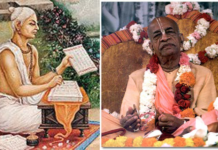
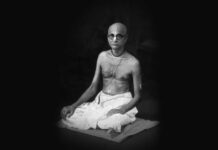
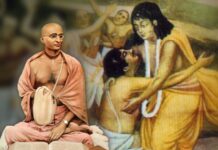
He was born during the eighteenth century AD., in a village near Remuna in the Balasore district of Orissa. He studied Vyakarana, Alamkara, and Nyayasastra in an academic center on the bank of Lake Cilka. Afterwards he went to Karnataka to study the Vedas. At that point he was initiated into the Madhva Sampradaya. After taking sannyasa he defeated the scholars of Puri (Purusottamaksetra) in a debate on Sastra.
Baladeva stayed at the Tattvavadi Matha, but after studying Satsandarbha under Radhadamodara, a resident of Kanauj and a disciple of Rasikananda Prabhu, he became attracted to the profound philosophical essence of Gaudiya Vaisnavism. Thus he became a disciple of his teacher, Radhadamodara. It is said that Baladeva studied Bhaktisastra under Pitamvaradasa, and Srimad Bhagavatam under Visvanatha Cakravarti.
After adopting Virakta Vaisnava Vesa, Baladeva became known as “Ekanti-Govindadasa”. It was Baladeva who installed the deity of Syamasundara in Vrndavana. Uddhavadasa and Nandamisra were the two foremost disciples of Baladeva.
In Visvanatha Cakravarti’s old age he received news that the Bengali sevaits from the temple of Jaipur had been branded as a-sampradaya and deprived of their right to offer seva. Visvanatha immediately sent Baladeva, accompanied by Krsnadeva and Sarvabhauma, to Jaipur. There Baladeva defeated his opponents in a debate and re-instated the Gaudiyas in their seat at the mountainous region of Galta. He also installed the deity of Vijaya Gopala there. (This temple and deity is still existing.)
At this same time Baladeva wrote the book Sri Govindabhasya, a glorious contribution to the Gaudiya Vaisnava community. The following is a list of Baladeva’s other works:
(1) Tika of Satsandarbha
(2) Tika of Laghubhagavatamrta
(3) Siddhantaratna
(4) Vedantasyamantaka
(5) Prameyaratnavalir
(6) Siddhantadarpanda
(7) Tika of Syamanandasataka
(8) Tika of Natakacandrika (rare)
(9) Sahityakaumudi
(10) Chandahkaustubha
(11) Kavyakaustubha
(12) Vaisnavanandini tika of Srimad Bhagavatam
(13) Sri Gopalatapnai, and bhasya of Srimad Bhagavadgita
(14) Tika of Stavamala
(15) Aisaryakadamvini
Deepen your Bhakti-yoga practice, harmonize relationships, and receive guided coaching — all at Vedavarsity.com