


According to Bhakti Movement in Orissa (BMO p. 73‑75), Acyutananda Dasa was a sixteenth century poet who showed versatile genius in writing books on Vaisnava philosophy and religion. He was born in the village Tilkana, situated one mile away from the famous village Nembala (Lembalo), on the bank of the Chitropala (a branch of Mahandi), in the district of Cuttack. According to Udayakahani he was born in 1482 A.D. His father was Dinabandhu Khuntia, and mother Padmavati. From boyhood Acyutananda showed no interest in his studies, and became increasingly indifferent to all worldly affairs as he grew.
Once Dinabandhu, along with his wife and son, went to Puri to pay respect to Lord Jagannatha. At that time Lord Caitanya was present at Puri. One day Dinabandhu and Acyuta went to see the Lord. Upon touching the feet of Lord Caitanya, Acyuta experienced a surge of spiritual energy.
In the Sunya Samhita it is stated that while Acyuta was in Puri with his father, Lord Caitanya advised Sanatana Goswami (not the Sanatana Goswami of the six goswami’s, but another from Doligram) to initiate Acyuta. Thus he took initiation in the name of Hari.
However in the Gurubhaktigita another story is related. Once while Acyuta was playing under a banyan tree Lord Caitanya came there in disguise to take rest. The Lord asked Acyuta about his parents and requested to see them. Acyuta conveyed the news to his father, who later came there to met Lord Caitanya. At that time the Lord told Dinabandhu that his child should be given Harinama initiation. Dinabandhu thus made preparations for his sons initiation and on the eleventh day of the new moon of Vaisaka Lord Caitanya initiated Achyuta. Afterwards, on the request of Dinabandhu, Lord Caitanya manifested His four‑armed form. The Lord also told Acyuta that they would meet again at Puri.
According to Sri Caitanya Bhagavata of Iswar Dasa, Achyuta was advised by Sri Krsna to take the paramhansa mantra from Lord Caitanya: “Accept Him as preceptor and propagate the name of Hari.” He then left for Puri where he served Caitanya Mahaprabhu.
Regardless of who Achyuta’s guru actually was, Lord Caitanya’s advent definitely marked a turning point in Achyuta’s life. In the Sunya Samhita it is said that Lord Caitanya gave Achyuta cymbals and drums (kola), and taught him the art of tuning, timing, and sense of rhythm.
On the order of Caitanya Mahaprabhu, Achyuta set out on a pilgrimage and returned after a long journey. During that journey Achyuta, being profoundly influenced by Lord Caitanya, formed a Sankirtana (Rahasa) party and preached the name of Sri Krsna in different provinces of India. The account of his Sankirtana party is discussed in an unpublished manuscript called Baranacharita‑grantha.
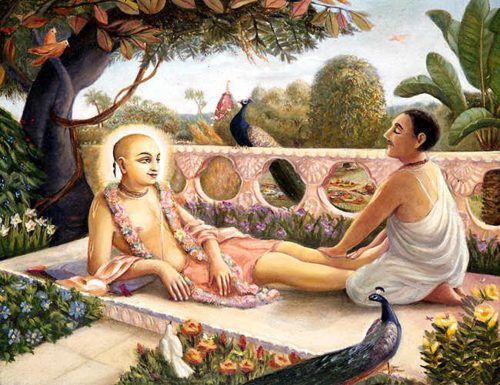
Lord Caitanya and Achyuta had a very cordial relationship and are certainly eternal associates. The description in chapter ten of Sunya Samhita reveals that Achyuta was not only associated with Lord Caitanya during the period mentioned, but he was also a companion in previous births. The story indicates that Sri Krsna informed Sudama that He was going to descend to the earth. Krsna said: “Go thou Sudama, we shall meet again in Kaliyuga. I shall reveal myself in the form of Buddha, and you will bear the name Sundarananda. Later I will manifest in Navadvipa as Sri Caitanya and preach the name of Hari from door to door. At that time you will stay with us, and will be known by the name Achyuta. You will save the cowherd class.”
In another passage of Sunya Samhita, Sudama, Subala and others asked Krsna how and when they would meet again. Krsna replied that they would be born as Panchasakhas in the Kaliyuga at Nilacala, and King Prataparudradeva would serve the.
Once Lord Caitanya came to Cuttack and the king desired to perform a religious festival. Lord Caitanya advised the king to bring the Panchasakhas. Thus the Panchasakhas came to Cuttack to join the party and the Lord embraced all of them. In the Chourasi Ajna it is described that Lord Caitanya sat in the Muktimandapa along with His five associates, the king, and Sarvabhauma. The Lord declared that the five associates were the followers of Krsna in every age. The associates replied that they were but five branches (panca sakha) of one tree. Lord Caitanya called them to his side and asked them to give a demonstration of their occult powers. He handed over the seed of a jackfruit to Jagannatha Dasa, and Acyutananda ripened the fruit.
In the Sri Caitanya Bhagavata it is further stated that Lord Caitanya once asked Achyuta about his writings, and Achyuta told the Lord that he had written many songs and bhajans. In the Gurubhaktigita it is also mentioned that Lord Caitanya advised Achyuta to compose books on rasa. In Anakarsamhita, Acyutananda states that he has written one lakh of padas and padavalis. The renowned scholars, Dr. A. B. Mahanty, claims that he has personally seen 3,000 manuscripts. Achyuta also wrote Samhitas and Upanisads. He was popular in Orissa and known as the Gopala guru. He was the guru of the milkman caste. His Ogalas are very popular amongst his disciples. His famous works are: Sunyasamhita, Sabdabrahmandasamhita, Anakarsamhita, Mahanitya‑rahasa, Nitya‑rahasa, Sunya‑rahasa, Brundarasa, Radha‑rasa. He is still remembered for his Bhabisyamalikas.
Deepen your Bhakti-yoga practice, harmonize relationships, and receive guided coaching — all at Vedavarsity.com