


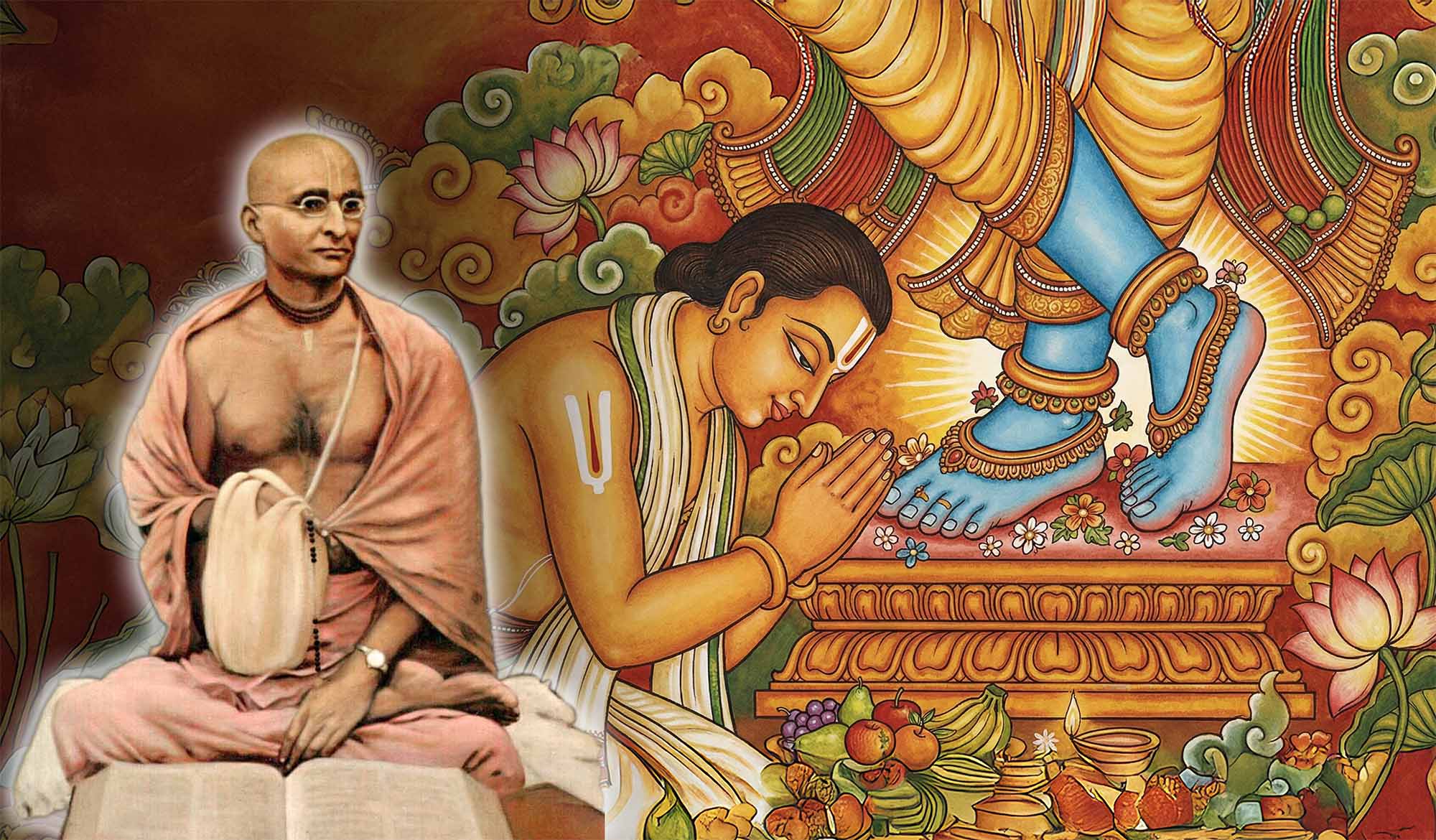
We continue the twenty-six qualities of a devotee, with Śrīla Sarasvatī Ṭhākura’s explanation of kṛṣṇaika-śaraṇa – taking exclusive shelter of Kṛṣṇa. This article was first published in Sajjana Toṣaṇī, Vol. 21, Issue 3, in 1918
Articles in This Series:
Of the twenty-six qualities of a Vaiṣṇava that have been mentioned, apart from taking exclusive shelter of Kṛṣṇa (kṛṣṇaika-śaraṇa), the remaining twenty-five qualities are considered to be marginal. The quality of taking exclusive shelter of Kṛṣṇa is solely defined as the inherent or primary quality. One who does not possess the quality of exclusive surrender to Kṛṣṇa cannot truly possess the remaining twenty-five qualities; or even if those qualities manifest in him, in the absence of this one quality they cannot remain in him permanently. Other qualities can be feigned and displayed by those who are not sādhus, but a non-devotee can never become one who takes exclusive shelter of Kṛṣṇa.
Only a devotee is exclusively surrendered to Kṛṣṇa. Śrī Kṛṣṇa alone is the foundational principle of the Supreme Lord. From Him have arisen Śrī Baladeva Prabhu, the quadruple expansions beginning with Vāsudeva and Saṅkarṣaṇa, the Puruṣa-avatāras, and the occasional avatāras. When a jīva comes to know the three Puruṣa-avatāras, he becomes freed from all worldly concerns, and by realising the purity of the Vaikuṇṭha realm, he can understand that eternal servitorship (nitya-dāsya) is his true nature. That Śrī Kṛṣṇa-candra – who is the sac-cid-ānanda vigraha who gives shelter to all, who is beginningless, the source of all, and the cause of all causes – is the sole refuge of the jīva. Separated from Him, the jīva has no other destination whatsoever. A jīva who rejects the shelter of Śrī Kṛṣṇa and wastes time in māyāvāda, karma-kāṇḍa, and various other desires under the guise of pseudo bhakti, cannot become exclusively surrendered to Kṛṣṇa. Furthermore, simply saying “I am surrendered to Kṛṣṇa” does not remove one’s aversion to Kṛṣṇa.
Only one who is an akiṣcana (who possesses no material desires) is truly exclusively surrendered to Kṛṣṇa. When one says ‘akiṣcana,’ one does not mean a māyāvādī, nor a karma-kāṇḍī sannyāsī, nor, in the language of those who possess other desires, does it refer to material poverty. The sole characteristic of one who is surrendered, or akiṣcana, is that his life is imbued with the purpose of serving Kṛṣṇa. Only when a jīva becomes exclusively surrendered to Kṛṣṇa does he become indifferent to all the glories of material māyā that are unrelated to Kṛṣṇa. Far from accepting all these glories, he flees from them out of fear of becoming entangled in them.
One who strongly adheres to varṇāśrama-dharma cannot become an akiṣcana or surrendered. Only by abandoning all dharmas and taking exclusive shelter of Kṛṣṇa can one be called kṛṣṇaika-śaraṇa. The characteristics of surrender are of six types:
Determination to act in accordance with favourable circumstances.
Avoidance of unfavourable circumstances.
Firm conviction that, “Apart from Kṛṣṇa I have no other protector.”
Acceptance of Kṛṣṇa as one’s sole protector and maintainer.
Complete self-surrender to Kṛṣṇa, refraining from any endeavour other than His service.
Rejecting pride and attachment to all kinds of mundane things, and always remaining utterly humble in one’s mind.
Possessing these six characteristics of surrender, a devotee completely surrenders himself to Kṛṣṇa.
A devotee who has taken sole refuge in Kṛṣṇa has no inclination to take shelter in those things which have no connection to Kṛṣṇa. However, those persons who, out of a desire to attain the recognition of being a Vaiṣṇava, deceptively present themselves as exclusively surrendered to Kṛṣṇa, and unjustly consider their own severe criticism of the pure bhakti of true devotees to be a sign of exclusive surrender, are certainly classified as false devotees or hypocrites.
By nature, a devotee does not interfere in the affairs of others, does not forcefully protest unnecessarily, shows no malice towards others, and has no envy. It is the inherent nature of those who are not sādhus to harbor enmity towards God and the devotees; this is not surrender to Kṛṣṇa alone, but merely aversion to Kṛṣṇa. Whenever a hypocritical or false devotee does become exclusively surrendered to Kṛṣṇa, he then realises the harm caused by his enmity toward Hari, guru, and the Vaiṣṇavas, and gradually becomes freed from the traces of his non-Vaiṣṇava tendencies.
Although exclusive surrender to Kṛṣṇa is extremely rare for a jīva who is averse to Hari, through the association of sādhus, his attention is drawn to this fundamental quality or svarūpa-lakṣaṇa (inherent characteristic) of a devotee. Gradually, abandoning envy and hypocrisy, he advances in the ideal of a devotee and steadily attains progress.
(Translated by Swami Bhaktivijṣāna Giri)
Deepen your Bhakti-yoga practice, harmonize relationships, and receive guided coaching — all at Vedavarsity.com