


Overview
We continue with the explanation on the twenty-six qualities of a devotee by Prabhupāda Sarasvatī Ṭhākura. In this article ‘A Devotee is Devoid of Possessiveness (Sajjana – Akiñcana)’ from Sajjana Toṣaṇī (Vol.20, Issue 11) published in 1917, Sarasvatī Ṭhākura describes the mood of a humble Vaiṣṇava who is free from the mentality of ‘I, me and mine.’
Articles In This Series
One who is not intoxicated by the pride of self-worship, who is not eager to attain the results of his actions, and who is not busily engaged in pursuing objects unconnected with Bhagavān – such a person’s mind is not eager for the acquisition of jñāna, success in karma, or the attainment of worldly happiness. While he remains in this material world, the jīva often becomes self-forgetful and, with impersonal knowledge, considers himself to be a jñānī, an enjoyer seeking celestial pleasures, or a worldly person absorbed in sense gratification. He thinks himself to be wealthy and endeavours to bring some object of this world under his control. With the aim of achieving various results, he sometimes takes on the guise of a renunciate, sometimes indulges in the enjoyments of a hedonist, and, driven by the powerful urges of unrestrained conduct, searches for ‘something’ (kiñcana) declaring, “This was mine,” “It is mine,” or “I want it!” As long as the jīva lays claim to be the pursuer of ‘something’, that ‘something’ never leaves him. As soon as that ‘something’ is acquired, all the people of the world begin to follow close behind him. He who does not possess that ‘something’ is truly an akiñcana. He alone is a virtuous devotee. He does not have to search for anything. There is no need to run after anything, thinking that it was, is, or will be yours.
Simply put, that ‘something’ is of the nature of a thing that one takes shelter of. Although the jīva himself is sunirmala āśraya jātīya (naturally in the pure category of a devotee), forgetting that, he comes to identify his own concept of ‘I-ness’ as being non-different from worldly objects. Thus, in his quest for shelter or support, he
roams around about trying to attain the shelter of that which itself is an object of enjoyment. He has forgotten the point that he himself is the āśraya jātīya and Bhagavān alone is the eternal viṣaya. Until the time that he realises his own akiñcanatā (absence of possessiveness), he remains sakiñcana (full of possessiveness) — in other words, as a jñānī, a karmī, or an anyābhilāṣī (dominated by desires for things unrelated to Kṛṣṇa).
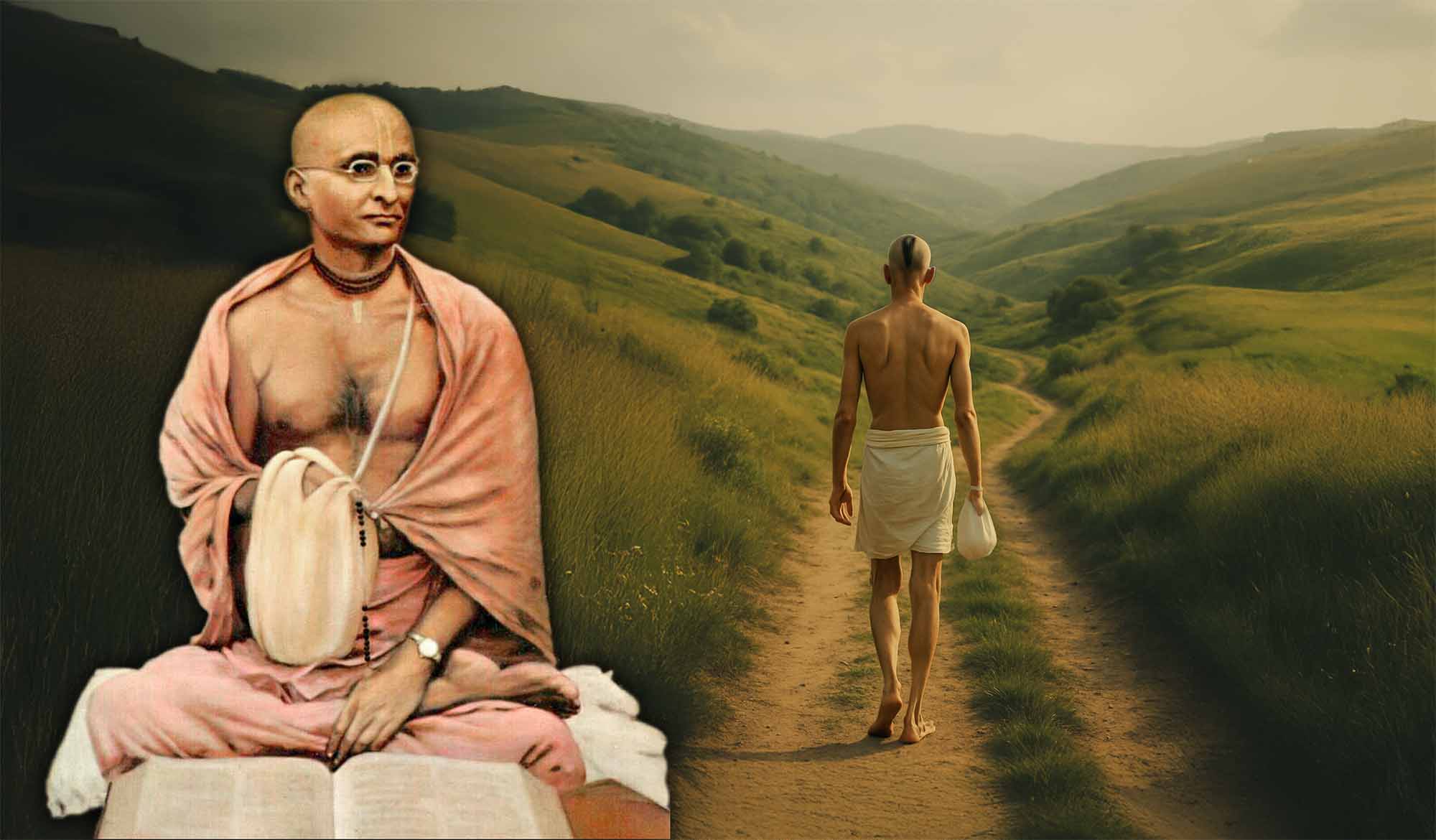
A pure devotee of Bhagavān is a complete akiñcana. An akiñcana is humbler than a blade of grass and does not consider anything to be his own property. This means that an akiñcana, endowed with the quality of tolerance greater than that of a tree, does not identify with any material designation. In other words, he does not consider himself as eligible to be attacked by any material object. An akiñcana considers everyone else as possessors of property and does not wish to establish himself with any possession. Only a devotee is an akiñcana. He is a completely pure, dedicated unit of service to Kṛṣṇa. A devotee is free from violent behaviour and envy, and is not dependent on others. According to the Śrīmad Bhāgavata:
yasyātma-buddhiḥ kuṇape tri-dhātuke
sva-dhīḥ kalatrādiṣu bhauma ijya-dhīḥ
yat-tīrtha-buddhiḥ salile na karhicij
janeṣv abhijñeṣu sa eva gokharaḥ
He who considers the true self to be this corpse-like body that is full of mucus, bile and air, who believes that his family belongs to him, who thinks his country of birth is worthy of worship, who thinks that a holy place is merely an ordinary body of water and who never seeks the association of the wise, is no different from an ass. (Śrīmad Bhāgavatam 10.84.13)
By accepting the essence of this śloka, he becomes an akiñcana or a sajjana (virtuous devotee). He has no investment in any perishable or inferior object. He is surrendered.
Deepen your Bhakti-yoga practice, harmonize relationships, and receive guided coaching — all at Vedavarsity.com