



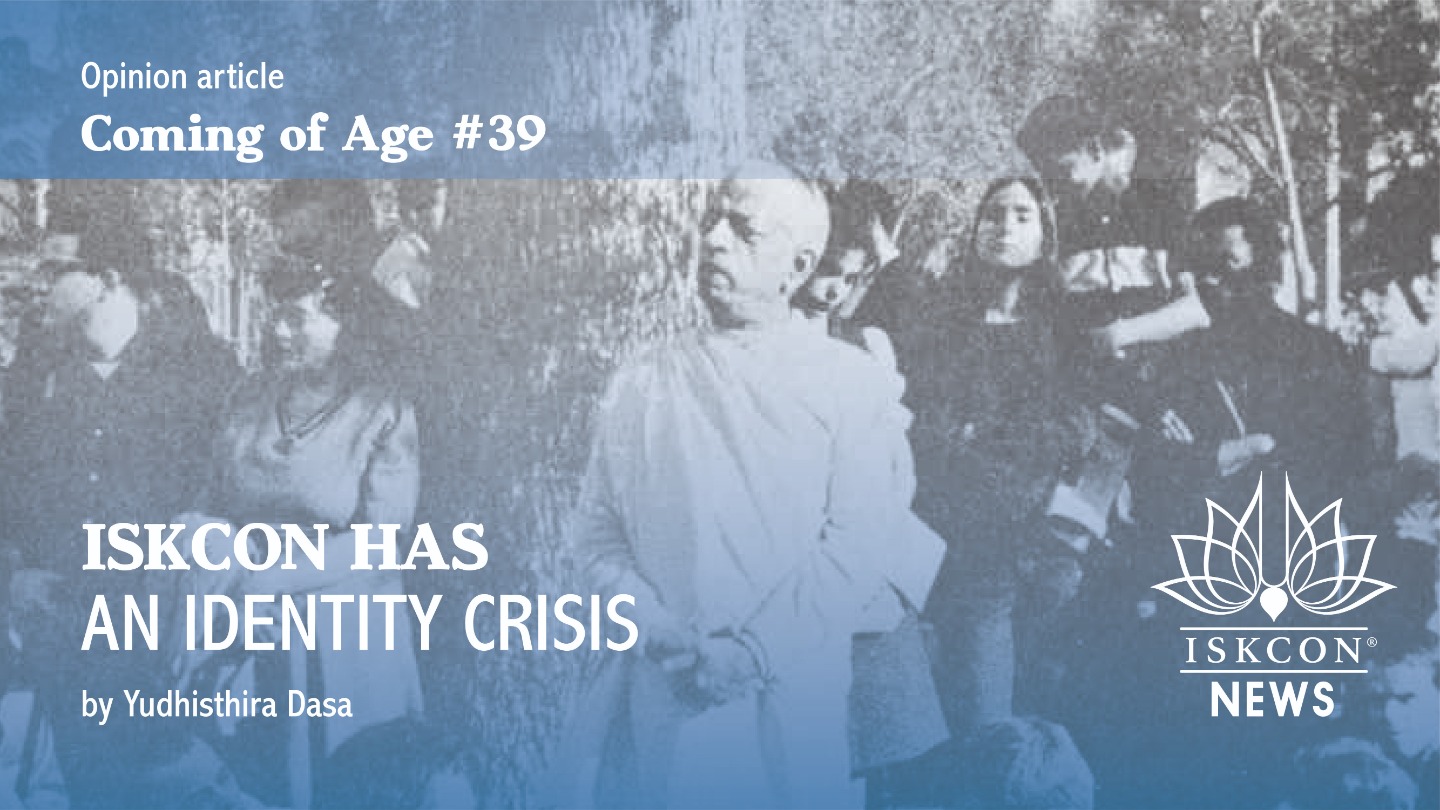
The ISKCON Identity Crisis raises an important question about the identity, cultural representation, and spiritual mission of the International Society for Krishna Consciousness. As the Hare Krishna movement continues to expand across different countries and cultures, it faces the challenge of preserving its spiritual identity while embracing the diversity of the global human community.
A recent reflection by Yudhisthira Dasa, published in ISKCON News on November 8, 2026, explores this subject through the changing cultural landscape of the Western world. It invites devotees to consider how ISKCON relates to Indian communities, Hindu traditions, and its original mission of spreading Krishna consciousness throughout the world.
At the heart of this discussion lies a fundamental teaching of Vedic philosophy: our real identity is not determined by the temporary material body but by our eternal relationship with the Supreme Personality of Godhead, Śrī Krishna.
Śrīla Prabhupāda’s Vision: Krishna Consciousness for Everyone
His Divine Grace A. C. Bhaktivedanta Swami Prabhupāda established ISKCON with a universal spiritual mission. He did not intend Krishna consciousness to remain limited to a particular nationality, ethnicity, language, or geographical region.
Following the instructions of his spiritual master, Śrīla Bhaktisiddhānta Sarasvatī Ṭhākura, Śrīla Prabhupāda dedicated his life to carrying the teachings of Lord Śrī Caitanya Mahāprabhu beyond the boundaries of India.
His mission was to make the science of bhakti-yoga accessible to every sincere soul.
The teachings of Bhagavad-gītā establish that every living entity is an eternal spiritual being, beyond the temporary designations of the material body.
As Lord Krishna declares:
na jāyate mriyate vā kadācin
” For the soul there is never birth or death.” (Bhagavad-gītā 2.20)
The soul is neither American nor Indian, neither European nor African. These identities belong to the temporary material body, whereas the constitutional identity of the living entity is that of an eternal servant of Krishna.
Therefore, Krishna consciousness transcends all material distinctions.
ISKCON Identity Crisis: Beyond Cultural and Bodily Designations
One of the central concerns discussed in the article is the growing association between ISKCON and the wider Indian and Hindu communities in Western countries.
Over the decades, the Indian diaspora has expanded considerably, bringing its traditions, languages, festivals, temples, and cultural practices into the mainstream of Western society.
This development has created new opportunities for cooperation and cultural exchange.
However, it also raises an important question: Should the identity of ISKCON be primarily understood through Indian culture, Hindu religious traditions, or its distinctive Gaudiya Vaishnava philosophy?
To understand this question properly, we must distinguish between cultural identity and spiritual identity.
The Concept of Dehātma-buddhi
In Vedic philosophy, dehātma-buddhi refers to the misconception of identifying oneself with the material body.
Śrīla Prabhupāda repeatedly explained that bodily identification is the foundation of material conditioning.
A person may identify himself as Indian, American, European, or African, but these are temporary bodily designations. The eternal soul is beyond such distinctions.
The Śrīmad-Bhāgavatam teaches that genuine spiritual vision develops when one recognises the spiritual nature of all living beings.
This understanding does not mean that cultural differences should be rejected or disrespected. Rather, it means that such differences should never become the basis of spiritual superiority, prejudice, or division.
The real purpose of human life is to awaken our forgotten relationship with Krishna.
Is ISKCON a Hindu Organisation or a Gaudiya Vaishnava Movement?
The question of whether ISKCON should be identified as Hindu is an important part of the ongoing discussion.
ISKCON is founded upon the teachings of the Vedic scriptures, including Bhagavad-gītā, Śrīmad-Bhāgavatam, and the devotional teachings of the Gaudiya Vaishnava ācāryas.
Its philosophical foundation is acintya-bhedābheda-tattva, the doctrine of inconceivable simultaneous oneness and difference between the Supreme Lord and His energies.
The movement follows the devotional path established by Śrī Caitanya Mahāprabhu, who taught the congregational chanting of the holy names of Krishna as the principal spiritual practice for the present age.
The word Hindu is commonly used as a broad designation for traditions originating in the Indian spiritual and cultural heritage. In this wider social context, ISKCON is frequently associated with the Hindu community.
However, its specific theological identity is Gaudiya Vaishnavism, a devotional tradition centred on the worship of Lord Krishna as the Supreme Personality of Godhead.
Thus, cultural association and theological identity should not be confused.
ISKCON can maintain respectful relationships with the wider Hindu community while clearly presenting its own spiritual philosophy and devotional practices.
The Changing Cultural Landscape of the Western World
The article highlights the significant growth of Indian communities in the United States, particularly in cities such as Frisco, Texas.
As Indian communities become increasingly visible in Western society, their cultural and religious institutions also become more influential.
This development presents both opportunities and challenges for ISKCON.
On one hand, the growing Indian diaspora can provide valuable opportunities for cultural exchange, cooperation, temple development, and the introduction of Vedic teachings to new audiences.
On the other hand, ISKCON must ensure that its spiritual mission is not understood merely as the preservation or promotion of Indian ethnic identity.
The vision of Śrīla Prabhupāda was much broader.
He wanted people from every background to understand the science of Krishna consciousness and adopt the principles of devotional service.
A person born in America can become a devotee of Krishna just as a person born in India can. Spiritual advancement depends upon sincere devotion, not birth, nationality, or social background.
The Universal Principle of Vasudhaiva Kuṭumbakam
The Vedic expression vasudhaiva kuṭumbakam means that the world is one family.
Although this expression is not a substitute for the specific teachings of Gaudiya Vaishnavism, it reflects a broad principle of universal spiritual fellowship.
The Bhagavad-gītā (5.18) describes the vision of a spiritually enlightened person who sees with equal vision a learned brāhmaṇa, a cow, an elephant, a dog, and a dog-eater.
This equal vision arises from understanding that the same spiritual nature is present within all living beings.
For devotees of Krishna, this understanding provides the foundation for genuine compassion and cooperation.
The purpose of spreading Krishna consciousness is not to establish the superiority of one ethnic or cultural group. It is to awaken the dormant love of God within every living entity.
Spiritual Unity Beyond Material Diversity
The diversity of languages, customs, appearances, and cultural traditions is a natural feature of material existence.
Yet, beneath these external differences, all living beings share the same spiritual identity as eternal servants of Krishna.
This understanding can help ISKCON build meaningful relationships with people from different cultural backgrounds without compromising its philosophical principles.
A devotee should neither develop pride in material birth nor look down upon others because of their cultural differences.
True spiritual advancement is reflected in humility, tolerance, compassion, and devotion.
Preserving Śrīla Prabhupāda’s Mission in a Changing World
As ISKCON continues to develop internationally, it must carefully balance cultural adaptation with philosophical consistency.
Local languages, customs, festivals, and social practices can help communicate Krishna consciousness effectively to different communities.
However, such adaptations should remain consistent with the teachings and instructions of the Founder-Ācārya.
The essential principles of the movement must remain unchanged:
- Recognising Krishna as the Supreme Personality of Godhead.
- Understanding the eternal spiritual identity of the living entity.
- Following the process of bhakti-yoga.
- Chanting the Hare Krishna mahā-mantra.
- Studying and distributing Bhagavad-gītā and Śrīmad-Bhāgavatam.
- Practising devotional service under proper spiritual guidance.
- Extending compassion and spiritual knowledge to all living beings.
The Sanskrit term svarūpa refers to the constitutional nature or original identity of the living entity.
For ISKCON, remembering this spiritual identity is essential. The movement’s identity should ultimately be understood through its commitment to pure devotional service to Śrī Krishna.
Conclusion: Resolving the ISKCON Identity Crisis Through Spiritual Understanding
The ISKCON Identity Crisis invites devotees and well-wishers to reflect upon the relationship between cultural identity and the universal spiritual mission established by Śrīla Prabhupāda.
ISKCON has its roots in the ancient Vedic tradition and specifically follows the Gaudiya Vaishnava philosophy of pure devotional service. While maintaining friendly relationships with Hindu communities and respecting India’s spiritual heritage, it must continue presenting Krishna consciousness as a universal science of spiritual life.
The ultimate identity of a devotee is not determined by nationality, ethnicity, language, or bodily designation.
As Śrīla Prabhupāda taught, our real identity is that we are eternal servants of Krishna.
When this understanding becomes the foundation of our individual and collective lives, cultural differences cease to be causes of division and instead become opportunities to share the message of Krishna consciousness throughout the world.
The true identity of ISKCON is found not in the temporary designations of the body, but in its eternal service to Śrī Krishna and the mission of spreading pure devotional love.
Hare Krishna.
Deepen your Bhakti-yoga practice, harmonize relationships, and receive guided coaching — all at Vedavarsity.com