Among the renowned Six Goswamis of Vrindavan, Raghunatha Bhatta Goswami is especially remembered for his extraordinary devotion to the Srimad Bhagavatam, his melodious recitation of sacred scripture, and his unwavering dedication to the holy names of Lord Krishna. Unlike several of the other Goswamis, he did not leave behind extensive written works. Instead, he taught through personal example, demonstrating that attentive hearing, pure chanting, and humble service are powerful expressions of devotional life.
His life reveals that the essence of bhakti is not measured by literary achievement or public recognition, but by wholehearted absorption in the service of the Supreme Lord.
Early Service to Sri Chaitanya Mahaprabhu
By the direct order of Sri Chaitanya Mahaprabhu, Raghunatha Bhatta Goswami remained a lifelong brahmachari, dedicating his entire life to devotional service without entering household life.
During his stay in Jagannatha Puri, he rendered personal service to Mahaprabhu through expert cooking and heartfelt kirtana. His devotional singing deeply pleased the Lord, and he became renowned as a kirtana-acharya, an exemplary leader in the congregational chanting of the holy names.
This service reflected an important principle of bhakti-yoga: every talent finds its highest perfection when offered in loving service to Krishna.
The Mission of Raghunatha Bhatta Goswami in Vrindavan
Following the instructions of Sri Chaitanya Mahaprabhu, Raghunatha Bhatta Goswami later settled in Vrindavan, where he dedicated himself to glorifying the Srimad Bhagavatam, often described in the Gaudiya tradition as the grantha-raja, the king of all sacred scriptures.
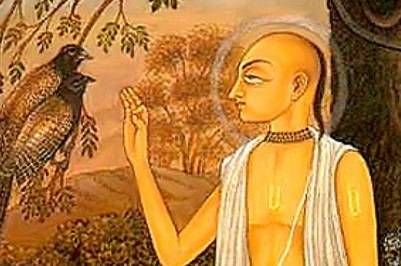
His recitation of the Bhagavatam became famous throughout Vrindavan. He would chant each verse in four distinct melodic tunes with a sweetness compared to the song of a cuckoo. The assembled Vaishnavas, including Sri Rupa Goswami and Sri Sanatana Goswami, regularly gathered to hear his recitations.
Traditional accounts describe his recitation as so spiritually elevated that even Srila Vyasadeva, the compiler of the Bhagavatam, would have delighted in hearing it.
Through this service, Raghunatha Bhatta Goswami fulfilled Mahaprabhu’s desire that the glories of the Srimad Bhagavatam be widely preached and appreciated.
Complete Absorption in Krishna-katha
One of the defining characteristics of Raghunatha Bhatta Goswami was his complete absorption in Krishna-katha, discussions centered on Lord Krishna and His devotees.
While reciting the Srimad Bhagavatam, tears of ecstatic love for Sri Sri Radha-Govinda would flow continuously, moistening the pages of the sacred text.
His mind remained entirely fixed on transcendental subjects. He neither spoke nor listened to ordinary worldly conversations. More significantly, he carefully avoided criticizing other devotees.
He maintained the conviction that every sincere Vaishnava serves the Lord according to his or her level of realization. Therefore, rather than seeking faults, one should appreciate the devotional sincerity of others.
This humble outlook continues to serve as an important lesson for practitioners seeking to cultivate harmonious devotional relationships.
Service to Sri Radha-Govindaji
Among the lasting contributions of Raghunatha Bhatta Goswami was his connection with the worship of Sri Sri Radha-Govindaji.
Inspired by his devotional character, one of his wealthy disciples constructed a magnificent temple for Radha-Govindaji in Vrindavan. Built from intricately carved red sandstone, this historic temple remains one of the finest examples of devotional architecture in northern India.
For approximately forty years, Raghunatha Bhatta Goswami personally rendered devoted service to Govindaji, demonstrating that Deity worship is not merely ritual but a loving exchange between the devotee and the Supreme Lord.
His service also illustrates the Vedic understanding that all resources—including wealth, craftsmanship, and artistic excellence—can be engaged in glorifying Krishna when offered with devotion.
A Master of Learning Through Hearing
Although Raghunatha Bhatta Goswami did not compose major theological works like several of the other Goswamis, he was recognized as a scholar thoroughly conversant with the Vedic scriptures.
His remarkable knowledge came primarily through attentive hearing from realized spiritual teachers.
This reflects the traditional Vedic method of acquiring spiritual wisdom through śravaṇam, or submissive hearing, one of the nine principal processes of devotional service described in the Srimad Bhagavatam.
His life demonstrates that scriptural realization is achieved not merely by intellectual study but through faithful hearing, reflection, and practical application.
The Character of a Pure Vaishnava
The conduct of Raghunatha Bhatta Goswami embodies several qualities repeatedly praised throughout the scriptures.
These include:
Constant Chanting
He remained continuously engaged in chanting the holy names of Krishna, making the maha-mantra the center of his daily life.
Respect for All Devotees
He refused to criticize others, choosing instead to recognize each devotee’s sincere effort in serving the Lord.
Attachment to Srimad Bhagavatam
His life revolved around hearing, reciting, and glorifying the Bhagavatam, which Gaudiya Vaishnavas regard as the mature fruit of Vedic literature.
Humble Service
Rather than seeking personal recognition, he dedicated himself to serving both the scriptures and the devotees with humility.
These qualities reveal that genuine spiritual advancement naturally manifests through simplicity, compassion, and constant remembrance of Krishna.
Final Pastimes and Samadhi
Toward the end of his earthly pastimes, Raghunatha Bhatta Goswami remained deeply absorbed in devotional service to Sri Radha-Govindaji.
Traditional accounts explain that after his departure, Sri Jiva Goswami arranged for his body to be cremated out of concern that invading forces might desecrate his sacred remains.
His ashes were respectfully placed in two samadhis—one at Radha-kunda and another within the historic area known as the Sixty-four Samadhis in Vrindavan.
Gaudiya Vaishnava tradition further describes his eternal spiritual identity as Rasa Manjari (also known in some traditions as Raga Manjari), one of the confidential maidservants assisting Srimati Radharani in Her eternal service to Sri Sri Radha-Govinda.
The Enduring Legacy of Raghunatha Bhatta Goswami
The influence of Raghunatha Bhatta Goswami continues through his example of scriptural devotion and devotional purity.
He demonstrated that the Srimad Bhagavatam is not simply a book to be studied academically but a living revelation to be heard with faith, spoken with devotion, and realized through sincere practice.
His life also reminds devotees that avoiding criticism, appreciating the service of others, and constantly hearing about Krishna are essential foundations for spiritual progress.
Conclusion
The life of Raghunatha Bhatta Goswami beautifully illustrates the transformative power of hearing and chanting the glories of the Supreme Lord. Through lifelong celibacy, unwavering dedication to the Srimad Bhagavatam, heartfelt kirtana, and humble service to Sri Radha-Govindaji, he embodied the essence of pure devotional service.
His example teaches that the eternal soul (atma) is nourished by hearing about Krishna and engaging in loving devotional service. By following his qualities of humility, scriptural absorption, and respect for all devotees, sincere seekers can steadily progress on the timeless path of bhakti and deepen their relationship with the Supreme Personality of Godhead.
Deepen your Bhakti-yoga practice, harmonize relationships, and receive guided coaching — all at Vedavarsity.com