Among the great saints of the Gaudiya Vaishnava tradition, Sanatana Goswami occupies a unique and revered position. As one of the celebrated Six Goswamis of Vrindavan, he combined profound scholarship with complete renunciation, demonstrating through his life how devotion to Lord Krishna transcends material prestige and worldly achievement. His writings, discoveries of Krishna’s holy places, and exemplary spiritual conduct continue to guide seekers on the path of bhakti.
The life of Sanatana Goswami illustrates a timeless Vedic principle: real success lies not in external position but in awakening one’s eternal relationship with the Supreme Lord. His extraordinary service fulfilled the mission personally entrusted to him by Sri Chaitanya Mahaprabhu.
Early Life of Sanatana Goswami
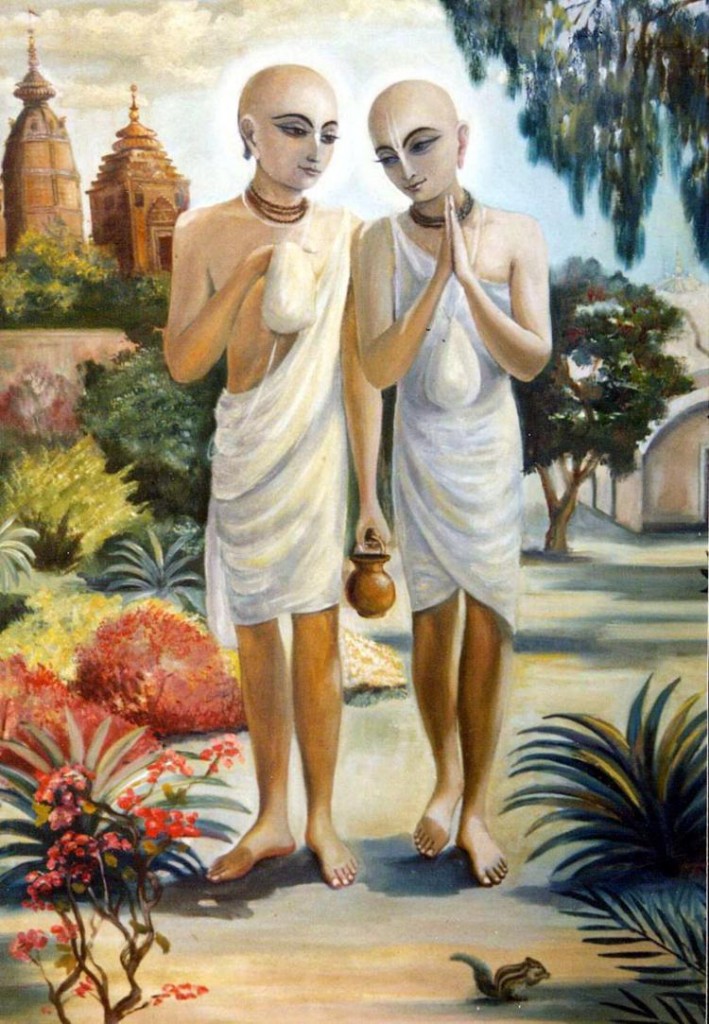
Sanatana Goswami appeared in 1488 in a Sarasvata brahmana family in Bengal, five years before the appearance of his younger brother, Sri Rupa Goswami. Together with their younger brother, Sri Anupama, they displayed deep devotion from childhood.
Their attraction to Vrindavan was evident even in their early years. While playing together, they named nearby forests after the twelve sacred forests of Vraja, including Talavana, Madhuvana, Kamyavana, and Mahavana. Likewise, their favorite ponds were affectionately called Radha-kunda and Shyama-kunda, revealing their natural absorption in Krishna’s eternal pastimes.
From an early age, Sanatana Goswami demonstrated that devotion arises from sincere spiritual cultivation rather than material circumstances.
A Divine Gift: Srimad Bhagavatam
One of the most cherished events in the life of Sanatana Goswami occurred during his youth. He dreamt that a beautiful brahmana boy presented him with a copy of Srimad Bhagavatam. Upon awakening, he was overwhelmed with longing when neither the boy nor the sacred scripture could be found.
The following morning, while performing worship, the same beautiful brahmana boy appeared before him and offered him the Bhagavatam, instructing him to study it constantly. Gaudiya Vaishnava tradition recognizes this mysterious visitor as Lord Krishna Himself.
Sanatana Goswami later expressed his deep attachment to the Bhagavatam in Krishna-lila-stava:
“O holy Bhagavata, you are my only company, my only friend, and my guru. You are my greatest treasure and my personal savior. You are the emblem of my highest fortune and the very form of ecstasy. I offer my obeisances unto you.”
This heartfelt prayer reflects the central place of Srimad Bhagavatam within Gaudiya theology as the spotless authority on pure devotional service.
Service Under the Bengal Government
Circumstances led Sanatana Goswami and Sri Rupa Goswami to accept high administrative positions under the Muslim government at Ramakeli. Although they outwardly served as ministers, their hearts remained fully devoted to Krishna.
Under the guidance of Vidyavachaspati, the brother of Sarvabhouma Bhattacharya, they mastered the Vedic scriptures. Their scholarship became renowned throughout India, attracting learned brahmanas and pandits who sought instruction from them. Their extraordinary learning earned them recognition as the crest jewels of Gaudiya Vaishnava scholarship.
Eventually, after receiving the mercy of Sri Chaitanya Mahaprabhu, both brothers renounced their wealth, influence, and prestigious positions to dedicate their lives exclusively to devotional service.
The Four Divine Missions Given by Sri Chaitanya Mahaprabhu
Sri Chaitanya Mahaprabhu instructed Sanatana Goswami and Sri Rupa Goswami to establish the theological and practical foundations of Gaudiya Vaishnavism. Their principal responsibilities included:
- Rediscovering the lost pastime places of Lord Krishna in Vrindavan.
- Establishing Deity worship and proper standards of temple worship.
- Composing authoritative scriptures explaining bhakti.
- Teaching and preserving the principles of devotional life for future generations.
These four services continue to shape the practice of Gaudiya Vaishnavism worldwide.
A Life of Extraordinary Renunciation
The renunciation of Sanatana Goswami was not motivated by rejection of the world but by complete absorption in service to Krishna.
He possessed no permanent residence and often rested beneath trees or bushes, sleeping for only about one and a half hours daily. The remainder of his time was devoted to writing, chanting the holy names, discussing Krishna’s pastimes, and serving the devotees.
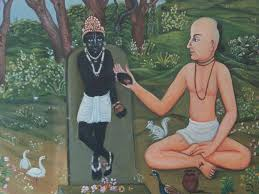
His daily food was remarkably simple. After begging for a small quantity of wheat flour, he mixed it with Yamuna water, shaped it into a small ball, baked it in hot ashes, and offered this unsalted preparation to his beloved Deity of Madana Mohana before honoring the prasadam.
His life demonstrated the Vedic understanding that genuine happiness comes not from accumulation but from wholehearted devotion to the Supreme Lord.
Sanatana Goswami and Sri Madana Mohana
Among the many lasting contributions of Sanatana Goswami was the establishment of the worship of Sri Sri Radha-Madana Mohana, the first of the major temples founded by the Six Goswamis in Vrindavan.
Within Gaudiya Vaishnava theology, Madana Mohana represents the Lord who establishes sambandha—our eternal relationship with Krishna. The name “Madana Mohana” means “He who attracts even Cupid,” indicating Krishna’s incomparable beauty and spiritual attractiveness.
Because Sanatana Goswami systematically explained the living entity’s eternal relationship with Krishna, he is honored as the Sambandha-acharya. Through his teachings, conditioned souls learn to redirect their attraction away from temporary material enjoyment toward loving devotional service.
Compassion for the People of Vraja
For approximately forty-three years, Sanatana Goswami traveled throughout Vraja, meeting the residents with genuine affection and concern.
The villagers respected him as a loving spiritual guardian. He patiently listened to their difficulties and offered practical guidance not only on spiritual matters but also on family harmony, agriculture, and everyday responsibilities. His life illustrated that authentic spirituality naturally expresses itself through compassion and practical service.
The Bhakti-ratnakara praises him as an ocean of mercy whose compassion extended to all suffering souls.
The Govardhana Shila Pastime
In his later years, Sanatana Goswami performed bhajana near Manasi Ganga at Govardhana after entrusting the worship of Madana Mohana to his disciple Krishna Dasa Brahmachari.
Despite advancing age, he continued his daily practice of circumambulating Govardhana Hill and offering 1,008 obeisances.
Seeing the physical difficulty experienced by His beloved devotee, Sri Madana Mohana appeared before him and requested that he discontinue the demanding pilgrimage. Sanatana Goswami respectfully declined, unwilling to abandon his devotional vow.
Out of divine compassion, Lord Krishna stood upon a Govardhana stone while playing His flute. The stone softened in ecstasy, receiving the impressions of His lotus feet. Krishna then instructed Sanatana Goswami that circumambulating this sacred Govardhana shila would carry the same spiritual benefit as walking around Govardhana Hill.
That sacred Govardhana shila remains worshiped today at the Radha-Damodara Temple, serving as a lasting testimony to the loving relationship between the Lord and His pure devotee.
Literary Contributions of Sanatana Goswami
The influence of Sanatana Goswami extends far beyond his exemplary personal life. His writings established essential philosophical foundations for the Gaudiya Vaishnava tradition.
Among his most influential works are:
Hari-bhakti-vilasa
A comprehensive guide to devotional practices, temple worship, Vaishnava conduct, and spiritual observances.
Brihad-Bhagavatamrita
A profound theological work exploring the progressive stages of devotion and the ultimate destination of pure love for Krishna.
Brihad-Vaishnava-Toshani
An authoritative commentary that enriches the understanding of Srimad Bhagavatam.
These works continue to inspire students, scholars, and practitioners of bhakti throughout the world.
The Eternal Identity of Sanatana Goswami
Gaudiya Vaishnava tradition describes Sanatana Goswami’s eternal spiritual identity as Labanga Manjari, a confidential servant assisting Srimati Vishakha Sakhi in the eternal pastimes of Sri Sri Radha and Krishna.
His samadhi is situated behind the historic Radha Madana Mohana Temple in Vrindavan, where pilgrims continue to honor his remarkable life and service.
Conclusion
The life of Sanatana Goswami demonstrates that genuine greatness is measured not by wealth, political influence, or intellectual achievement alone, but by unwavering devotion to the Supreme Lord and compassionate service to all living beings. His renunciation, scholarship, humility, and dedication established enduring foundations for Gaudiya Vaishnavism that continue to illuminate the path of bhakti today.
His example reminds us that every soul is eternal (atma), and lasting fulfillment arises when one’s knowledge, actions, and heart are harmonized in loving service to Krishna. Through his writings, teachings, and personal example, Sanatana Goswami continues to guide sincere seekers toward that timeless spiritual goal.
Deepen your Bhakti-yoga practice, harmonize relationships, and receive guided coaching — all at Vedavarsity.com