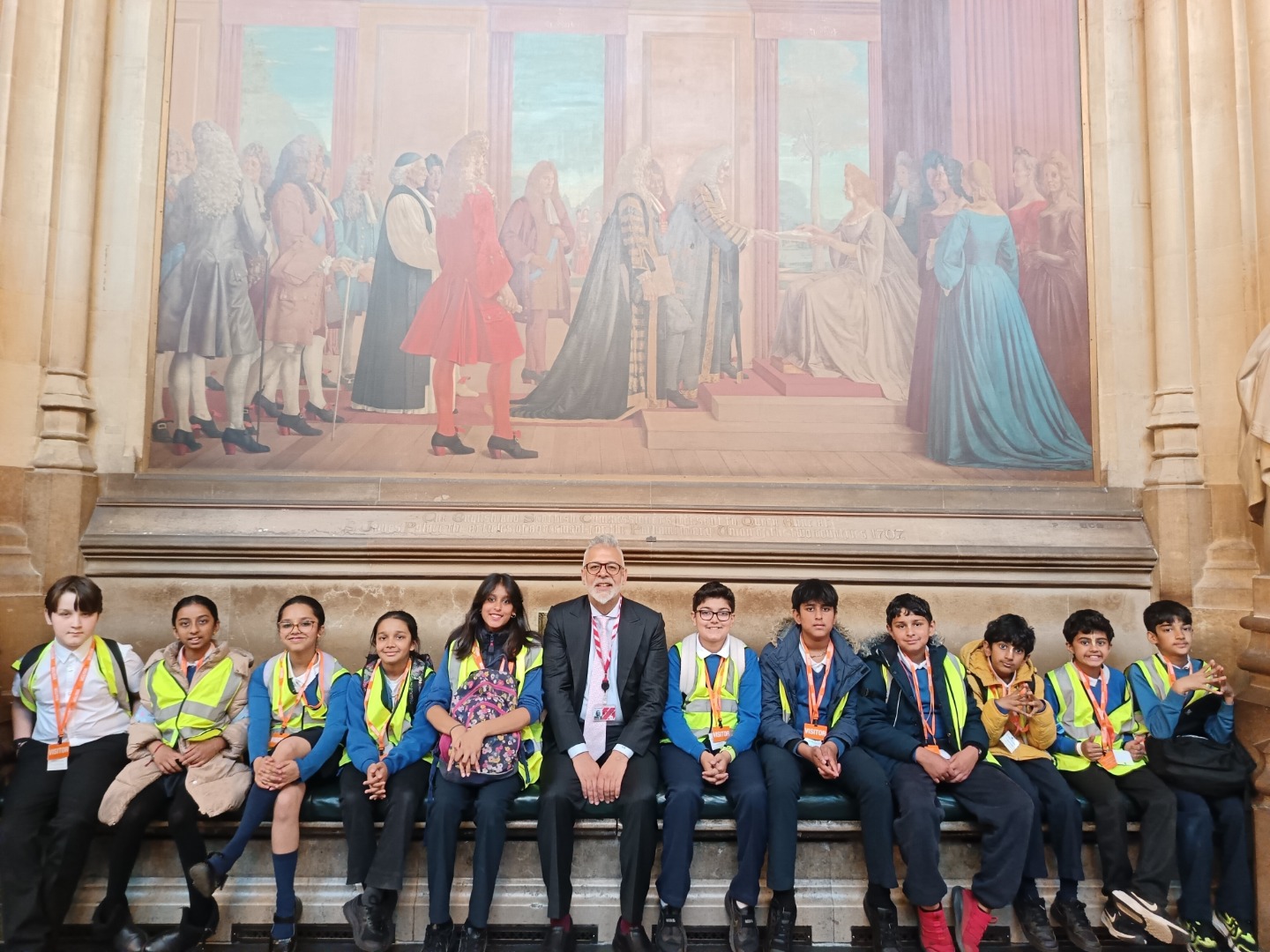
The event in which Lord Raval welcomes Gurukula students to Parliament marks a noteworthy moment in the ongoing engagement between spiritual education and public life. Students from Year 6 at Gurukula—The Hare Krishna Primary School—recently visited the UK Parliament at the invitation of Lord Raval of Hertsmere OBE, gaining firsthand insight into the workings of one of the world’s oldest democratic institutions.
The visit provided the students with an opportunity to learn about governance, civic responsibility, and leadership while meeting a distinguished member of the House of Lords whose personal journey reflects both public service and spiritual conviction.
Lord Raval’s Unique Place in Parliamentary History
Lord Raval holds a distinctive place in British parliamentary history. He is recognized as the first person to take the oath of allegiance in the House of Lords using Bhagavad-gita As It Is, the celebrated edition of the Bhagavad-gita presented by His Divine Grace A. C. Bhaktivedanta Swami Prabhupada.
For members of the Hare Krishna community and many students of Vedic wisdom, this act symbolized the harmonious coexistence of spiritual values and civic duty. In the Vedic tradition, genuine leadership is guided by dharma—the principle of righteous responsibility and ethical conduct.
Lord Raval’s invitation to Gurukula students reflected his continuing interest in encouraging young people to participate thoughtfully in society while remaining grounded in moral and spiritual principles.
Gurukula Students Explore the UK Parliament
During their visit, the students toured the historic parliamentary buildings and learned about the legislative process, public administration, and the responsibilities of elected representatives and members of the House of Lords.
The experience enabled the children to see how important decisions affecting society are discussed and implemented. Such educational visits help students appreciate the value of informed citizenship and constructive participation in public affairs.
Meeting Lord Raval and his parliamentary team added a personal dimension to the visit, allowing the students to ask questions and engage directly with individuals involved in national governance.
A Positive Impression on Parliamentary Staff
Following the visit, Lord Raval wrote to Gurukula headteacher Gunacuda Dasi, expressing his appreciation for the students and their conduct.
“The Gurukula children who visited me in Parliament, and their parents, should know they were a credit to their families, their school, and their faith,” he wrote.
He further noted the quality of the students’ questions and their enthusiasm during discussions.
According to Lord Raval, the children demonstrated maturity, curiosity, and confidence throughout the visit. Such qualities are often cultivated through a balanced education that emphasizes both academic learning and character development.
A Historic Chanting of the Mahamantra
One of the most memorable moments occurred when Lord Raval invited the students to chant in a parliamentary committee room.
Reflecting on the event, he described the experience as potentially historic.
“When I invited them to chant in committee, they answered readily, the Mahamantra rising in call and response—my team and I were enchanted,” he wrote.
Lord Raval further observed:
“Some of us have waited until our late forties to be heard in Parliament. Gurukula’s Year 6, at just 11, made history: the first children of that age, in a thousand years of parliamentary tradition, to chant the Mahamantra in an official committee room.”
The Mahamantra—the chanting of the holy names of God—is central to the spiritual practice of the International Society for Krishna Consciousness (ISKCON). In the Vedic tradition, sacred sound is understood to elevate consciousness and remind individuals of their eternal spiritual identity beyond temporary bodily designations.
While the parliamentary visit was primarily educational, this unique moment highlighted the growing presence of diverse spiritual traditions within modern public institutions.
Leadership, Aspiration, and the Future
Another memorable exchange occurred when Lord Raval asked the students how many would like to become Prime Minister in the future.
Several hands immediately went up.
Rather than viewing leadership merely as a position of authority, Lord Raval emphasized the qualities already visible in the children.
“Every one of them is a leader already—I watch their unlimited futures with immense anticipation,” he remarked.
This observation aligns with a broader understanding of leadership found in Vedic teachings. True leadership is measured not only by status or influence but by responsibility, integrity, and service to others.
Education that develops character alongside knowledge can help prepare young people to contribute meaningfully to society, regardless of the profession or role they eventually pursue.
The Role of Gurukula Education
Gurukula schools seek to provide students with academic excellence while nurturing virtues such as self-discipline, respect, compassion, and responsibility.
These values are increasingly recognized as essential for preparing future generations to navigate a rapidly changing world. By exposing students to both spiritual wisdom and practical civic engagement, educational experiences such as this parliamentary visit can broaden their understanding of their role within society.
From a Vedic perspective, every individual possesses unique abilities and responsibilities. When these are guided by dharma, they contribute positively to the welfare of both the individual and the broader community.
A Meaningful Meeting of Education and Public Service
The occasion in which Lord Raval welcomes Gurukula students to Parliament demonstrates how educational institutions and public leaders can work together to inspire the next generation.
The students gained valuable insight into democratic governance while sharing aspects of their own spiritual heritage. At the same time, parliamentary staff witnessed the enthusiasm, confidence, and thoughtful engagement of young students committed to learning and service.
Such interactions help foster mutual understanding and respect across different sectors of society.
Conclusion
The visit in which Lord Raval welcomes Gurukula students to Parliament will likely remain a memorable milestone for the students, their families, and their school. Through touring Parliament, meeting public officials, asking thoughtful questions, and participating in a unique moment of devotional chanting, the students experienced both civic education and cultural representation in a meaningful way.
The event also serves as a reminder that genuine leadership begins with character, responsibility, and a willingness to serve others. In the Vedic understanding, when education is connected with higher values and guided by dharma, it helps individuals develop not only successful careers but also purposeful lives. Such moments quietly reflect a deeper order in which knowledge, service, and spiritual awareness can work together for the benefit of society.
library.vedavarsity.com || www.vedavarsity.com
Deepen your Bhakti-yoga practice, harmonize relationships, and receive guided coaching — all at Vedavarsity.com