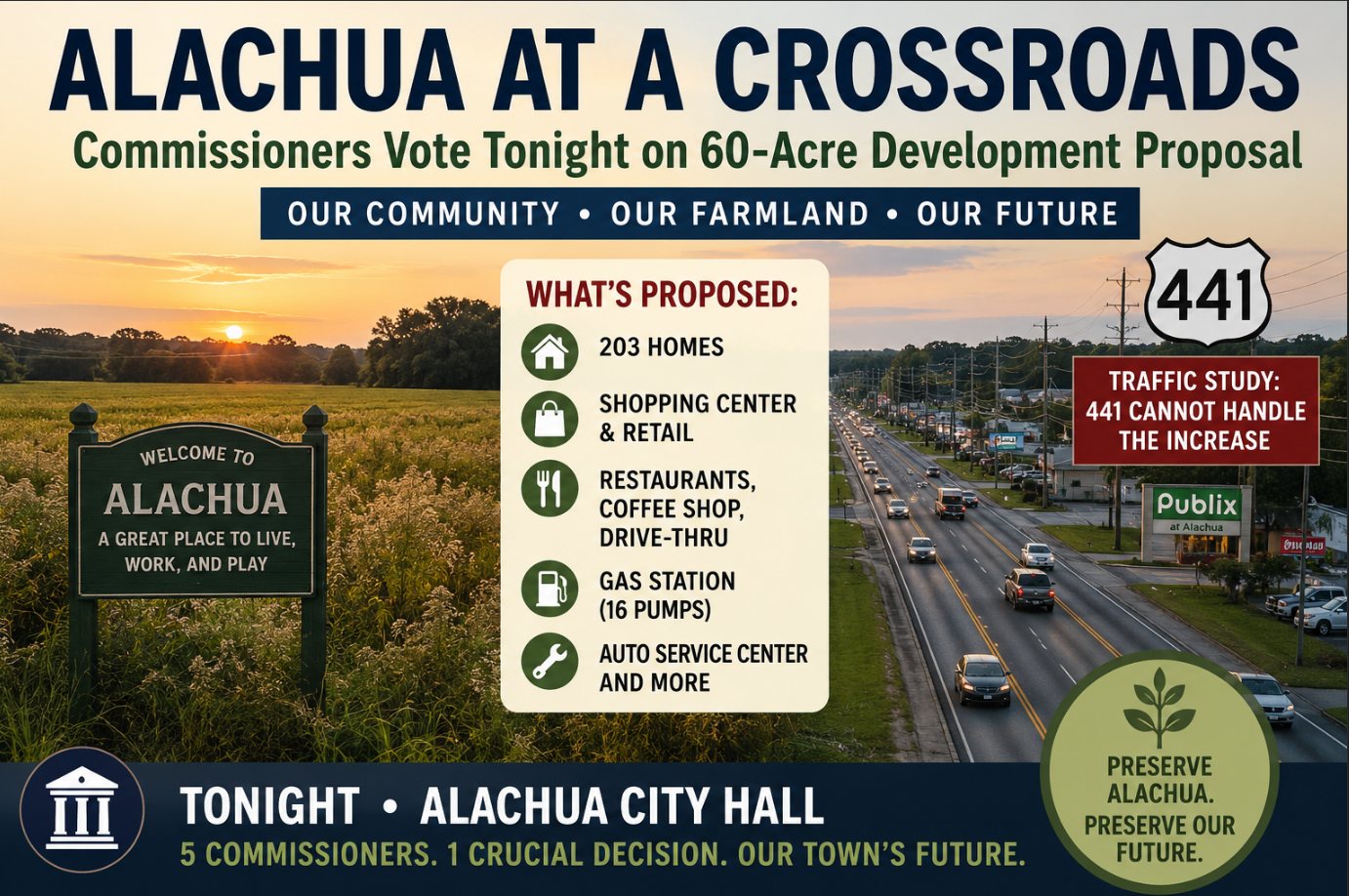
A proposed Alachua Farmland Development project has become the focus of significant public discussion as city commissioners prepare to vote on a plan that would transform approximately 60 acres of land along U.S. Highway 441 near Alachua, Florida.
The proposal has drawn strong reactions from local residents, including members of the nearby ISKCON community, who fear that the scale of the development could permanently alter the character of the area. Supporters view the project as an opportunity for growth, while opponents argue that the costs to infrastructure, traffic flow, and community identity may outweigh the benefits.
As commissioners gather for a decisive meeting at Alachua City Hall, many residents are expected to attend and present their views during public comment sessions.
What the Alachua Farmland Development Proposal Includes
According to information shared by local residents, the proposed development would convert approximately 60 acres of farmland into a large mixed-use commercial and residential project.
The concept reportedly includes:
- 203 residential homes
- A shopping center
- Future retail space
- Three sit-down restaurants
- Three fast-food restaurants
- A coffee shop with drive-through service
- A gas station with 16 fuel pumps
- An automotive service center
Some residents have also stated that a Walmart may be included in future plans, although this detail has not been officially confirmed within the information presented at the meeting announcement.
The proposed site is located along Highway 441, north of the local Publix shopping center.
Concerns About Traffic and Infrastructure
One of the primary concerns surrounding the Alachua Farmland Development proposal involves transportation infrastructure.
Residents opposing the project point to a traffic study indicating that Highway 441 may already face significant congestion during peak hours. Critics argue that introducing hundreds of new homes and multiple commercial businesses could substantially increase traffic volume and place additional pressure on local roads.
Many community members believe that existing traffic conditions, particularly during evening rush hours, are already challenging. They contend that further commercial expansion could create safety concerns and reduce the quality of life for current residents.
Questions regarding how future traffic impacts would be managed have become a central issue in the public debate.
Community Character at the Center of the Discussion
Beyond transportation concerns, many residents are focused on preserving the unique identity of Alachua.
For decades, the area has maintained a balance between residential neighborhoods, agricultural land, and local businesses. Opponents of the proposal fear that large-scale commercial development could gradually transform the city into a regional retail destination centered around highway traffic rather than local community needs.
Some residents have expressed support for a significantly smaller development footprint. According to comments shared before the meeting, an earlier proposal involving approximately seven acres was viewed by some as a more reasonable compromise compared to the current 60-acre plan.
The debate therefore extends beyond a single project and reflects broader questions about the future direction of the city.
The Importance of the Commissioners’ Vote
The decision ultimately rests with five city commissioners.
Residents following the issue closely believe that two commissioners are expected to oppose the proposal. If a third commissioner also votes against it, the project would not move forward in its current form.
As a result, considerable attention is focused on the upcoming vote.
Public meetings of this nature often serve as an important forum for civic participation. Local residents have the opportunity to address elected officials directly, typically within a limited speaking period, and share their perspectives regarding community planning and development.
The meeting is expected to attract substantial public attendance and extended discussion due to the significance of the proposal.
Stewardship, Responsibility, and Long-Term Vision
Questions concerning land use are not merely economic or political. They also involve stewardship and responsibility toward future generations.
Vedic wisdom teaches that human beings are caretakers rather than absolute proprietors of the resources entrusted to them. The principle of dharma—responsible duty—encourages thoughtful decision-making that considers long-term consequences rather than immediate gains alone.
Whether one supports or opposes the Alachua Farmland Development proposal, the broader discussion highlights the importance of balancing growth with sustainability, community well-being, and responsible planning.
In every action, there are consequences—a principle reflected in the Vedic understanding of karma, the law of action and reaction. Decisions regarding land, infrastructure, and community development often produce effects that extend far beyond the present moment.
Conclusion
The proposed Alachua Farmland Development project has emerged as a significant issue for residents, community leaders, and city officials. Concerns regarding traffic congestion, infrastructure capacity, and preservation of local character have motivated many citizens to participate actively in the public process.
As commissioners prepare to cast their votes, the outcome will help shape the future of Alachua and its surrounding communities. Regardless of the final decision, the discussion serves as a reminder that responsible development requires careful consideration of both present needs and future consequences.
Thoughtful planning, guided by wisdom and long-term vision, remains essential for communities seeking progress while preserving the qualities that make them unique.
library.vedavarsity.com || www.vedavarsity.com
Deepen your Bhakti-yoga practice, harmonize relationships, and receive guided coaching — all at Vedavarsity.com