



The Bhakti Yoga Conference 2026 concluded after drawing more than 7,000 online participants from across the world for a month-long exploration of devotion, sacred relationships, and spiritual life in community. Centered on the theme, “Sacred Community: Walking the Path of Love Together,” the conference brought together monks, scholars, musicians, teachers, and spiritual practitioners to discuss the living practice of bhakti in contemporary society.
The free international gathering opened with a live event at Harvard Divinity School and concluded at the Oxford Centre for Hindu Studies (OCHS), creating a meaningful connection between academic inquiry and lived spiritual practice. The event reflected the growing global interest in bhakti-yoga as a practical and community-centered spiritual path rooted in timeless Vedic wisdom.
In an age marked by isolation and social fragmentation, the conference emphasized the importance of spiritual association, known in Sanskrit as sādhu-saṅga—the uplifting company of spiritually minded persons. Vedic teachings consistently affirm that human life reaches fulfillment through conscious relationships centered on higher purpose and service.
Bhakti Yoga Conference 2026 Connected Scholarship and Devotion
The opening and closing events of the Bhakti Yoga Conference 2026 symbolized a thoughtful dialogue between scholarship and spiritual realization.
Conference founder Rasananda Das explained that beginning at Harvard Divinity School and concluding at the Oxford Centre for Hindu Studies created “a meaningful arc for the conference — bringing scholarship and lived devotion into dialogue.”
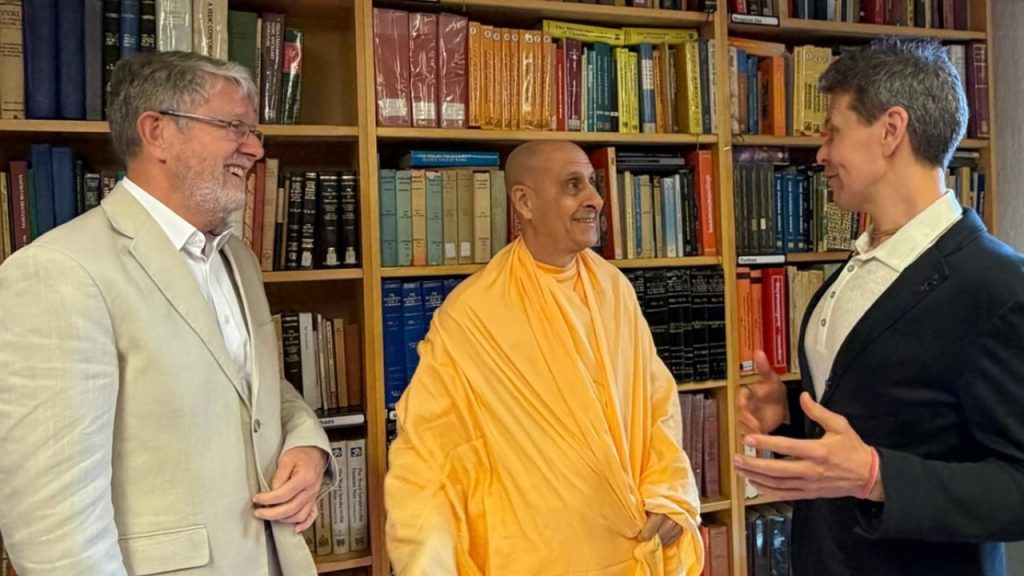
The Oxford Centre for Hindu Studies has long served as a respected institution for the academic study of Hindu traditions, while simultaneously maintaining appreciation for authentic spiritual practice. The closing session featured notable devotional leaders and scholars, including Shaunaka Rishi Das, Director of OCHS, alongside Radhanath Swami and Rasananda Das.
The conference demonstrated that bhakti is not merely a theoretical philosophy but a practical process meant to transform character, consciousness, and relationships. In Vedic understanding, knowledge achieves perfection when it leads to service, humility, and genuine spiritual realization.
Sacred Community as a Central Theme
Bhakti as a Relationship-Centered Path
A central focus of the conference was the idea of sacred community. Speakers repeatedly emphasized that spiritual life flourishes through meaningful association, mutual encouragement, and shared spiritual practices.
Unlike highly individualistic approaches to spirituality, bhakti-yoga teaches that spiritual advancement naturally develops in relationship with others. The Sanskrit term bhakti refers to loving devotional service directed toward the Supreme Lord and expressed through compassion, service, and cooperation among living beings.
Throughout the conference, discussions explored themes such as:
- Devotional service
- Spiritual mentorship
- Sacred friendship
- Community-based spiritual practice
- The role of compassion in devotional life
- The importance of humility and cooperation
Presenters highlighted that spiritual communities function best when centered on service rather than personal ambition. This principle reflects the Vedic understanding of dharma, or rightful duty, where harmony emerges when individuals act in alignment with higher spiritual purpose.
Spiritual Practice in Modern Society
Several sessions addressed the practical challenges of maintaining spiritual focus in contemporary life. Participants discussed how bhakti practices such as mantra meditation, kirtan, scriptural study, and devotional service can help individuals cultivate steadiness amidst social uncertainty and mental distraction.
Modern society often encourages identity based solely on bodily designations such as nationality, profession, or social status. However, bhakti philosophy teaches that the living being is fundamentally ātma—an eternal spiritual self distinct from the temporary body.
This understanding naturally supports unity and compassion because all beings are seen as spiritually connected. The conference repeatedly returned to this foundational principle while encouraging practical applications in family life, education, leadership, and community development.
International Participation Reflects Growing Interest in Bhakti
The attendance of more than 7,000 online participants demonstrated the expanding global interest in devotional spirituality and Vedic teachings. The virtual format allowed individuals from diverse cultural and geographic backgrounds to engage in discussions, presentations, and devotional programs.
The accessibility of the conference also reflected an important aspect of bhakti tradition: spiritual knowledge is meant to be shared widely for the benefit of all humanity. In the Bhagavad-gītā, spiritual wisdom is described as the highest form of education because it addresses the eternal nature of the self and the ultimate purpose of life.
Participants included experienced practitioners as well as newcomers exploring bhakti for the first time. The inclusive atmosphere encouraged thoughtful dialogue while maintaining philosophical seriousness and spiritual authenticity.
The conference also demonstrated how digital platforms can be used constructively for spiritual education and global cooperation when guided by higher values and purposeful communication.
Replay Sessions Made Freely Available
Conference organizers announced that all presentations and replay sessions from the Bhakti Yoga Conference 2026 are now available online free of charge.
This decision reflects the traditional Vedic principle that spiritual knowledge should not be restricted to a privileged few. Historically, saintly teachers and ācāryas traveled widely to distribute wisdom for the upliftment of society without selfish motivation.
By making the sessions freely accessible, the organizers have extended the conference’s educational and spiritual impact beyond the live event itself. Individuals interested in devotional philosophy, meditation, sacred music, and community-based spirituality can continue benefiting from the discussions and presentations.
The availability of these resources may also help preserve thoughtful and balanced conversations about spiritual life in a rapidly changing world increasingly shaped by distraction, anxiety, and superficial engagement.
Theme Announced for Bhakti Yoga Conference 2027
During the closing program at Oxford, organizers officially announced the theme for the 2027 conference: “The Essential Role of Women in Sacred Community.”
The upcoming theme signals an important continuation of discussions concerning spiritual leadership, service, and the contributions of women within devotional traditions and communities.
Rasananda Das expressed enthusiasm for the future gathering, stating, “We are deeply excited for this important and timely conversation and look forward to gathering again next year to continue walking this path together.”
The theme also reflects an enduring Vedic principle that spiritual qualification is based not on bodily designation but on sincerity, character, wisdom, and devotion. Throughout history, many exalted women have played significant roles in preserving and transmitting spiritual culture.
Conclusion
The Bhakti Yoga Conference 2026 served as a significant international gathering dedicated to spiritual dialogue, devotional practice, and sacred community. By bringing together scholars, monks, musicians, and practitioners from around the world, the conference highlighted the continuing relevance of bhakti-yoga in modern life.
Its emphasis on humility, service, meaningful relationships, and spiritual identity offered a thoughtful alternative to the growing loneliness and fragmentation of contemporary society. The conference also demonstrated how timeless Vedic wisdom can be presented in a practical and accessible manner without losing philosophical depth.
Ultimately, the event reminded participants that genuine spiritual advancement does not occur in isolation but through sincere association, shared practice, and a collective effort toward higher consciousness and divine understanding.
library.vedavarsity.com || www.vedavarsity.com
Deepen your Bhakti-yoga practice, harmonize relationships, and receive guided coaching — all at Vedavarsity.com