


From divine origin to modern classrooms—understanding the continuity of authentic Ayurvedic knowledge
The concept of Ayurveda Lineage refers to the transmission of sacred knowledge through an unbroken chain of teachers and students. According to traditional understanding, lineage is not merely historical succession but a living continuity of wisdom, preserved through discipline, realization, and service.
The term “lineage,” as defined by the Merriam-Webster dictionary, refers to descent from a common origin. In the Vedic context, this meaning deepens significantly. Knowledge is not considered a human invention but a divine revelation passed down through qualified teachers.
The Ayurveda Lineage is one such example, where ancient healing knowledge continues to guide individuals even in the modern world.
The Divine Origin of Ayurveda Lineage
Vedic literature describes the origin of Ayurveda as descending from higher sources. This knowledge was first realized by Brahma, the creator, and then passed to Prajapati. From there, it was transmitted to the Ashwini Kumaras, the celestial physicians, and later to Indra.
Indra then entrusted this wisdom to sages such as Kashyapa, Dhanvantari, and Bharadwaja.
While these accounts are presented in a traditional framework, their deeper significance lies in the principle of paramparā—the disciplic succession. Knowledge is preserved not merely through texts but through realized teachers who embody and transmit it.
This reflects a key Vedic understanding: true knowledge is received through humility, discipline, and service, not merely intellectual study.
Understanding the Guru-Disciple Tradition
The Ayurveda Lineage is sustained through the guru-disciple relationship. In this system, knowledge is not fragmented or diluted but preserved in its original intent.
A guru does not simply inform but transforms. The student, in turn, approaches with sincerity and dedication. This relationship ensures that knowledge remains practical, experiential, and spiritually grounded.
In Vedic philosophy, this aligns with dharma—performing one’s duty with integrity. The teacher’s duty is to preserve and transmit truth, while the student’s duty is to receive and apply it responsibly.
The Journey of Vasant Lad in Ayurveda Lineage
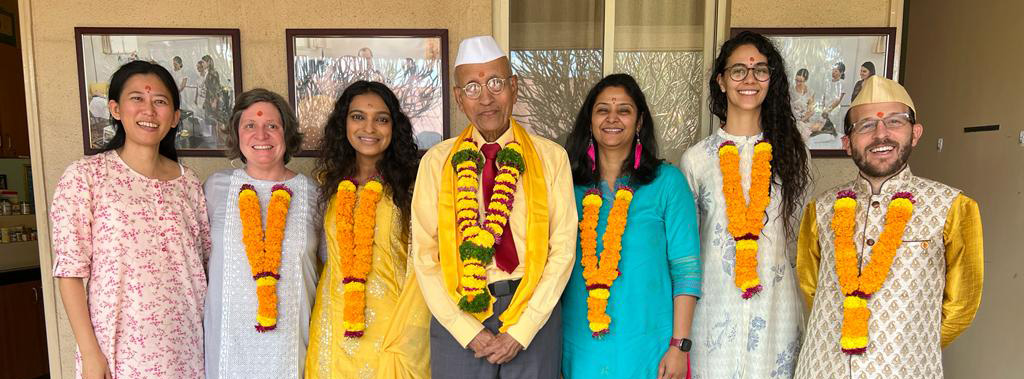
A modern example of the Ayurveda Lineage is seen in the life of Vasant Lad. Born in Pune, India, he was introduced to Ayurveda at a young age. His early exposure came through a guru whose words would shape his destiny.
At the age of ten, he received a prediction from his teacher that he would become a great student and teacher of Ayurveda, travel abroad, and share this knowledge widely. This guidance reflects the traditional role of the guru—not merely to instruct, but to foresee and direct the student’s path.
Academic and Professional Formation
Vasant Lad later completed his Bachelor of Ayurvedic Medicine and Surgery from the University of Pune in 1968, followed by a Master’s degree from Tilak Ayurved Mahavidyalaya in 1980.
He served as director of an Ayurvedic hospital in Pune and taught clinical medicine for over fifteen years. These roles demonstrate the integration of traditional knowledge with practical application.
Expansion of Ayurveda Lineage in the West
In the 1980s, Vasant Lad carried the Ayurveda Lineage to the United States. In 1984, he established the The Ayurvedic Institute in Albuquerque.
This marked a significant step in making Ayurveda accessible globally. What was once restricted to select groups became available to sincere learners across cultures.
Despite cultural differences, the essence of the lineage was preserved. This demonstrates that authentic knowledge can adapt externally while remaining unchanged in principle.
Ayurveda Lineage in the Vedic Classroom
One of the distinctive features of the Ayurveda Lineage at the institute is the concept of a “Vedic Classroom.”
Technology-Free Learning Environment
Students are encouraged to set aside modern distractions such as phones and digital devices. This creates an atmosphere of focus and receptivity.
Silence, mindfulness, and gentle meditation are practiced before lectures. Such an environment aligns the mind and senses, allowing deeper absorption of knowledge.
The Concept of the “Speaker”
Vasant Lad often refers to a “Speaker,” representing the divine source of knowledge. This idea helps students understand that true wisdom flows through a higher intelligence.
The presence of this “Speaker” depends on the collective consciousness of the classroom. A peaceful and sattvic (pure) atmosphere allows deeper insights to manifest.
This reflects a fundamental Vedic principle: knowledge reveals itself when the mind is purified.
Oral Tradition and Sacred Practices
Another essential element of the Ayurveda Lineage is the preservation of Sanskrit prayers. Students learn specific chants dedicated to deities such as Ganesha, Saraswati, and Ganga.
These prayers are transmitted orally and are not widely available in written form. This method ensures authenticity and maintains a direct connection with the lineage.
Although initially challenging, these chants become deeply ingrained in the student’s consciousness. This demonstrates the power of disciplined repetition and sincere engagement.
Why Preserving Ayurveda Lineage Matters
The preservation of Ayurveda Lineage is essential for maintaining the integrity of this ancient science. Without lineage, knowledge risks becoming fragmented or misinterpreted.
Lineage ensures:
- Authentic transmission of principles
- Consistency in practice
- Alignment with original intent
- Integration of spiritual and practical knowledge
In earlier times, Ayurveda was restricted to select individuals. Today, through teachers like Vasant Lad, it is accessible to a global audience.
This accessibility carries responsibility. Students must approach the knowledge with respect and sincerity to preserve its value.
Conclusion: Ayurveda Lineage as a Living Tradition
The Ayurveda Lineage represents more than historical continuity—it is a living tradition that connects divine knowledge with human application. From its origins in higher consciousness to its modern expression in global institutions, it continues to guide those seeking balance and well-being.
Through the guru-disciple relationship, disciplined practice, and preservation of tradition, this lineage remains relevant and effective.
A deeper reflection reveals that when knowledge is received with humility and applied with sincerity, it becomes not only a means of healing but a path toward higher understanding.
In this way, the Ayurveda Lineage continues to serve humanity, bridging ancient wisdom with contemporary life while remaining rooted in timeless truth.
Deepen your Bhakti-yoga practice, harmonize relationships, and receive guided coaching — all at Vedavarsity.com