



A shift toward personal expression and experiential spirituality within modern bhakti communities
Emerging devotional music in urban bhakti spaces reflects a notable transformation in how younger practitioners engage with spiritual life. Rooted in traditional practices of bhakti-yoga, yet expressed through contemporary artistic forms, this movement highlights a synthesis of discipline and creativity. Independent artists are not merely performing; they are offering their inner journey as a form of sādhana (spiritual practice), thus redefining devotional outreach in modern contexts.
The Rise of Emerging Devotional Music in Urban Bhakti Spaces
In recent years, urban centers have become fertile ground for new expressions of devotion. Emerging devotional music in urban bhakti spaces is characterized by simplicity, authenticity, and personal realization rather than formal presentation. This shift aligns with a broader inclination toward experiential spirituality, where individuals seek direct connection rather than institutional mediation.
One such example is VisnuMaya, a New York-based practitioner whose work demonstrates how traditional elements—such as mantra and kīrtan—can be harmonized with modern musical sensibilities. Her live EP Puspāñjali presents an acoustic, intimate form of Krishna-conscious songwriting that prioritizes sincerity over technical perfection.
Institutional Anchors and Cultural Context
Despite its independent nature, this musical evolution does not arise in isolation. It remains connected to established spiritual institutions such as ISKCON (International Society for Krishna Consciousness). The Bhakti Center in New York serves as a cultural and spiritual hub, hosting kīrtan gatherings, philosophical discussions, and artistic events.
Such environments provide both guidance and freedom—guidance through paramparā (disciplic succession), and freedom for individual expression. This balance reflects the Vedic understanding of dharma: one acts within a structured framework while offering one’s unique nature in service.
VisnuMaya’s introduction to bhakti began during a visit to Govardhan EcoVillage in 2023, followed by deeper engagement in New York. Her journey illustrates how spiritual awakening often begins with inquiry and matures through association (sādhu-saṅga).
A Generational Shift Toward Authentic Expression
A defining feature of emerging devotional music in urban bhakti spaces is its emphasis on authenticity. Artists are not presenting themselves as perfected beings but as sincere practitioners navigating the path.
VisnuMaya describes her style as “devotional Indie,” combining Sanskrit mantra with personal lyricism and minimal instrumentation. This reflects an important philosophical principle: bhakti is not dependent on external complexity but on internal sincerity (bhāva).
Rather than treating music as a final product, she views it as part of an ongoing process of self-realization. This approach resonates with the understanding of karma-yoga—action performed not for egoistic result but as an offering to the Supreme.
The Intimacy of Puspāñjali: Participation Over Performance
The Puspāñjali recording exemplifies the shift from performance to participation. Conducted in a small gathering of approximately 40 individuals, the event emphasized collective experience over audience-performer distinction.
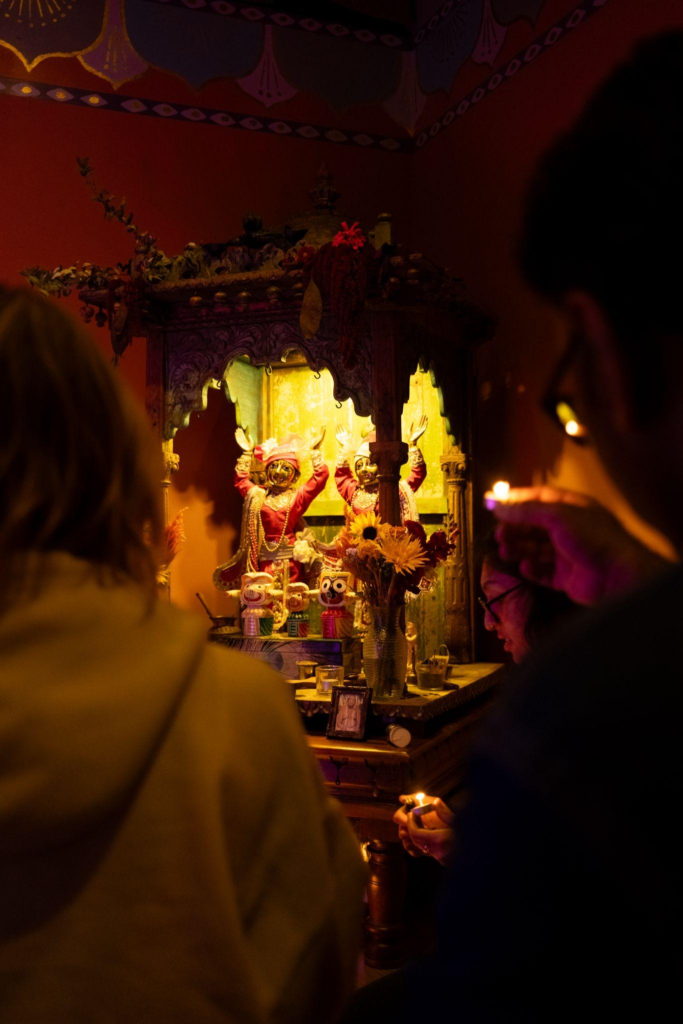
The setting—floor seating, soft lighting, minimal amplification—created an atmosphere conducive to attentiveness and reflection. Participants engaged in traditional practices such as lamp offerings during the Kārtika period, even if unfamiliar with the rituals.
This inclusivity demonstrates an essential principle of bhakti: accessibility. Devotional service is not restricted by background or qualification but is open to all who approach with sincerity.
Importantly, the recording preserves imperfections—moments of nervousness and vocal strain—which enhance its authenticity. In Vedic understanding, the value of an offering lies not in external polish but in the consciousness behind it.
Spontaneity and the Role of Sādhana
A notable aspect of the EP is its spontaneous opening invocation, which originated as a simple microphone check. This unplanned moment became an offering, illustrating how devotion transforms ordinary actions into spiritual acts when performed with proper intention.
Daily chanting (japa) forms the foundation of VisnuMaya’s creative process. This integration of sādhana and art reflects the principle that spiritual life is not separate from daily activity but permeates it.
Such integration aligns with the Bhagavad-gītā’s teaching that all actions can be spiritualized when offered to the Supreme (īśvara). Thus, music becomes not merely expression but transformation.
From Personal Struggle to Devotional Identity
Her earlier release, Basejump (2025), provides insight into the inner dimension of this journey. The composition explores vulnerability and surrender, themes central to bhakti philosophy.
Moments of uncertainty often compel the individual to seek higher shelter. In Vedic terms, this is the transition from false ego (ahaṅkāra) to genuine dependence on divine will. The metaphor of standing at the edge and “jumping” reflects surrender (śaraṇāgati), a cornerstone of devotional life.
Through such works, the artist establishes a unified identity where creative expression and spiritual aspiration are no longer separate pursuits.
Art as Outreach: A Decentralized Approach
Emerging devotional music in urban bhakti spaces also functions as a subtle yet effective form of outreach. Unlike formal preaching, which may appear structured or didactic, artistic expression invites participation through shared human experience.
VisnuMaya observes that when music is created as a genuine offering, it naturally attracts others. This reflects a deeper truth: authenticity carries intrinsic potency. Just as a lamp illuminates without effort, sincere devotion influences others without force.
This decentralized model aligns with contemporary cultural dynamics while remaining rooted in timeless principles.
Collaboration and Community Support
Although the expression is personal, it is sustained by community. Fellow practitioners, musicians, and organizers contribute to production, logistics, and spiritual encouragement.
This cooperative spirit reflects the principle of saṅkīrtana—collective glorification—which lies at the heart of the bhakti movement. Individual offerings gain strength when supported by a community aligned in purpose.
The clarity of the Puspāñjali recording, despite its simplicity, demonstrates how collaborative effort can enhance the effectiveness of devotional expression.
Future Directions: Expanding Sacred Spaces
Looking ahead, plans to develop Puspāñjali into a recurring concert series indicate a structured evolution of this movement. Such gatherings may serve as platforms where artists can offer spiritually inspired work in an environment of mutual respect and attentiveness.
Simultaneously, continued development of production skills suggests a maturation of the medium itself. As artists refine their craft, the reach and impact of devotional music may expand without compromising its essence.
This expansion reflects a broader principle: when rooted in dharma, growth does not dilute authenticity but extends its influence.
Conclusion: Devotion in a Contemporary Form
Emerging devotional music in urban bhakti spaces represents not a departure from tradition but its natural adaptation. By integrating personal experience with established spiritual practices, contemporary practitioners are demonstrating that bhakti is both timeless and dynamic.
Such expressions remind us that the essence of spiritual life lies not in external form but in internal consciousness. Whether through formal ritual or simple song, the ultimate aim remains the same—to reconnect the self (ātma) with the Supreme source.
In this way, even within the complexity of urban life, sincere offerings of sound and intention can become a path toward higher realization, subtly guiding both performer and listener toward divine harmony.
Deepen your Bhakti-yoga practice, harmonize relationships, and receive guided coaching — all at Vedavarsity.com