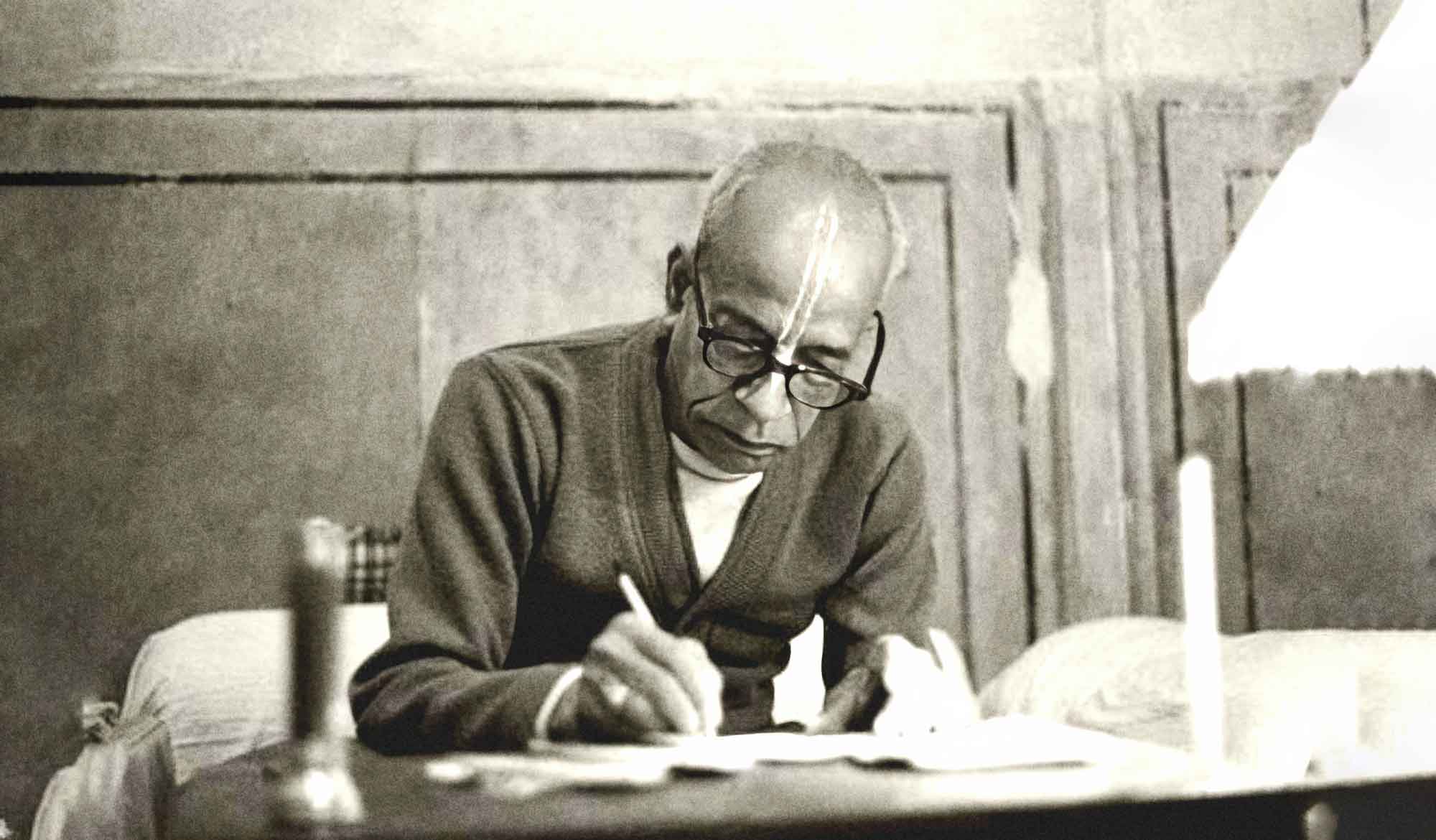
The Letter to Navbharat Times written in 1958 by Śrī Abhaya Caraṇāravinda Bhaktivedānta Swami reveals the uncompromising theological clarity of the Gauḍīya Vaiṣṇava tradition. In this historic correspondence, the ācārya firmly corrects philosophical errors published regarding Śrī Kṛṣṇa Janmāṣṭamī. The central issue addressed in the Letter to Navbharat Times is the mistaken claim that Śrī Kṛṣṇa was a “human incarnation.”
From the standpoint of Śrīmad-Bhāgavatam and Bhagavad-gītā, such a statement is not merely inaccurate—it is philosophically offensive.
Historical Context of the Letter to Navbharat Times
Dated September 2nd, 1958, from Bombay, this Letter to Navbharat Times was addressed to the editor of the prominent newspaper. The article published on September 1st had described Lord Kṛṣṇa as an incarnation appearing from the womb of Devakī in a human manner.
Śrīla Bhaktivedānta Swami objected strongly to this characterization.
In the Bhāgavata tradition, Bhagavān is never subject to material limitations. To equate Him with conditioned souls is a serious misunderstanding of tattva (philosophical truth).
Why Calling Kṛṣṇa a Human Is Philosophically Incorrect
The Verdict of Bhagavad-gītā
In Bhagavad-gītā (9.11), Lord Kṛṣṇa declares:
avajānanti māṁ mūḍhā mānuṣīṁ tanum āśritam
“Fools deride Me when I descend in human form.”
This verse directly refutes the misconception addressed in the Letter to Navbharat Times. Kṛṣṇa appears like a human being, but He is not a human being. His form is divya (transcendental), not prakṛta (material).
Kṛṣṇas Tu Bhagavān Svayam
The conclusive statement of Śrīmad-Bhāgavatam (1.3.28) declares:
kṛṣṇas tu bhagavān svayam
“Kṛṣṇa is the Supreme Personality of Godhead Himself.”
The Letter to Navbharat Times emphasizes this ontological truth: Śrī Kṛṣṇa is not an avatāra (incarnation) of someone else; rather, He is the avatārī, the source of all incarnations.
Rāma, Nṛsiṁha, Varāha, and even Nārāyaṇa are His expansions (viṣṇu-tattva-vilāsa). Although there is no essential difference in divinity, the original Personality is Śyāmasundara, the two-armed flute player.
The Doctrine of Sac-Cid-Ānanda Vigraha
In the Letter to Navbharat Times, the author cites a foundational verse from Brahma-saṁhitā (5.1):
īśvaraḥ paramaḥ kṛṣṇaḥ sac-cid-ānanda-vigrahaḥ
anādir ādir govindaḥ sarva-kāraṇa-kāraṇam
This verse establishes four essential theological principles:
- Īśvaraḥ paramaḥ – Kṛṣṇa is the Supreme Controller.
- Sac-cid-ānanda-vigrahaḥ – His form is eternal (sat), full of knowledge (cit), and full of bliss (ānanda).
- Anādir ādiḥ – He is beginningless yet the origin of all.
- Sarva-kāraṇa-kāraṇam – He is the cause of all causes.
Unlike conditioned souls, there is no difference between Kṛṣṇa and His body. This is called advaya-jñāna-tattva—nondual spiritual reality.
The Error of “Human Incarnation”
Material Birth vs Divine Appearance
The newspaper article implied that Kṛṣṇa was born like an ordinary human being from Devakī’s womb. However, the Letter to Navbharat Times clarifies a crucial distinction:
- Conditioned souls take birth due to karma.
- Bhagavān appears by His own internal potency (cit-śakti).
His appearance is termed janma, but it is transcendental. As stated in Bhagavad-gītā (4.9):
janma karma ca me divyam
“My birth and activities are divine.”
Thus, divine descent (avatāraṇa) cannot be equated with material birth.
The Misuse of the Word “Jayantī”
The Letter to Navbharat Times also objects to the modern trend of celebrating the birthdays of ordinary men as “jayantī.”
The term jayantī properly applies to the appearance day of Bhagavān. To equate human birthdays with Janmāṣṭamī is to blur the ontological distinction between jīva-tattva (individual soul) and viṣṇu-tattva (Supreme Lord).
Liberation (mokṣa) is attained by understanding Kṛṣṇa’s transcendental appearance—not by celebrating mundane births.
Ontological Hierarchy in Vaiṣṇava Theology
Viṣṇu-Tattva vs Demigods
Another error addressed in the Letter to Navbharat Times is the idea that forms such as Rāma and Nārāyaṇa are equivalent to exalted demigods.
In Vaiṣṇava siddhānta:
- Viṣṇu-tattva – Fully divine expansions of Bhagavān.
- Jīva-tattva – Atomic living entities.
- Devatās – Empowered administrators within material creation.
To reduce Viṣṇu-tattva to the level of demigods is theological confusion.
Kṛṣṇa as Ādi-Puruṣa
Śrī Kṛṣṇa is described as the ādi-puruṣa—the original person. His two-armed form playing the flute in Vṛndāvana is not a secondary manifestation; it is the highest revelation of the Absolute Truth.
The Letter to Navbharat Times thus protects the unique position of Śyāmasundara:
- The four-armed Nārāyaṇa is a vilāsa-vigraha.
- Kṛṣṇa is the svayaṁ-rūpa.
- All incarnations emanate from Him.
This is the Gauḍīya Vaiṣṇava conclusion (siddhānta).
The Importance of Philosophical Precision
Avoiding Māyāvāda Tendencies
To consider Bhagavān an ordinary human reflects subtle impersonalism. Such thinking minimizes the Lord’s transcendence.
The Letter to Navbharat Times exemplifies how an ācārya safeguards scriptural conclusions from dilution. Without philosophical rigor, devotional sentiment becomes sentimentality.
Bhakti must stand upon śāstra-pramāṇa (scriptural authority).
Relevance for Modern Readers
Although written in 1958, the Letter to Navbharat Times remains profoundly relevant.
Today, many portray Kṛṣṇa as:
- A historical reformer
- A mythological hero
- A symbolic archetype
But the Bhāgavata conclusion is clear: He is Bhagavān Himself.
Understanding this transforms Janmāṣṭamī from cultural festival to spiritual revelation.
Conclusion: The Enduring Significance of the Letter to Navbharat Times
The Letter to Navbharat Times stands as a theological declaration rooted in śāstra and paramparā. It firmly establishes that Śrī Kṛṣṇa is not a human incarnation but Svayaṁ Bhagavān, the Supreme Personality of Godhead.
To know Him as He is—sac-cid-ānanda-vigraha—is liberation.
To reduce Him to humanity is ignorance.
Therefore, this historic Letter to Navbharat Times serves not merely as a correction to a newspaper article, but as a timeless defense of Vaiṣṇava siddhānta. By studying its message carefully, one aligns with the conclusions of Śrīmad-Bhāgavatam and the teachings of the great ācāryas.
May such clarity guide all sincere seekers toward the lotus feet of Govinda, the cause of all causes.
Deepen your Bhakti-yoga practice, harmonize relationships, and receive guided coaching — all at Vedavarsity.com