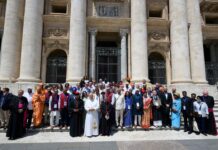
The Solemn Inauguration of the ISKCON Constitution
On 4 February 2026, during its Annual General Meeting convened in Śrīdhāma Māyāpur, the Governing Body Commission (GBC) formally inaugurated the ISKCON Constitution. This historic occasion marked a significant milestone in the institutional life of the International Society for Krishna Consciousness. On behalf of the GBC, its Chairman, Śrī Govardhana Dāsa, ceremonially offered a copy of the Constitution to His Divine Grace A. C. Bhaktivedanta Swami Prabhupāda, the Founder-Ācārya of ISKCON, thereby affirming that the Society’s governance rests eternally at the lotus feet of its founder.
Origins and Historical Development of the ISKCON Constitution
In October 2006, the Governing Body Commission convened a special strategic meeting in Prabhupādadeśa, Italy, to deliberate upon initiatives vital to the long-term spiritual health, unity, and vitality of ISKCON. At that time, the GBC confronted a sobering reality: the gradual physical departure of Śrīla Prabhupāda’s direct disciples and the understanding that, in the coming decades, none of them would remain personally present.
Among the foremost priorities identified at that meeting was the establishment of a formal ISKCON Constitution. Such a document was envisioned as an essential instrument for providing the Society with a unified and enduring framework of governance—one that would clearly delineate rights, responsibilities, authority, and foundational principles. The Constitution was intended to foster unity, preserve institutional integrity, align governance with śāstra and Śrīla Prabhupāda’s expressed intentions, address legal and structural gaps, guide the resolution of sensitive matters, and promote clarity, consistency, and legal effectiveness throughout the worldwide movement.
Importantly, the desire for ISKCON to be guided by a Constitution was not new. Śrīla Prabhupāda himself had expressed such an intention during his lifetime. In response, a committee was formed, and its members began meeting regularly to draft proposals and present them to the GBC for consideration.
Over the course of approximately ten years, five drafts were produced. Despite sincere effort, none of these early versions reached a stage at which the GBC felt confident that the document fully met the Society’s needs or was suitable for formal adoption.
Renewal of the Constitutional Project
In June 2017, the initiative was revitalized with the inclusion of new members in the Constitution Project team. The work was recommenced using a revised methodology that placed greater emphasis on systematic theological grounding and a broader, more integrated approach.
Later that same year, the newly constituted team submitted its first revised draft to the GBC during the October 2017 midterm meetings held in Ujjain, India. Although this draft was not discussed in plenary sessions, it clearly established a new direction: the development of a comprehensive constitutional document thoroughly supported by references from śāstra and the teachings and instructions of Śrīla Prabhupāda.
Draft Two and Draft Three followed in due course, each incorporating extensive feedback from GBC members, GBC Deputies, SABHA members, and other senior devotees. Input was gathered through written correspondence, surveys, and in-person consultations, including during GBC midterm meetings in Kanpur (October 2018) and Tirupati (October 2019), as well as at several Annual General Meetings in Māyāpur.
Perseverance Through Adversity and Finalization
Although the global COVID-19 pandemic significantly slowed progress, the work continued steadily. In early 2023, the team convened in person in Singapore, where Draft Four was prepared and subsequently submitted to the GBC at its 2023 Annual General Meeting.
Following that meeting, the draft was published online in multiple languages, and devotees throughout the world were invited to study the document carefully and submit their reflections and suggestions. The team attentively reviewed this feedback and then gathered for four days of in-person deliberation in Washington, DC, in May 2024, to further revise and refine the text.
The revised draft was thereafter submitted for professional English editing to Śrīmatī Kaiśorī Devī Dāsī of the Bhaktivedanta Book Trust. After studying her thorough and insightful recommendations, the team implemented the necessary refinements. Throughout this entire period, the members of the Constitution Project maintained weekly meetings via Zoom to ensure continuity and steady progress.
Draft Five was formally submitted to the GBC in January 2025. A few months later, during the GBC Annual General Meeting in Māyāpur in May 2025, the team presented the nearly completed Constitution and requested a vote on a remaining unresolved matter.
On 16 April 2025, during the first online GBC meetings following the Māyāpur AGM, the Governing Body Commission formally approved and ratified the text of the ISKCON Constitution, subject to an external legal review undertaken for additional security and due diligence.
Legal Review and Worldwide Release
After identifying a qualified and cost-effective legal firm, the Constitution underwent a comprehensive external legal review. The firm’s assessment was both detailed and affirming: while offering numerous observations and considerations, it confirmed the document’s overall legal soundness.
With this final step completed, the GBC authorized the worldwide release of the ISKCON Constitution for the guidance, orientation, and benefit of all ISKCON devotees and centers. The official release date was set for the auspicious festival of Vasant Pañcamī, which in 2026 fell on 23 January, traditionally marking the advent of spring within the six-season system.
The ISKCON Constitution is not merely an internal administrative document. It carries legal relevance and may be examined by courts throughout the world in the context of disputes or legal proceedings. It is also expected to be studied by journalists, scholars, interfaith practitioners, and all those seeking a serious and informed understanding of the movement founded by Śrīla Prabhupāda.
Significantly, more than fifty percent of the Constitution consists of direct quotations from śāstra and from Śrīla Prabhupāda’s own words. It is the earnest hope of the GBC and the Constitution Project team that devotees will feel profound appreciation and rightful pride in the spiritual tradition that ISKCON embodies and faithfully carries forward.
Ten Considerations Demonstrating the Necessity of an ISKCON Constitution
- Unified Governance: A Constitution provides a cohesive framework for regulating ISKCON’s diverse activities and membership, ensuring consistency in the application of laws.
- Clearly Defined Rights and Duties: It articulates the rights, responsibilities, and authority of ISKCON’s constituents, grounded in clearly stated principles.
- Transparency in Governance: It delineates ISKCON’s foundational tenets and governance structures, offering clarity to members and the public alike.
- Stability and Institutional Integrity: By establishing a durable governance foundation, the Constitution protects ISKCON from frequent or arbitrary changes.
- Preservation of Unity: Clearly defined roles, responsibilities, and boundaries enable decisions to be accepted in a spirit of good faith, thereby safeguarding unity.
- Fidelity to Tradition: Extensive quotations from śāstra and Śrīla Prabhupāda reinforce ISKCON’s theological roots and affirm his central role.
- Protection of the GBC’s Mandate: The Constitution ensures that the GBC functions strictly within the authority intended by Śrīla Prabhupāda.
- Addressing Structural Gaps: It fills lacunae within existing ISKCON laws, providing a solid foundation for future governance.
- Guidance on Essential Matters: Appendices may address sensitive and significant topics—such as ṛtvikism, varṇāśrama, and child protection—in alignment with Śrīla Prabhupāda’s instructions.
- Legal Clarity and Efficiency: A clearly documented governance system assists in legal proceedings by providing an authoritative and coherent framework.
The Drafting Committee
The Drafting Committee that brought the ISKCON Constitution to completion consisted of the following devotees (listed alphabetically):
Anuttama Dāsa (ACBSP), Devakinandana Dāsa (MVG), Devaśrī Rādhikā Devī Dāsī (BCS/KKS), Kaunteya Dāsa (JPS), Pañcaratna Dāsa (ACBSP), and Vṛndā Devī Dāsī (GKG).
At various stages and in different capacities, many other devotees also contributed to the Constitution Project (listed alphabetically):
Akrurānātha Dāsa (ACBSP), Bhakta-rūpa Dāsa (ACBSP), Bhakti Gauravāṇī Gosvāmī (ACBSP), Bhakti Mārga Swāmī (ACBSP), Dvārakādhīśa Dāsa, Gopikā Rādhikā Devī Dāsī (JPS), Hṛdaya Caitanya Dāsa (SDG), Kaiśorī Devī Dāsī (SDG), Nṛsiṁha Kavaca Dāsa (IDS), Praghosa Dāsa (SDG), Praharaṇa Devī Dāsī (AGBSP), Parivādī Dāsa, Prema Bhakti Dāsa (TKG), Śālagrāma Dāsa (TKG), and Śeṣa Dāsa (ACBSP). Many additional devotees offered valuable feedback and suggestions over the years.
To read and download the ISKCON Constitution, devotees and interested readers are invited to visit its official website. Questions or comments may be submitted through the Contact form provided there. The ISKCON Constitution Drafting Committee has also prepared a document addressing frequently asked questions (FAQs), .here
Deepen your Bhakti-yoga practice, harmonize relationships, and receive guided coaching — all at Vedavarsity.com