For almost forty years, ISKCON Karuna Bhavan Lesmahagow has cultivated a steady and unassuming presence—one founded not only upon formal preaching, but equally upon patient relationship-building within the local community. What began as pioneering book distribution throughout Scotland has, over time, naturally unfolded into a broader spectrum of outreach. This now includes food relief, wellness initiatives, youth engagement, and, most recently, a practical expression of care through support for a local boxing academy serving children from a socially deprived area.
The recent donation toward protective headgear for young participants at Bell’s Boxing Academy, may appear small in material terms. Yet for Prabhupada Prana Dāsa, Temple President of ISKCON Karuna Bhavan, it represents a meaningful continuation of a long journey—one directed toward sincere, trust-based engagement with those living around the temple.
The Growth of a Yātrā Through Constancy and Transformation
Prabhupada Prana Dāsa joined the International Society for Krishna Consciousness in 1983 and returned to Scotland in 1986, shortly before the formal establishment of what later became ISKCON Karuna Bhavan Lesmahagow. Over the ensuing decades, the yātrā passed through various phases, shaped by changes in leadership, physical location, and outreach emphasis. Each stage, he observed, contributed to the present stability of the temple and its ability to extend itself outward with confidence and maturity.
“This year marks forty years since I came to Scotland,” he reflected. “During that time, the yātrā has grown, relocated, consolidated, and matured.” Although administrative structures evolved, the essential purpose remained unchanged—to serve Śrīla Prabhupāda’s desire that Krishna consciousness be presented in a manner accessible and meaningful to local people.
In the early years, outreach was firmly centered upon book distribution. “We based our growth on Śrīla Prabhupāda’s instruction that if one simply distributes his books, there will be no financial difficulty,” Prabhupada Prana Dāsa explained. Devotees traveled widely across Scotland and northern England, supported by a robust network of nāma-haṭṭa programs. “At one time, we were conducting as many as twelve nāma-haṭṭas each week,” he recalled.
Expanding Outreach While Preserving the Essential Principle
While maintaining full faith in book distribution as the foundation of ISKCON’s mission, Prabhupada Prana Dāsa gradually perceived the importance of cultivating receptivity within the broader public. “Although we are presenting the highest knowledge, not everyone is prepared to appreciate it immediately,” he noted. Many people encountered the temple or its teachings unexpectedly, without prior context.
This understanding led to a gradual expansion of outreach activities—not as a replacement for traditional preaching, but as a supportive means of preparing hearts and minds. “One must create a favorable atmosphere,” he explained. “Often, people first connect through practical kindness, which later opens the door to deeper understanding.”
A prominent expression of this spirit has been the temple’s Food for Scotland initiative. During the COVID-19 pandemic, Karuna Bhavan distributed meals to shelters, hostels, and temporary housing. As restrictions eased, the focus shifted toward nearby villages.
“We began delivering prasādam meals door to door,” Prabhupada Prana Dāsa said. “We placed flyers through every letterbox, because many—especially elderly residents—are not digitally connected.” Since that time, he estimates that nearly one hundred thousand meals have been distributed. The program is now formally recognized by local authorities, who refer individuals and families in need directly to the temple.

Prasadam prepared by devotees and ready for distribution through the Food for Scotland initiative.

Holi Festival of draws 300–400 locals each year for kirtan, yoga, prasadam, Q&A sessions, and cultural activities.

Local residents, volunteers, and students take part in a wellbeing event featuring yoga and mantra meditation at Karuna Bhavan.
Support for Bell’s Boxing Academy: Outreach Expressed Through Practical Care
The connection with Bell’s Boxing Academy developed from relationships formed years earlier during the construction of the Gauranga Hall. A local father-and-son building team—both involved in boxing—had once utilized an unused barn on temple property to conduct classes for children. Although the space was later reclaimed by the temple, the personal relationship endured.
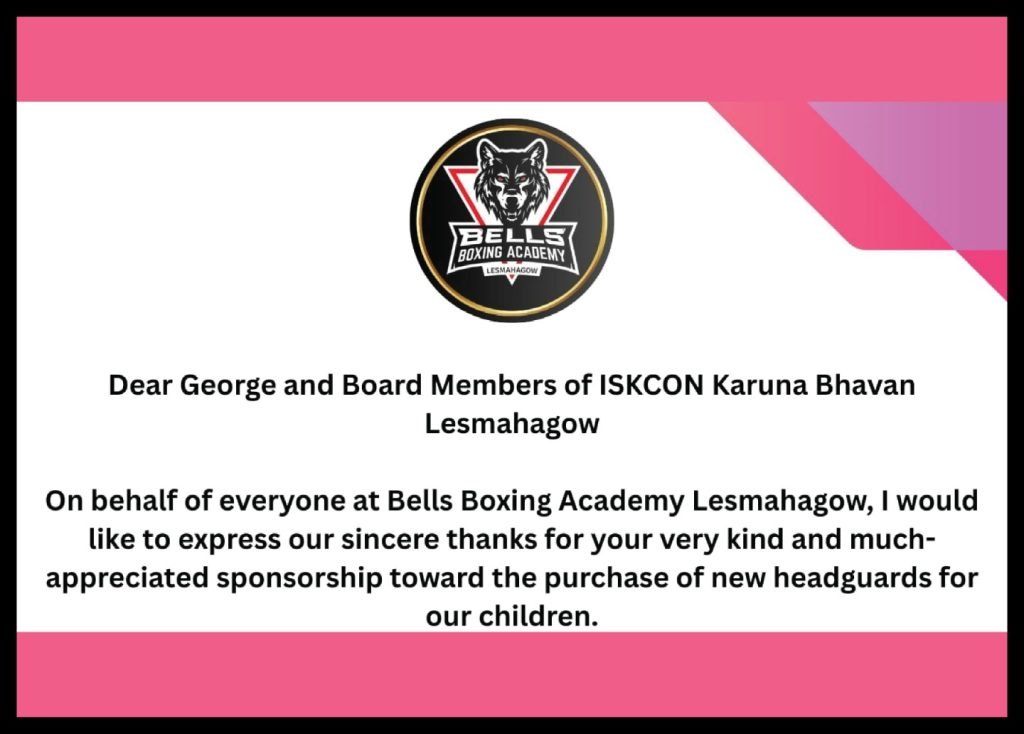
When the builders’ sons later established Bell’s Boxing Academy in Lesmahagow, they approached ISKCON Karuna Bhavan seeking assistance to purchase protective headgear for the children they serve. “Initially, I was uncertain,” Prabhupada Prana Dāsa admitted. “After all, it is Krishna’s Lakṣmī.” Seeking guidance from a senior godbrother clarified the matter. “He told me, ‘Your best public relations are with the local people.’”
The academy’s response was immediate and deeply appreciative. Andrew Bell publicly expressed gratitude to the temple, emphasizing how the donation contributed to the safety of the children. In time, he himself began volunteering with the temple’s food distribution program—demonstrating how the relationship naturally became reciprocal rather than merely transactional.
On one occasion, following incidents of vandalism on temple property, Bell addressed the children directly. “He gathered around thirty children and told them, ‘These are our people. They are helping us,’” Prabhupada Prana Dāsa recalled. “From that point onward, there were no further problems.” For him, this moment clearly illustrated how mutual respect arises organically when trust is sincerely established.
Shared Development and a Vision for the Future
Prabhupada Prana Dāsa perceives a natural connection between sporting discipline, community life, and spiritual culture. Having himself been a Scottish wrestling champion, he recognizes the parallels. “No one achieves anything—materially or spiritually—without discipline,” he observed. “Sports cultivate respect, self-control, and humility.”
Looking ahead, he foresees continued cooperation with local authorities and community organizations, undertaken with deliberation and care. Rather than viewing expanded outreach as a risk, he regards it as a conscious step toward collective growth. He likened this to a “goldfish leap”—the transition from a small bowl into a larger aquarium. “It is a movement into a broader space,” he reflected, “where there is greater opportunity to grow.”
In this way, such engagements are not merely acts of charity, but shared journeys of development, through which both the temple and the surrounding community gradually mature and benefit together.
Ultimately, Prabhupada Prana Dāsa emphasizes that authenticity lies at the heart of meaningful outreach. “Śrīla Prabhupāda wanted local people to become devotees,” he said. “And local people more readily relate to those they perceive as their own.”
The support extended to Bell’s Boxing Academy thus stands as a quiet yet powerful example of this principle in practice—demonstrating how steadiness, humility, and practical compassion naturally allow Krishna consciousness to extend beyond the temple walls.
Readers may follow ISKCON Karuna Bhavan Lesmahagow on Instagram and Facebook for regular updates and community highlights, or visit the temple’s website to learn more about its outreach initiatives and devotional activities.
Deepen your Bhakti-yoga practice, harmonize relationships, and receive guided coaching — all at Vedavarsity.com