The great sage Maitreya said: My dear Vidura, thereafter Dhruva Mahārāja married the daughter of Prajāpati Śiśumāra, whose name was Bhrami, and two sons named Kalpa and Vatsara were born of her (1).The greatly powerful Dhruva Mahārāja had another wife, named Ilā, who was the daughter of the demi god Vāyu. By her he begot a son named Utkala and a very beautiful daughter (2). Dhruva Mahārāja’s younger brother Uttama, who was still unmarried, once went on a hunting excur sion and was killed by a powerful Yakṣa in the Himālaya Mountains. Along with him, his mother, Suruci, also followed the path of her son [she died] (3).
When Dhruva Mahārāja heard of the killing of his brother Uttama by the Yakṣas in the Himālaya Mountains, being overwhelmed with lamentation and anger, he got on his chariot and went out for victory over the city of the Yakṣas, Alakāpuri (4).Dhruva Mahārāja went to the northern direction of the Himālayan range. In a valley he saw a city full of ghostly persons who were followers of Lord Śiva (5). Maitreya con tinued: My dear Vidura, as soon as Dhruva Mahārāja reached Alakāpurī, he immediately blew his conchshell, and the sound reverber ated throughout the entire sky and in every di rection. The wives of the Yakṣas became very much frightened. From their eyes it was appar ent that they were full of anxiety (6). O hero Vidura, the greatly powerful heroes of the Yakṣas, unable to tolerate the resounding vibration of the conchshell of Dhruva Mahārāja, came forth from their city with weapons and attacked Dhruva (7).
Dhruva Mahārāja, who was a great charioteer and cer tainly a great bowman also, immediately began to kill them by simultaneously discharging ar rows three at a time (8).When the heroes of the Yakṣas saw that all their heads were being thus threatened by Dhruva Mahārāja, they could very easily understand their awkward position, and they concluded that they would certainly be defeated. But, as heroes, they lauded the action of Dhruva (9).Just like serpents, who cannot tolerate being trampled upon by anyone’s feet, the Yakṣas, being intolerant of the wonderful prowess of Dhruva Mahārāja, threw twice as many arrows six from each of their soldiers and thus they very valiantly exhibited their prowess (10).
The Yakṣa soldiers were 130,000 strong, all greatly angry and all desiring to de feat the wonderful activities of Dhruva Mahārāja. With full strength they showered upon Mahārāja Dhruva, along with his chariot and charioteer, various types of feathered ar rows, parighas [iron bludgeons], nistriṁśas [swords], prāsaśūlas [tridents], paraśvadhas [lances], śaktis [pikes], ṛṣṭis [spears] and bhuśuṇḍī weapons (11-12).Dhruva Mahārāja was completely covered by an incessant shower of weapons, just as a mountain is covered by incessant rainfall (13).All the Siddhas from the higher planetary systems were observing the fight from the sky, and when they saw that Dhruva Mahārāja had been covered by the in cessant arrows of the enemy, they roared tu multuously, “The grandson of Manu, Dhruva, is now lost!” They cried that Dhruva Mahārāja was just like the sun and that now he had set within the ocean of the Yakṣas (14).
The Yakṣas, being temporarily victorious, ex claimed that they had conquered Dhruva Mahārāja. But in the meantime Dhruva’s char iot suddenly appeared, just as the sun suddenly appears from within foggy mist (15). Dhruva Mahārāja’s bow and arrows twanged and hissed, causing lamentation in the hearts of his enemies. He began to shoot inces sant arrows, shattering all their different weap ons, just as the blasting wind scatters the as sembled clouds in the sky (16).The sharp ar rows released from the bow of Dhruva Mahārāja pierced the shields and bodies of the enemy, like the thunderbolts released by the King of heaven, which dismantle the bodies of the mountains (17). The great sage Maitreya continued: My dear Vidura, the heads of those who were cut to pieces by the arrows of Dhruva Mahārāja were decorated very beautifully with earrings and turbans. The legs of their bodies were as beautiful as golden palm trees, their arms were decorated with golden bracelets and armlets, and on their heads there were very val uable helmets bedecked with gold. All these or naments lying on that battlefield were very at tractive and could bewilder the mind of a hero (18-19).
The remaining Yakṣas who somehow or other were not killed had their limbs cut to pieces by the arrows of the great warrior Dhruva Mahārāja. Thus they began to flee, just as elephants flee when defeated by a lion (20).Dhruva Mahārāja, the best of human be ings, observed that in that great battlefield not one of the opposing soldiers was left standing with proper weapons. He then desired to see the city of Alakāpurī, but he thought to himself, “No one knows the plans of the mystic Yakṣas” (21). In the meantime, while Dhruva Mahārāja, doubtful of his mystic enemies, was talking with his charioteer, they heard a tremendous sound, as if the whole ocean were there, and they found that from the sky a great dust storm was coming over them from all directions (22). Within a moment the whole sky was over cast with dense clouds, and severe thundering was heard. There was glittering electric light ning and severe rainfall (23).
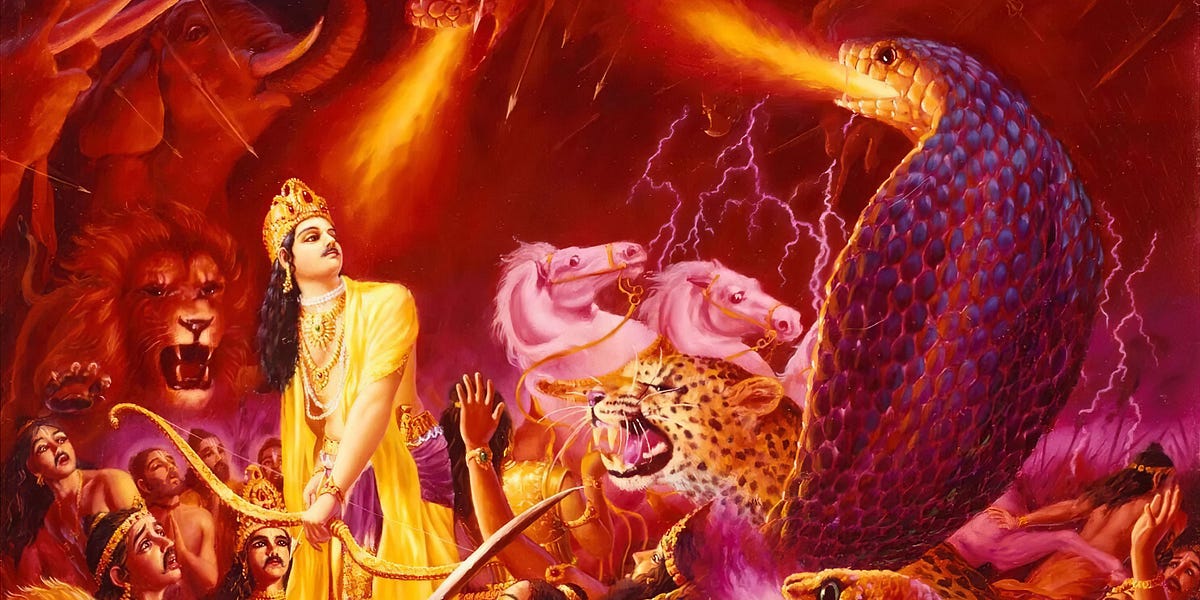
My dear faultless Vidura, in that rainfall there was blood, mucus, pus, stool, urine and marrow falling heavily be fore Dhruva Mahārāja, and there were trunks of bodies falling from the sky (24).Next, a great mountain was visible in the sky, and from all directions hailstones fell, along with lances, clubs, swords, iron bludgeons and great pieces of stone (25). Dhruva Mahārāja also saw many big serpents with angry eyes, vomiting forth fire and coming to devour him, along with groups of mad elephants, lions and tigers (26).Then, as if it were the time of the dissolu tion of the whole world, the fierce sea with foaming waves and great roaring sounds came forward before him (27).
The demon Yakṣas are by nature very heinous, and by their demoniac power of illusion they can create many strange phenomena to frighten one who is less intelli gent (28). When the great sages heard that Dhruva Mahārāja was overpowered by the illu sory mystic tricks of the demons, they immedi ately assembled to offer him auspicious encour agement (29). All the sages said: Dear Dhruva, O son of King Uttānapāda, may the Supreme Personality of Godhead known as Śārṅgadhanvā, who re lieves the distresses of His devotees, kill all your threatening enemies. The holy name of the Lord is as powerful as the Lord Himself. There fore, simply by chanting and hearing the holy name of the Lord, many men can be fully pro tected from fierce death without difficulty. Thus a devotee is saved (30).
Deepen your Bhakti-yoga practice, harmonize relationships, and receive guided coaching — all at Vedavarsity.com