The First Chapter describes how Rūpa Gosvāmī met Śrī Caitanya Mahāprabhu for the second time and how the Lord heard his two dramas [Vidagdha- mādhava and Lalita- mādhava]. (103) That chapter also describes the incident of Śivānanda Sena’s dog, who was induced by Śrī Caitanya Mahāprabhu to chant the holy name of Kṛṣṇa and was thus liberated. (104) The Second Chapter tells how the Lord instructively punished Junior Haridāsa. Also in that chapter is a description of the wonderful vision of Śivānanda Sena. (105) In the Third Chapter is a description of the forceful glories of Haridāsa Ṭhākura. That chapter also mentions how Dāmodara Paṇḍita spoke words of criticism to Śrī Caitanya Mahāprabhu. (106) The Third Chapter also tells how Śrī Caitanya Mahāprabhu delivered everyone by bestowing upon the universe the holy name of the Lord, and it describes how Haridāsa Ṭhākura established the glories of the holy name by his practical example. (107)
The Fourth Chapter describes Sanātana Gosvāmī’s second visit with Śrī Caitanya Mahāprabhu and how the Lord saved him from committing suicide. (108) The Fourth Chapter also tells how Sanātana Gosvāmī was tested in the sunshine of Jyaiṣṭha [May-June] and was then empowered and sent back to Vṛndāvana. (109) The Fifth Chapter tells how the Lord showed His favor to Pradyumna Miśra and made him hear topics of Kṛṣṇa from Rāmānanda Rāya. (110) That chapter also describes how Svarūpa Dāmodara Gosvāmī rejected the drama of a poet from Bengal and established the glories of the Deity. (111) The Sixth Chapter describes how Raghunātha dāsa Gosvāmī met Śrī Caitanya Mahāprabhu and performed the chipped rice festival in accordance with Nityānanda Prabhu’s order. (112) That chapter also tells how the Lord entrusted Raghunātha dāsa Gosvāmī to the care of Svarūpa Dāmodara Gosvāmī and gave Raghunātha dāsa the gift of a stone from Govardhana Hill and a garland of small conchshells. (113)
The Seventh Chapter tells how Śrī Caitanya Mahāprabhu met Vallabha Bhaṭṭa and dismantled his false pride in various ways. (114) The Eighth Chapter describes the arrival of Rāmacandra Purī and how Śrī Caitanya Mahāprabhu minimized His eating due to fear of him. (115) In the Ninth Chapter is a description of how Gopīnātha Paṭṭanāyaka was delivered and how the people of the three worlds were able to see Śrī Caitanya Mahāprabhu. (116) In the Tenth Chapter I have described how Śrī Caitanya Mahāprabhu tasted the food given by His devotees, and I have also described the assortment of prasādam in the bags of Rāghava Paṇḍita. (117) Also in that chapter is a description of how the Lord examined Govinda and how He danced in the temple. (118) The Eleventh Chapter describes the disappearance of Haridāsa Ṭhākura and how Śrī Caitanya Mahāprabhu, the Supreme Personality of Godhead, showed His affection for His devotees. (119)
In the Twelfth Chapter are descriptions of how Jagadānanda Paṇḍita broke a pot of oil and how Lord Nityānanda chastised Śivānanda Sena. (120) The Thirteenth Chapter tells how Jagadānanda Paṇḍita went to Mathurā and returned and how Śrī Caitanya Mahāprabhu by chance heard a song sung by a deva- dāsī dancing girl. (121) Also in the Thirteenth Chapter is an account of how Raghunātha Bhaṭṭa met Śrī Caitanya Mahāprabhu, who by His causeless mercy sent him to Vṛndāvana. (122) The Fourteenth Chapter describes the beginning of the Lord’s spiritual trance, in which His body was at Jagannātha Purī but His mind was in Vṛndāvana. (123) Also in that chapter is a description of how Śrī Caitanya Mahāprabhu fell down in front of the Siṁha- dvāra gate of the Jagannātha temple, His bones separated at the joints, and how various transcendental symptoms awakened in Him. (124)
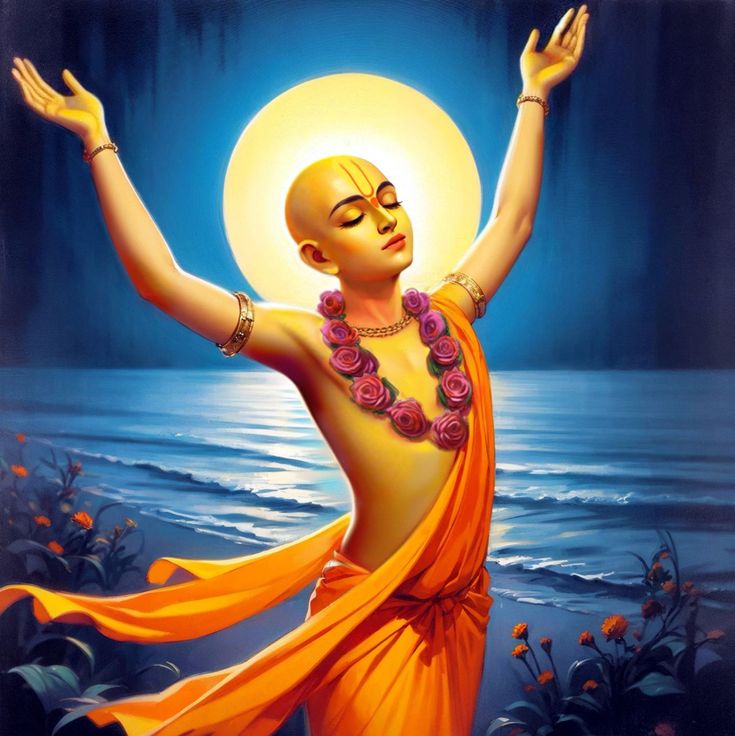
Also in that chapter is a description of how Śrī Caitanya Mahāprabhu ran toward Caṭaka- parvata and spoke like a madman. (125) In the Fifteenth Chapter is a description of how Śrī Caitanya Mahāprabhu entered a garden on the seashore and mistook it for Vṛndāvana. (126) Also in that chapter is a description of the attraction of Lord Caitanya’s five senses to Kṛṣṇa and how He searched for Kṛṣṇa in the rāsa dance. (127) The Sixteenth Chapter tells how Śrī Caitanya Mahāprabhu showed His mercy to Kālidāsa and thus demonstrated the result of eating the remnants of the food of Vaiṣṇavas. (128) It also describes how Śivānanda’s son composed a verse and how the doorkeeper of the Siṁha- dvāra showed Kṛṣṇa to Śrī Caitanya Mahāprabhu. (129) Also in that chapter, the glories of mahā- prasādam are explained, and a verse is tasted describing the effect of nectar from the lips of Kṛṣṇa. (130) The Seventeenth Chapter recounts how Śrī Caitanya Mahāprabhu fell among the cows and assumed the form of a tortoise as His ecstatic emotions awakened. (131)
That chapter also tells how the attributes of Kṛṣṇa’s sound attracted the mind of Śrī Caitanya Mahāprabhu, who then described in ecstasy the meaning of the “kā stry aṅga te” verse. (132) The Seventeenth Chapter also tells how Śrī Caitanya Mahāprabhu, due to the conjunction of various ecstatic emotions, again began speaking like a madman and described in detail the meaning of a verse from the Kṛṣṇa- karṇāmṛta. (133) In the Eighteenth Chapter is an account of how the Lord fell into the ocean and in ecstasy saw in a dream the pastimes of a water fight between Kṛṣṇa and the gopīs. (134) In that dream, Śrī Caitanya Mahāprabhu saw Kṛṣṇa’s picnic in the forest. As Lord Caitanya floated in the sea, a fisherman caught Him, and then the Lord returned to His own residence. All this is recounted in the Eighteenth Chapter. (135) In the Nineteenth Chapter is a description of how Lord Śrī Caitanya Mahāprabhu rubbed His face against the walls and spoke like a madman because of separation from Kṛṣṇa. (136)
That chapter also describes Kṛṣṇa’s wandering in a garden on a spring night, and it fully describes the meaning of a verse about the scent of Kṛṣṇa’s body. (137) The Twentieth Chapter tells how Lord Śrī Caitanya Mahāprabhu recited His own eight stanzas of instruction and tasted their meaning in ecstatic love. (138) Śrī Caitanya Mahāprabhu composed those eight stanzas to instruct the devotees, but He also personally tasted their meaning. (139) I have thus repeated the principal pastimes and their meaning, for by such repetition one can remember the descriptions in the book. (140) In every chapter there are various topics, but I have repeated only those that are principal, for not all of them could be described again. (141) The Vṛndāvana Deities of Madana- mohana with Śrīmatī Rādhārāṇī, Govinda with Śrīmatī Rādhārāṇī, and Gopīnātha with Śrīmatī Rādhārāṇī are the life and soul of the Gauḍīya Vaiṣṇavas. (142-143)
So that my desires may be fulfilled, I place the lotus feet of these personalities on my head: Lord Śrī Caitanya Mahāprabhu, with Lord Nityānanda, Advaita Ācārya and Their devotees, as well as Śrī Svarūpa Dāmodara Gosvāmī, Śrī Rūpa Gosvāmī, Śrī Sanātana Gosvāmī, Śrī Raghunātha dāsa Gosvāmī, who is my spiritual master, and Śrīla Jīva Gosvāmī. (144-146) The mercy of their lotus feet is my spiritual master, and my words are my disciples, whom I have made dance in various ways. (147) Seeing the fatigue of the disciples, the spiritual master has stopped making them dance, and because that mercy no longer makes them dance, my words now sit silently. (148) My inexperienced words do not know how to dance by themselves. The mercy of the guru made them dance as much as possible, and now, after dancing, they have taken rest. (149)
I now worship the lotus feet of all my readers, for by the mercy of their lotus feet there is all good fortune. (150) If one hears the pastimes of Lord Śrī Caitanya Mahāprabhu as described in Śrī Caitanya- caritāmṛta, I wash his lotus feet and drink the water. (151) I decorate my head with the dust of the lotus feet of my audience. Now you have all drunk this nectar, and therefore my labor is successful. (152) Praying at the lotus feet of Śrī Rūpa and Śrī Raghunātha, always desiring their mercy, I, Kṛṣṇadāsa, narrate Śrī Caitanya- caritāmṛta, following in their footsteps. (153) Śrī Caitanya- caritāmṛta is filled with the activities of Śrī Caitanya Mahāprabhu, who is the Supreme Personality of Godhead Himself. It invokes all good fortune and destroys everything inauspicious. If one tastes the nectar of Śrī Caitanya- caritāmṛta with faith and love, I become like a bumblebee tasting the honey of transcendental love from his lotus feet. (154)
Since this book, Caitanya- caritāmṛta, is now complete, having been written for the satisfaction of the most opulent Deities Madana- mohanajī and Govindajī, let it be offered at the lotus feet of Śrī Kṛṣṇa Caitanyadeva. (155) Realized devotees are like bumblebees maddened by their own mellows at Kṛṣṇa’s lotus feet. The scent of those lotus feet perfumes the entire world. Who is the realized soul that could give them up? (156) In Vṛndāvana in the year 1537 Śakābda Era [A.D 1615], in the month of Jyaiṣṭha [May-June], on Sunday, the fifth day of the waning moon, this Caitanya- caritāmṛta has been completed. (157)
Deepen your Bhakti-yoga practice, harmonize relationships, and receive guided coaching — all at Vedavarsity.com