


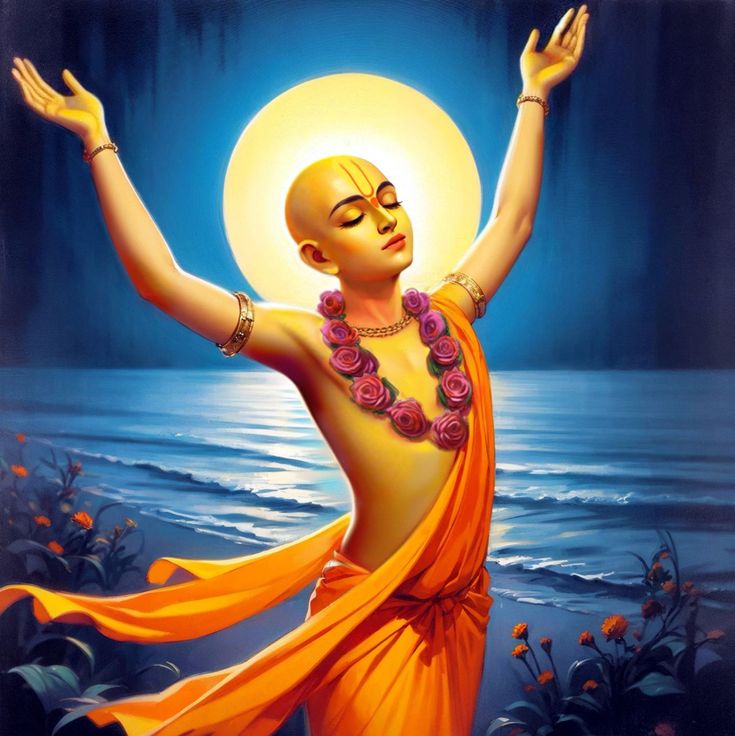
Only the most fortunate will relish the mad words of Śrī Caitanya Mahāprabhu, which were mixed with jubilation, envy, agitation, submissiveness and grief, all produced by ecstatic loving emotions. (1) All glories to Lord Śrī Caitanya Mahāprabhu! All glories to Lord Nityānanda! All glories to Advaitacandra! And all glories to all the devotees of Śrī Caitanya Mahāprabhu! (2) While Śrī Caitanya Mahāprabhu thus resided at Jagannātha Purī [Nīlācala], He was continuously overwhelmed, night and day, by separation from Kṛṣṇa. (3) Day and night He tasted transcendental blissful songs and verses with two associates, namely Svarūpa Dāmodara Gosvāmī and Rāmānanda Rāya. (4)
He relished the symptoms of various transcendental emotions, such as jubilation, lamentation, anger, humility, anxiety, grief, eagerness and satisfaction. (5) He would recite His own verses, expressing their meanings and emotions, and thus enjoy tasting them with these two friends. (6) Sometimes the Lord would be absorbed in a particular emotion and would stay awake all night reciting related verses and relishing their taste. (7) In great jubilation, Śrī Caitanya Mahāprabhu said, “My dear Svarūpa Dāmodara and Rāmānanda Rāya, know from Me that chanting the holy names is the most feasible means of salvation in this Age of Kali. (8) “In this Age of Kali, the process of worshiping Kṛṣṇa is to perform sacrifice by chanting the holy name of the Lord. One who does so is certainly very intelligent, and he attains shelter at the lotus feet of Kṛṣṇa. (9)
“‘In the Age of Kali, intelligent persons perform congregational chanting to worship the incarnation of Godhead who constantly sings the name of Kṛṣṇa. Although His complexion is not blackish, He is Kṛṣṇa Himself. He is accompanied by His associates, servants, weapons and confidential companions.’ (10) “Simply by chanting the holy name of Lord Kṛṣṇa, one can be freed from all undesirable habits. This is the means of awakening all good fortune and initiating the flow of waves of love for Kṛṣṇa. (11) “‘Let there be all victory for the chanting of the holy name of Lord Kṛṣṇa, which can cleanse the mirror of the heart and stop the miseries of the blazing fire of material existence. That chanting is the waxing moon that spreads the white lotus of good fortune for all living entities. It is the life and soul of all education. The chanting of the holy name of Kṛṣṇa expands the blissful ocean of transcendental life. It gives a cooling effect to everyone and enables one to taste full nectar at every step.’ (12) “By performing congregational chanting of the Hare Kṛṣṇa mantra, one can destroy the sinful condition of material existence, purify the unclean heart and awaken all varieties of devotional service. (13)
“The result of chanting is that one awakens his love for Kṛṣṇa and tastes transcendental bliss. Ultimately, one attains the association of Kṛṣṇa and engages in His devotional service, as if immersing himself in a great ocean of love.” (14) Lamentation and humility awoke within Śrī Caitanya Mahāprabhu, and He began reciting another of His own verses. By hearing the meaning of that verse, one can forget all unhappiness and lamentation. (15) “‘My Lord, O Supreme Personality of Godhead, in Your holy name there is all good fortune for the living entity, and therefore You have many names, such as “Kṛṣṇa” and “Govinda,” by which You expand Yourself. You have invested all Your potencies in those names, and there are no hard and fast rules for remembering them. My dear Lord, although You bestow such mercy upon the fallen, conditioned souls by liberally teaching Your holy names, I am so unfortunate that I commit offenses while chanting the holy name, and therefore I do not achieve attachment for chanting.’ (16)
“Because people vary in their desires, You have distributed various holy names by Your mercy. (17) “Regardless of time or place, one who chants the holy name, even while eating or sleeping, attains all perfection. (18) “You have invested Your full potencies in each individual holy name, but I am so unfortunate that I have no attachment for chanting Your holy names.” (19) Śrī Caitanya Mahāprabhu continued, “O Svarūpa Dāmodara Gosvāmī and Rāmānanda Rāya, hear from Me the symptoms of how one should chant the Hare Kṛṣṇa mahā- mantra to awaken very easily one’s dormant love for Kṛṣṇa. (20) “‘One who thinks himself lower than the grass, who is more tolerant than a tree, and who does not expect personal honor but is always prepared to give all respect to others can very easily always chant the holy name of the Lord.’ (21) “These are the symptoms of one who chants the Hare Kṛṣṇa mahā- mantra. Although he is very exalted, he thinks himself lower than the grass on the ground, and like a tree, he tolerates everything in two ways. (22)
“When a tree is cut down, it does not protest, and even when drying up, it does not ask anyone for water. (23) “The tree delivers its fruits, flowers and whatever else it possesses to anyone and everyone. It tolerates scorching heat and torrents of rain, yet it still gives shelter to others. (24) “Although a Vaiṣṇava is the most exalted person, he is prideless and gives all respect to everyone, knowing everyone to be the resting place of Kṛṣṇa. (25) “If one chants the holy name of Lord Kṛṣṇa in this manner, he will certainly awaken his dormant love for Kṛṣṇa’s lotus feet.” (26) As Lord Caitanya spoke in this way, His humility increased, and He began praying to Kṛṣṇa that He could discharge pure devotional service. (27) Wherever there is a relationship of love of Godhead, its natural symptom is that the devotee does not think himself a devotee. Instead, he always thinks that he has not even a drop of love for Kṛṣṇa. (28)
“‘O Lord of the universe, I do not desire material wealth, materialistic followers, a beautiful wife or fruitive activities described in flowery language. All I want, life after life, is unmotivated devotional service to You.’ (29) “My dear Lord Kṛṣṇa, I do not want material wealth from You, nor do I want followers, a beautiful wife or the results of fruitive activities. I only pray that by Your causeless mercy You give Me pure devotional service to You, life after life.” (30) In great humility, considering Himself a conditioned soul of the material world, Śrī Caitanya Mahāprabhu again expressed His desire to be endowed with service to the Lord. (31) “‘O My Lord, O Kṛṣṇa, son of Mahārāja Nanda, I am Your eternal servant, but because of My own fruitive acts I have fallen into this horrible ocean of nescience. Now please be causelessly merciful to Me. Consider Me a particle of dust at Your lotus feet.’ (32) “I am Your eternal servant, but I forgot Your Lordship. Now I have fallen into the ocean of nescience and have been conditioned by the external energy. (33)
“Be causelessly merciful to Me by giving Me a place with the particles of dust at Your lotus feet so that I may engage in the service of Your Lordship as Your eternal servant.” (34) Natural humility and eagerness then awoke in Lord Śrī Caitanya Mahāprabhu. He prayed to Kṛṣṇa to be able to chant the mahā- mantra in ecstatic love. (35) “‘My dear Lord, when will My eyes be beautified by filling with tears that constantly glide down as I chant Your holy name? When will My voice falter and all the hairs on My body stand erect in transcendental happiness as I chant Your holy name?’ (36) “Without love of Godhead, My life is useless. Therefore I pray that You accept Me as Your servant and give Me the salary of ecstatic love of God.” (37) Separation from Kṛṣṇa awoke various mellows of distress, lamentation and humility. Thus Śrī Caitanya Mahāprabhu spoke like a crazy man. (38) “‘My Lord Govinda, because of separation from You, I consider even a moment a great millennium. Tears flow from My eyes like torrents of rain, and I see the entire world as void.’ (39)
“In My agitation, a day never ends, for every moment seems like a millennium. Pouring incessant tears, My eyes are like clouds in the rainy season. (40) “The three worlds have become void because of separation from Govinda. I feel as if I were burning alive in a slow fire. (41) “Lord Kṛṣṇa has become indifferent to Me just to test My love, and My friends say, ‘Better to disregard Him.'” (42) While Śrīmatī Rādhārāṇī was thinking in this way, the characteristics of natural love became manifest because of Her pure heart. (43) The ecstatic symptoms of envy, great eagerness, humility, zeal and supplication all became manifest at once. (44) In that mood, the mind of Śrīmatī Rādhārāṇī was agitated, and therefore She spoke a verse of advanced devotion to Her gopī friends. (45) In the same spirit of ecstasy, Śrī Caitanya Mahāprabhu recited that verse, and as soon as He did so, He felt like Śrīmatī Rādhārāṇī. (46)
“Let Kṛṣṇa tightly embrace this maidservant who has fallen at His lotus feet, or let Him trample Me or break My heart by never being visible to Me. He is a debauchee, after all, and can do whatever He likes, but He is still no one other than the worshipable Lord of My heart. (47) “I am a maidservant at the lotus feet of Kṛṣṇa. He is the embodiment of transcendental happiness and mellows. If He likes He can tightly embrace Me and make Me feel oneness with Him, or by not giving Me His audience, He may corrode My mind and body. Nevertheless, it is He who is the Lord of My life. (48) “My dear friend, just hear the decision of My mind. Kṛṣṇa is the Lord of My life in all conditions, whether He shows Me affection or kills Me by giving Me unhappiness. (49)
“Sometimes Kṛṣṇa gives up the company of other gopīs and becomes controlled, mind and body, by Me. Thus He manifests My good fortune and gives others distress by performing His loving affairs with Me. (50) “Or, since after all He is a very cunning, obstinate debauchee with a propensity to cheat, He takes to the company of other women. He then indulges in loving affairs with them in front of Me to give distress to My mind. Nevertheless, He is still the Lord of My life. (51) “I do not mind My personal distress. I only wish for the happiness of Kṛṣṇa, for His happiness is the goal of My life. However, if He feels great happiness in giving Me distress, that distress is the best of My happiness. (52)
Deepen your Bhakti-yoga practice, harmonize relationships, and receive guided coaching — all at Vedavarsity.com