Lord Śrī Caitanya Mahāprabhu, the most exalted of all devotees of mothers, spoke like a madman and rubbed His face against the walls. Overwhelmed by emotions of ecstatic love, He would sometimes enter the Jagannātha- vallabha garden to perform His pastimes. I offer my respectful obeisances unto Him. (1) All glories to Śrī Caitanya Mahāprabhu! All glories to Lord Nityānanda! All glories to Advaita Ācārya! And all glories to all the devotees of Lord Caitanya Mahāprabhu! (2) In the ecstasy of love of Kṛṣṇa, Śrī Caitanya Mahāprabhu thus behaved like a madman, talking insanely all day and night. (3) Jagadānanda Paṇḍita was a very dear devotee of Śrī Caitanya Mahāprabhu. The Lord derived great pleasure from his activities. (4) Knowing His mother to be greatly afflicted by separation from Him, the Lord would send Jagadānanda Paṇḍita to Navadvīpa every year to console her. (5)
Śrī Caitanya Mahāprabhu told Jagadānanda Paṇḍita, “Go to Nadia and offer My obeisances to My mother. Touch her lotus feet in My name. (6) “Tell her for Me, ‘Please remember that I come here every day and offer My respects to your lotus feet. (7) “‘Any day you desire to feed Me, I certainly come and accept what you offer. (8) “‘I have given up service to you and have accepted the vow of sannyāsa. I have thus become mad and have destroyed the principles of religion. (9) “‘Mother, please do not take this as an offense, for I, your son, am completely dependent upon you. (10) “‘I am staying here at Nīlācala, Jagannātha Purī, according to your order. As long as I live, I shall not leave this place.'” (11) Following the order of Paramānanda Purī, Śrī Caitanya Mahāprabhu sent His mother the prasāda clothing left by Lord Jagannātha after His pastimes as a cowherd boy. (12)
Śrī Caitanya Mahāprabhu very carefully brought first- class prasādam from Lord Jagannātha and sent it in separate packages to His mother and the devotees at Nadia. (13) Śrī Caitanya Mahāprabhu is the topmost gem of all devotees of mothers. He rendered service to His mother even after He had accepted the vow of sannyāsa. (14) Jagadānanda Paṇḍita thus went to Nadia, and when he met Śacīmātā, he conveyed to her all the Lord’s salutations. (15) He then met all the other devotees, headed by Advaita Ācārya, and gave them the prasādam of Jagannātha. After staying for one month, he took permission from mother Śacī to leave. (16) When he went to Advaita Ācārya and also asked His permission to return, Advaita Prabhu gave him a message to deliver to Śrī Caitanya Mahāprabhu. (17) Advaita Ācārya had written a sonnet in equivocal language with an import that Śrī Caitanya Mahāprabhu could understand but others could not. (18)
In His sonnet, Advaita Prabhu first offered His obeisances hundreds and thousands of times unto the lotus feet of Lord Śrī Caitanya Mahāprabhu. He then submitted the following statement at His lotus feet. (19) “Please inform Śrī Caitanya Mahāprabhu, who is acting like a madman, that everyone here has become mad like Him. Inform Him also that in the marketplace rice is no longer in demand. (20) “Further tell Him that those now mad in ecstatic love are no longer interested in the material world. Also tell Śrī Caitanya Mahāprabhu that one who has also become a madman in ecstatic love [Advaita Prabhu] has spoken these words.” (21) When he heard Advaita Ācārya’s statement, Jagadānanda Paṇḍita began to laugh, and when he returned to Jagannātha Purī, Nīlācala, he informed Caitanya Mahāprabhu of everything. (22) After hearing the equivocal sonnet by Advaita Ācārya, Śrī Caitanya Mahāprabhu quietly smiled. “That is His order,” He said. Then He fell silent. (23) Although he knew the secret, Svarūpa Dāmodara Gosvāmī inquired from the Lord, “What is the meaning of this sonnet? I could not understand it.” (24)
Śrī Caitanya Mahāprabhu replied, “Advaita Ācārya is a great worshiper of the Lord and is very expert in the regulative principles enjoined in the Vedic literatures. (25) “Advaita Ācārya invites the Lord to come and be worshiped, and to perform the worship He keeps the Deity for some time. (26) “After the worship is completed, He sends the Deity somewhere else. I do not know the meaning of this sonnet, nor do I know what is in Advaita Prabhu’s mind. (27) “Advaita Ācārya is a great mystic. No one can understand Him. He is expert in writing sonnets that even I Myself cannot understand.” (28) Hearing this, all the devotees were astonished, especially Svarūpa Dāmodara, who became somewhat morose. (29) From that day on, Śrī Caitanya Mahāprabhu’s emotional state changed markedly; His feelings of separation from Kṛṣṇa doubled in intensity. (30) As His feelings of separation in the ecstasy of Śrīmatī Rādhārāṇī increased at every moment, the Lord’s activities, both day and night, were now wild, insane performances. (31)
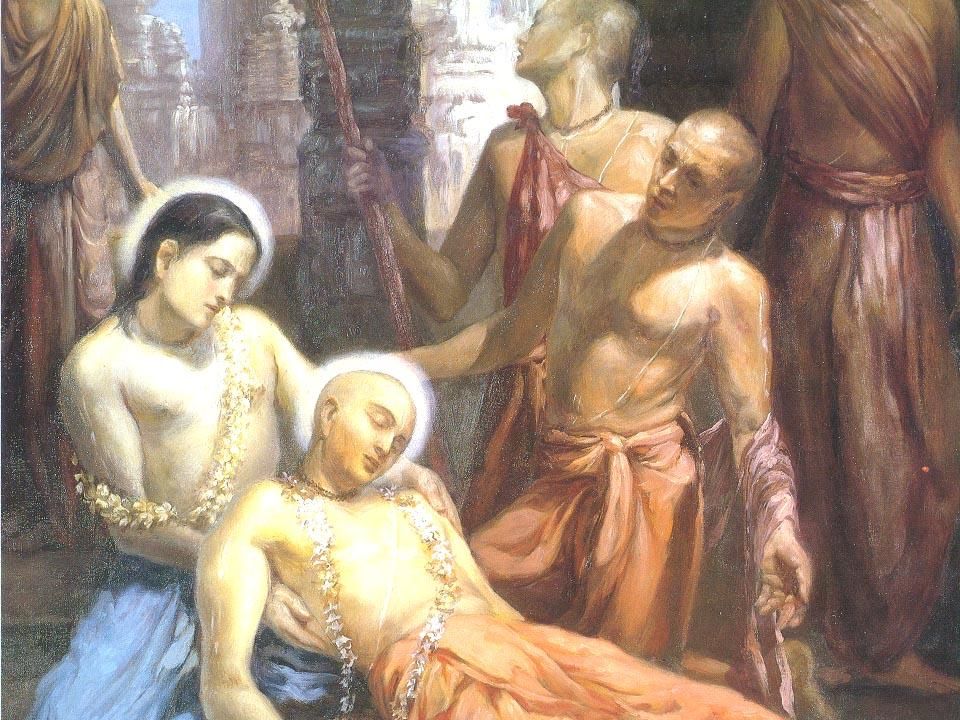
Suddenly there awoke within Śrī Caitanya Mahāprabhu the scene of Lord Kṛṣṇa’s departure to Mathurā, and He began exhibiting the symptom of ecstatic madness known as udghūrṇā. (32) Śrī Caitanya Mahāprabhu spoke like a madman, holding Rāmānanda Rāya by the neck, and He questioned Svarūpa Dāmodara, thinking him to be His gopī friend. (33) Just as Śrīmatī Rādhārāṇī inquired from Her personal friend Viśākhā, Śrī Caitanya Mahāprabhu, reciting that very verse, began speaking like a madman. (34) “‘My dear friend, where is Kṛṣṇa, who is like the moon rising from the ocean of Mahārāja Nanda’s dynasty? Where is Kṛṣṇa, His head decorated with a peacock feather? Where is He? Where is Kṛṣṇa, whose flute produces such a deep sound? Oh, where is Kṛṣṇa, whose bodily luster is like the luster of the blue indranīla jewel? Where is Kṛṣṇa, who is so expert in rāsa dancing? Oh, where is He, who can save My life? Kindly tell Me where to find Kṛṣṇa, the treasure of My life and best of My friends. Feeling separation from Him, I hereby condemn Providence, the shaper of My destiny.’ (35)
“The family of Mahārāja Nanda is just like an ocean of milk, wherein Lord Kṛṣṇa has arisen like the full moon to illuminate the entire universe. The eyes of the residents of Vraja are like cakora birds that continuously drink the nectar of His bodily luster and thus live peacefully. (36) “My dear friend, where is Kṛṣṇa? Kindly let Me see Him. My heart breaks at not seeing His face even for a moment. Kindly show Him to Me immediately; otherwise I cannot live. (37) “The women of Vṛndāvana are just like lilies growing hot in the sun of lusty desires. But moonlike Kṛṣṇa makes them all jubilant by bestowing upon them the nectar of His hands. O My dear friend, where is My moon now? Save My life by showing Him to Me! (38) “My dear friend, where is that beautiful helmet with a peacock feather upon it like a rainbow upon a new cloud? Where are those yellow garments, shining like lightning? And where is that necklace of pearls that resemble flocks of ducks flying in the sky? The blackish body of Kṛṣṇa triumphs over the new blackish rain cloud. (39)
“If a person’s eyes even once capture that beautiful body of Kṛṣṇa, it remains always prominent within his heart. Kṛṣṇa’s body resembles the sap of the mango tree, for when it enters the minds of women, it will not come out, despite great endeavor. Thus Kṛṣṇa’s extraordinary body is like a thorn of the seyā berry tree. (40) “Kṛṣṇa’s bodily luster shines like the indranīla gem and surpasses the luster of the tamāla tree. The luster of His body drives the entire world mad because Providence has made it transparent by refining the essence of the mellow of conjugal love and mixing it with moonshine. (41) “The deep vibration of Kṛṣṇa’s flute surpasses the thundering of new clouds and attracts the aural reception of the entire world. Thus the inhabitants of Vṛndāvana rise and pursue that sound, drinking the showering nectar of Kṛṣṇa’s bodily luster like thirsty cātaka birds. (42) “Kṛṣṇa is the reservoir of art and culture, and He is the panacea that saves My life. O My dear friend, since I live without Him, who is the best among My friends, I condemn the duration of My life. I think that Providence has cheated Me in many ways. (43)
“Why does Providence continue the life of one who does not wish to live?” This thought aroused anger and lamentation in Śrī Caitanya Mahāprabhu, who then recited a verse from Śrīmad- Bhāgavatam that chastises Providence and makes an accusation against Kṛṣṇa. (44) “‘O Providence, you have no mercy! You bring embodied souls together through friendship and affection, but before their desires are fulfilled, you separate them. Your activities are like the foolish pranks of children.’ (45) “Providence, you do not know the purport of loving affairs, and therefore you baffle all Our endeavors. This is very childish of you. If We could catch you, We would give you such a lesson that you would never again make such arrangements. (46)
“Oh, cruel Providence! You are very unkind, for you bring together in love people who are rarely in touch with each other. Then, after you have made Them meet but before They are fulfilled, you again spread Them far apart. (47) “O Providence, you are so unkind! You reveal the beautiful face of Kṛṣṇa and make the mind and eyes greedy, but after they have drunk that nectar for only a moment, you whisk Kṛṣṇa away to another place. This is a great sin because you thus take away what you have given as charity. (48) “O misbehaved Providence! If you reply to Us, ‘Akrūra is actually at fault; why are You angry with me?’ then I say to you, ‘Providence, you have taken the form of Akrūra and have stolen Kṛṣṇa away. No one else would behave like this.’ (49)
“But this is the fault of My own destiny. Why should I needlessly accuse you? There is no intimate relationship between you and Me. Kṛṣṇa, however, is My life and soul. It is We who live together, and it is He who has become so cruel. (50) “He for whom I have left everything is personally killing Me with His own hands. Kṛṣṇa has no fear of killing women. Indeed, I am dying for Him, but He doesn’t even turn back to look at Me. Within a moment, He has broken off Our loving affairs. (51) “Yet why should I be angry with Kṛṣṇa? It is the fault of My own misfortune. The fruit of My sinful activities has ripened, and therefore Kṛṣṇa, who has always been dependent on My love, is now indifferent. This means that My misfortune is very strong.” (52) In this way, Śrī Caitanya Mahāprabhu lamented in the mood of separation, “Alas, alas! O Kṛṣṇa, where have You gone?” Feeling in His heart the ecstatic emotions of the gopīs, Śrī Caitanya Mahāprabhu agonized in their words, saying, “O Govinda! O Dāmodara! O Mādhava!” (53)
Deepen your Bhakti-yoga practice, harmonize relationships, and receive guided coaching — all at Vedavarsity.com