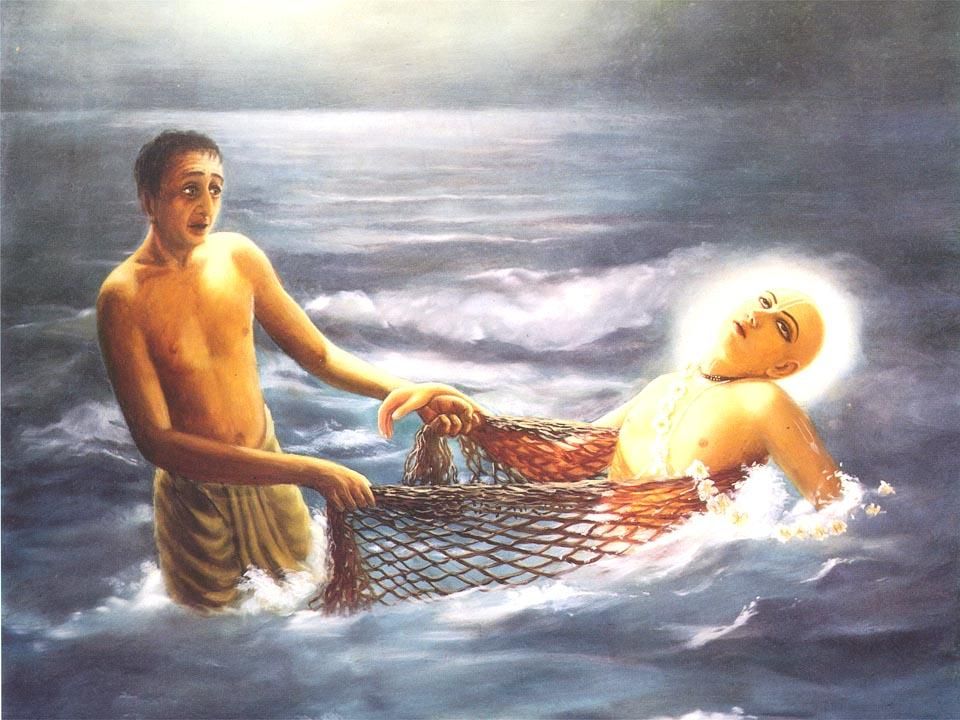
Hearing this, Svarūpa Dāmodara could understand the full truth of the matter. He spoke sweetly to the fisherman. (60) “I am a famous exorcist,” he said, “and I know how to rid you of this ghost.” He then chanted some mantras and placed his hand on top of the fisherman’s head. (61) He slapped the fisherman three times and said, “Now the ghost has gone away. Do not be afraid.” By saying this, he pacified the fisherman. (62) The fisherman was affected by ecstatic love, but he was also fearful. He had thus become doubly agitated. Now that his fear had subsided, however, he had become somewhat normal. (63) Svarūpa Dāmodara said to the fisherman, “My dear sir, the person you are thinking is a ghost is not actually a ghost but is the Supreme Personality of Godhead, Śrī Kṛṣṇa Caitanya Mahāprabhu. (64) “Because of ecstatic love, the Lord fell into the sea, and you have caught Him in your net and rescued Him. (65)
“Simply touching Him has awakened your dormant love of Kṛṣṇa, but because you thought Him a ghost, you were very much afraid of Him. (66) “Now that your fear has gone and your mind is peaceful, please show me where He is.” (67) The fisherman replied, “I have seen the Lord many times, but this is not He. This body is very much deformed.” (68) Svarūpa Dāmodara said, “The Lord’s body becomes transformed in His love for God. Sometimes the joints of His bones separate, and His body becomes very much elongated.” (69) Hearing this, the fisherman became very happy. He brought all the devotees with him and showed them Śrī Caitanya Mahāprabhu. (70) The Lord was lying on the ground, His body elongated and bleached white by the water. He was covered from head to foot with sand. (71)
The Lord’s body was stretched, and His skin was slack and hanging loose. To lift Him and take Him the long distance home would have been impossible. (72) The devotees removed His wet undergarment and replaced it with a dry one. Then, laying the Lord on an outer cloth, they cleaned the sand from His body. (73) They all performed saṅkīrtana, loudly chanting the holy name of Kṛṣṇa into the Lord’s ear. (74) After some time the sound of the holy name entered the ear of the Lord, who immediately got up, making a great noise. (75) As soon as He got up, His bones assumed their proper places. With half- external consciousness, the Lord looked here and there. (76) The Lord remained in one of three different states of consciousness at all times: internal, external and half- external. (77)
When the Lord was deeply absorbed in internal consciousness but He nevertheless exhibited some external consciousness, devotees called His condition ardha- bāhya, or half- external consciousness. (78) In this half- external consciousness, Śrī Caitanya Mahāprabhu talked like a madman. The devotees could distinctly hear Him speaking to the sky. (79) “Seeing the river Yamunā,” He said, “I went to Vṛndāvana. There I saw the son of Nanda Mahārāja performing His sporting pastimes in the water. (80) “Lord Kṛṣṇa was in the water of the Yamunā in the company of the gopīs, headed by Śrīmatī Rādhārāṇī. They were performing pastimes in a great sporting manner. (81) “I saw this pastime as I stood on the bank of the Yamunā in the company of the gopīs. One gopī was showing some other gopīs the pastimes of Rādhā and Kṛṣṇa in the water. (82) “All the gopīs entrusted their silken garments and ornaments to the care of their friends and then put on fine white cloth. Lord Kṛṣṇa, taking His beloved gopīs with Him, bathed and performed very nice pastimes in the water of the Yamunā. (83)
“My dear friends, just see Lord Kṛṣṇa’s sporting pastimes in the water! Kṛṣṇa’s restless palms resemble lotus flowers. He is just like the chief of mad elephants, and the gopīs who accompany Him are like she- elephants. (84) “The sporting pastimes in the water began, and everyone started splashing water back and forth. In the tumultuous showers of water, no one could be certain which party was winning and which was losing. This sporting water fight increased unlimitedly. (85) “The gopīs were like steady streaks of lightning, and Kṛṣṇa resembled a blackish cloud. The lightning began sprinkling water upon the cloud, and the cloud upon the lightning. Like thirsty cātaka birds, the eyes of the gopīs joyously drank the nectarean water from the cloud. (86) “As the fight began, they splashed water on one another. Then they fought hand to hand, then face to face, then chest to chest, teeth to teeth and finally nail to nail. (87)
“Thousands of hands splashed water, and the gopīs saw Kṛṣṇa with thousands of eyes. With thousands of legs they came near Him, and they kissed Him with thousands of faces. Thousands of bodies embraced Him. The gopīs heard His joking words with thousands of ears. (88) “Kṛṣṇa forcibly swept Rādhārāṇī away and took Her into water up to Her neck. Then He released Her where the water was very deep. She grasped Kṛṣṇa’s neck, however, and floated on the water like a lotus flower plucked by the trunk of an elephant. (89) “Kṛṣṇa expanded Himself into as many forms as there were gopīs and then took away all the garments that covered them. The water of the river Yamunā was crystal clear, and Kṛṣṇa saw the glittering bodies of the gopīs in great happiness. (90)
“The lotus stems were friends of the gopīs and therefore helped them by offering them lotus leaves. The lotuses pushed their large, round leaves over the surface of the water with their hands, the waves of the Yamunā, to cover the gopīs’ bodies. Some gopīs undid their hair and kept it in front of them as dresses to cover the lower portions of their bodies and used their hands as bodices to cover their breasts. (91) “Then Kṛṣṇa quarreled with Rādhārāṇī, and all the gopīs hid themselves in a cluster of white lotus flowers. They submerged their bodies up to their necks in the water. Only their faces floated above the surface, and the faces were indistinguishable from the lotuses. (92) “In the absence of the other gopīs, Lord Kṛṣṇa behaved with Śrīmatī Rādhārāṇī as freely as He desired. When the gopīs began searching for Kṛṣṇa, Śrīmatī Rādhārāṇī, being of very fine intelligence and thus knowing the situation of Her friends, immediately mingled in their midst. (93)
“Many white lotus flowers were floating in the water, and as many bluish lotus flowers came nearby. As they came close together, the white and blue lotuses collided and began fighting with one another. The gopīs on the bank of the Yamunā watched with great amusement. (94) “When the raised breasts of the gopīs, which resembled the globelike bodies of cakravāka birds, emerged from the water in separate couples, the bluish lotuses of Kṛṣṇa’s hands rose to cover them. (95) “The hands of the gopīs, which resembled red lotus flowers, arose from the water in pairs to obstruct the bluish flowers. The blue lotuses tried to plunder the white cakravāka birds, and the red lotuses tried to protect them. Thus there was a fight between the two. (96) “Blue and red lotus flowers are unconscious objects, whereas cakravākas are conscious and alive. Nevertheless, in ecstatic love, the blue lotuses began to taste the cakravākas. This is a reversal of their natural behavior, but in Lord Kṛṣṇa’s kingdom such reversals are a principle of His pastimes. (97)
“The blue lotuses are friends of the sun- god, and though they all live together, the blue lotuses plunder the cakravākas. The red lotuses, however, blossom at night and are therefore strangers or enemies to the cakravākas. Yet in Kṛṣṇa’s pastimes the red lotuses, which are the hands of the gopīs, protect their cakravāka breasts. This is a metaphor of contradiction.” (98) Śrī Caitanya Mahāprabhu continued, “In His pastimes, Kṛṣṇa displayed the two ornaments of hyperbole and reverse analogy. Tasting them brought gladness to My mind and fully satisfied My ears and eyes. (99) “After performing such wonderful pastimes, Lord Śrī Kṛṣṇa went up on the shore of the Yamunā River, taking with Him all His beloved gopīs. Then the gopīs on the riverbank rendered service by massaging Kṛṣṇa and the other gopīs with scented oil and smearing paste of āmalakī fruit on their bodies. (100)
“Then they all bathed again, and after putting on dry clothing, they went to a small jeweled house, where the gopī Vṛndā arranged to dress them in forest clothing by decorating them with fragrant flowers, green leaves and all kinds of other ornaments. (101) “In Vṛndāvana, the trees and creepers are wonderful because throughout the entire year they produce all kinds of fruits and flowers. The gopīs and maidservants in the bowers of Vṛndāvana picked these fruits and flowers and brought them before Rādhā and Kṛṣṇa. (102) “The gopīs peeled all the fruits and placed them together on large plates on a platform in the jeweled cottage. They arranged the fruit in orderly rows for eating, and in front of it they made a place to sit. (103) “Among the fruits were many varieties of coconuts and mangoes, bananas, berries, jackfruits, dates, tangerines, oranges, blackberries, santarās, grapes, almonds and all kinds of dried fruit. (104)
“There were cantaloupes, kṣīrikās, palm fruits, keśuras, water fruits, lotus fruits, bel, pīlus, pomegranates and many others. Some of them are variously known in different places, but in Vṛndāvana all of them are always available in so many thousands of varieties that no one can fully describe them. (105) “At home Śrīmatī Rādhārāṇī had made various types of sweetmeats from milk and sugar, such as gaṅgājala, amṛtakeli, pīyūṣagranthi, karpūrakeli, sarapūrī, amṛti, padmacini and khaṇḍa- kṣīrisāra- vṛkṣa. She had then brought them all for Kṛṣṇa. (106) “When Kṛṣṇa saw the very nice arrangement of food, He happily sat down and had a forest picnic. Then, after Śrīmatī Rādhārāṇī and Her gopī friends partook of the remnants, Rādhā and Kṛṣṇa lay down together in the jeweled house. (107) “Some of the gopīs fanned Rādhā and Kṛṣṇa, others massaged Their feet, and some fed Them betel leaves to chew. When Rādhā and Kṛṣṇa fell asleep, all the gopīs also lay down. When I saw this, My mind was very happy. (108)
“Suddenly, all of you created a great tumult and picked Me up and brought Me back here. Where now is the river Yamunā? Where is Vṛndāvana? Where are Kṛṣṇa and the gopīs? You have broken My happy dream!” (109) Speaking in this way, Śrī Caitanya Mahāprabhu fully returned to external consciousness. Seeing Svarūpa Dāmodara Gosvāmī, the Lord questioned him. (110) “Why have you brought Me here?” He asked. Then Svarūpa Dāmodara answered Him. (111) “You mistook the sea for the Yamunā River,” he said, “and You jumped into it. You have been carried this far by the waves of the sea. (112) “This fisherman caught You in his net and rescued You from the water. Because of Your touch, he is now mad with ecstatic love for Kṛṣṇa. (113) “Throughout the night, we all walked about in search of You. After hearing from this fisherman, we came here and found You. (114)
“While apparently unconscious, You witnessed the pastimes in Vṛndāvana, but when we saw You unconscious, we suffered great agony in our minds. (115) “When we chanted the holy name of Kṛṣṇa, however, You came to semiconsciousness, and we have all been hearing You speak like a madman.” (116) Śrī Caitanya Mahāprabhu said, “In My dream I went to Vṛndāvana, where I saw Lord Kṛṣṇa perform the rāsa dance with all the gopīs. (117) “After sporting in the water, Kṛṣṇa enjoyed a picnic. I can understand that after seeing this I must certainly have talked like a madman.” (118 ) Thereafter, Svarūpa Dāmodara Gosvāmī had Lord Śrī Caitanya Mahāprabhu bathe in the sea, and then he very happily brought Him back home. (119) Thus I have described the incident of Lord Śrī Caitanya Mahāprabhu’s falling into the ocean. Anyone who listens to this pastime will certainly attain shelter at the lotus feet of Śrī Caitanya Mahāprabhu. (120) Praying at the lotus feet of Śrī Rūpa and Śrī Raghunātha, always desiring their mercy, I, Kṛṣṇadāsa, narrate Śrī Caitanya- caritāmṛta, following in their footsteps. (121)
Deepen your Bhakti-yoga practice, harmonize relationships, and receive guided coaching — all at Vedavarsity.com