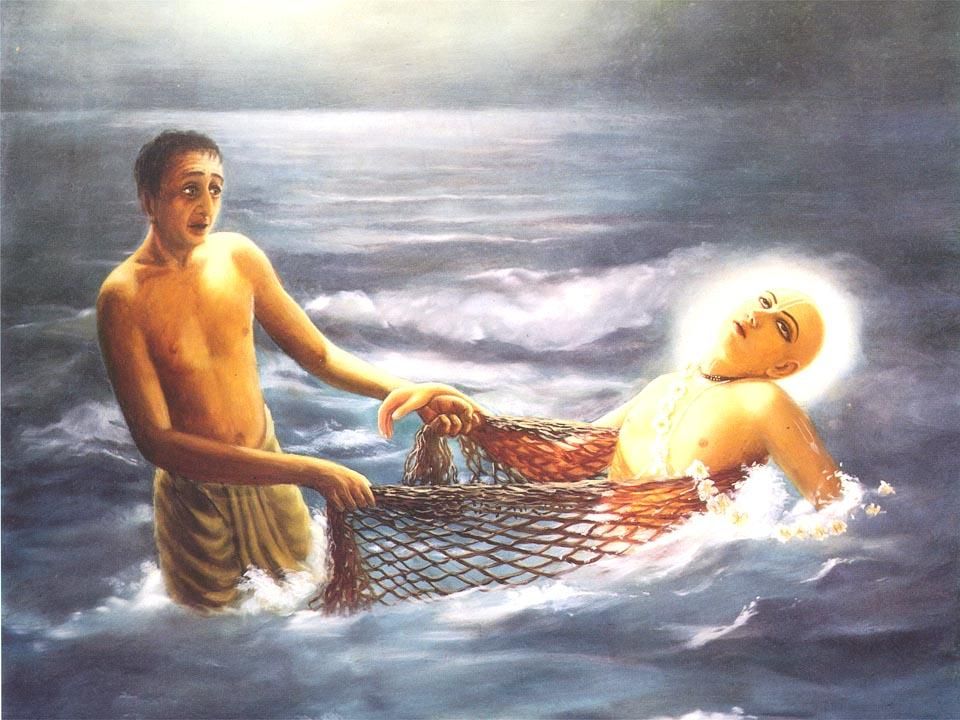
In the brilliant autumn moonlight, Śrī Caitanya Mahāprabhu mistook the sea for the river Yamunā. Greatly afflicted by separation from Kṛṣṇa, He ran and dove into the sea and remained unconscious in the water the entire night. In the morning, He was found by His personal devotees. May that Śrī Caitanya Mahāprabhu, the son of mother Śacī, protect us by His transcendental pastimes. (1) All glories to Śrī Caitanya Mahāprabhu! All glories to Nityānanda Prabhu! All glories to Advaita Ācārya! And all glories to all the devotees of Śrī Caitanya Mahāprabhu! (2) While thus living at Jagannātha Purī, Śrī Caitanya Mahāprabhu floated all day and night in an ocean of separation from Kṛṣṇa. (3) During a night of the autumn season when a full moon brightened everything, Śrī Caitanya Mahāprabhu wandered all night long with His devotees. (4)
He walked from garden to garden, seeing the pastimes of Lord Kṛṣṇa and hearing and reciting songs and verses concerning the rāsa- līlā. (5) He sang and danced in ecstatic love and sometimes imitated the rāsa dance in emotional ecstasy. (6) He sometimes ran here and there in the madness of ecstasy and sometimes fell and rolled on the ground. Sometimes He became completely unconscious. (7) When He heard Svarūpa Dāmodara recite a verse concerning the rāsa- līlā or He Himself recited one, He would personally explain it, as He had previously done. (8) In this way, He explained the meaning of all the verses concerning the rāsa- līlā. Sometimes He would be very sad and sometimes very happy. (9) To explain fully all those verses and all the transformations that took place in the Lord’s body would require a very large volume. (10) So as not to increase the size of this book, I have not written about all the Lord’s pastimes, for He performed them every moment of every day for twelve years. (11)
As I have previously indicated, I am describing the mad speeches and bodily transformations of the Lord only in brief. (12) If Ananta, with His one thousand hoods, tried to describe even one day’s pastimes of Śrī Caitanya Mahāprabhu, He would find them impossible to describe fully. (13) If Gaṇeśa, Lord Śiva’s son and the expert scribe of the demigods, tried for millions of millenniums to fully describe one day of the Lord’s pastimes, he would be unable to find their limit. (14) Even Lord Kṛṣṇa is struck with wonder at seeing the transformations of ecstasy in His devotees. If Kṛṣṇa Himself cannot estimate the limits of such emotions, how could others? (15) Kṛṣṇa Himself cannot fully understand the conditions, the mode of progress, the happiness and unhappiness, and the moods of ecstatic love of His devotees. He therefore accepts the role of a devotee to taste these emotions fully. (16 17) Ecstatic love of Kṛṣṇa makes Kṛṣṇa and His devotees dance, and it also dances personally. In this way, all three dance together in one place. (18)
One who wants to describe the transformations of ecstatic love of Kṛṣṇa is like a dwarf trying to catch the moon in the sky. (19) As the wind can carry away but a drop of the water in the ocean, a living entity can touch only a particle of the ocean of love of Kṛṣṇa. (20) Endless waves arise moment after moment in that ocean of love. How could an insignificant living entity estimate their limits? (21) Only a person on the level of Svarūpa Dāmodara Gosvāmī can fully know what Lord Śrī Caitanya Mahāprabhu tastes in His love for Kṛṣṇa. (22) When an ordinary living entity describes the pastimes of Śrī Caitanya Mahāprabhu, he purifies himself by touching one drop of that great ocean. (23) Thus all the verses about the rāsa- līlā dance were recited. Then finally the verse concerning the pastimes in the water was recited. (24)
“As an independent leader among elephants enters the water with its female elephants, Kṛṣṇa, who is transcendental to the Vedic principles of morality, entered the water of the Yamunā with the gopīs. His chest had brushed against their breasts, crushing His flower garland and coloring it with red kuṅkuma powder. Attracted by the fragrance of that garland, humming bumblebees followed Kṛṣṇa like celestial beings of Gandharvaloka. In this way, Lord Kṛṣṇa mitigated the fatigue of the rāsa dance.” (25) While thus wandering near the temple of Āiṭoṭā, Śrī Caitanya Mahāprabhu suddenly saw the sea. (26) Brightened by the shining light of the moon, the high waves of the sea glittered like the waters of the river Yamunā. (27) Mistaking the sea for the Yamunā, the Lord ran swiftly and jumped into the water, unseen by the others. (28) Falling into the sea, He lost consciousness and could not understand where He was. Sometimes He sank beneath the waves, and sometimes He floated above them. (29)
The waves carried Him here and there like a piece of dry wood. Who can understand this dramatic performance by Śrī Caitanya Mahāprabhu? (30) Keeping the Lord sometimes submerged and sometimes afloat, the waves carried Him toward the Koṇārka temple. (31) Śrī Caitanya Mahāprabhu fully merged in the pastimes Lord Kṛṣṇa performed with the gopīs in the waters of the Yamunā. (32) Meanwhile, all the devotees, headed by Svarūpa Dāmodara, lost sight of Śrī Caitanya Mahāprabhu. Astonished, they began searching for Him, asking, “Where has the Lord gone?” (33) Śrī Caitanya Mahāprabhu had run off at the speed of the mind. No one could see Him. Thus everyone was puzzled as to His whereabouts. (34) “Has the Lord gone to the temple of Jagannātha, or has He fallen down in madness in some garden? (35) “Perhaps He went to the Guṇḍicā temple, or to Lake Narendra, or to the Caṭaka- parvata. Maybe He went to the temple at Koṇārka.” (36)
Talking like this, the devotees wandered here and there looking for the Lord. Finally they came to the shore, accompanied by many others. (37) While they were searching for the Lord, the night ended, and thus they all decided, “Lord Śrī Caitanya Mahāprabhu has now disappeared.” (38) In separation from the Lord, everyone felt as though he had lost his very life. The devotees concluded that there must have been some mishap. They could not think of anything else. (39) “A relative or intimate friend is always fearful of some injury to his beloved.” (40) When they arrived at the seashore, they conferred among themselves. Then some of them sought out Śrī Caitanya Mahāprabhu at Caṭaka- parvata. (41) Svarūpa Dāmodara proceeded east with others, looking for the Lord on the beach or in the water. (42)
Everyone was overwhelmed with moroseness and almost unconscious, but out of ecstatic love they continued to wander here and there, searching for the Lord. (43) Passing along the beach, they saw a fisherman approaching with his net over his shoulder. Laughing, crying, dancing and singing, he kept repeating the holy name “Hari, Hari.” (44) Seeing the activities of the fisherman, everyone was astonished. Svarūpa Dāmodara Gosvāmī, therefore, asked him for information. (45) “My dear fisherman,” he said, “why are you behaving like this? Have you seen someone hereabouts? What is the cause of your behavior? Please tell us.” (46) The fisherman replied, “I have not seen a single person here, but while casting my net in the water, I captured a dead body. (47)
“I lifted it with great care, thinking it a big fish, but as soon as I saw that it was a corpse, great fear arose in my mind. (48) “As I tried to release the net, I touched the body, and as soon as I touched it, a ghost entered my heart. (49) “I shivered in fear and shed tears. My voice faltered, and all the hairs on my body stood up. (50) “I do not know whether the corpse I found was the ghost of a dead brāhmaṇa or an ordinary man, but as soon as one looks upon it, the ghost enters his body. (51) The body of this ghost is very long, five to seven cubits. Each of its arms and legs is as much as three cubits long. (52) “Its joints are all separated beneath the skin, which is completely slack. No one could see it and remain alive in his body. (53)
“That ghost has taken the form of a corpse, but He keeps his eyes open. Sometimes He utters the sounds ‘goṅ- goṅ,’ and sometimes He remains unconscious. (54) “I have seen that ghost directly, and He is haunting me. But if I die, who will take care of my wife and children? (55) “The ghost is certainly very difficult to talk about, but I am going to find an exorcist and ask him if he can release me from it. (56) “I wander alone at night killing fish in solitary places, but because I remember the hymn to Lord Nṛsiṁha, ghosts do not touch me. (57) This ghost, however, overcomes me with redoubled strength when I chant the Nṛsiṁha mantra. When I even see the form of this ghost, great fear arises in my mind. (58) “Do not go near there. I forbid you. If you go, that ghost will catch you all.” (59)
Deepen your Bhakti-yoga practice, harmonize relationships, and receive guided coaching — all at Vedavarsity.com