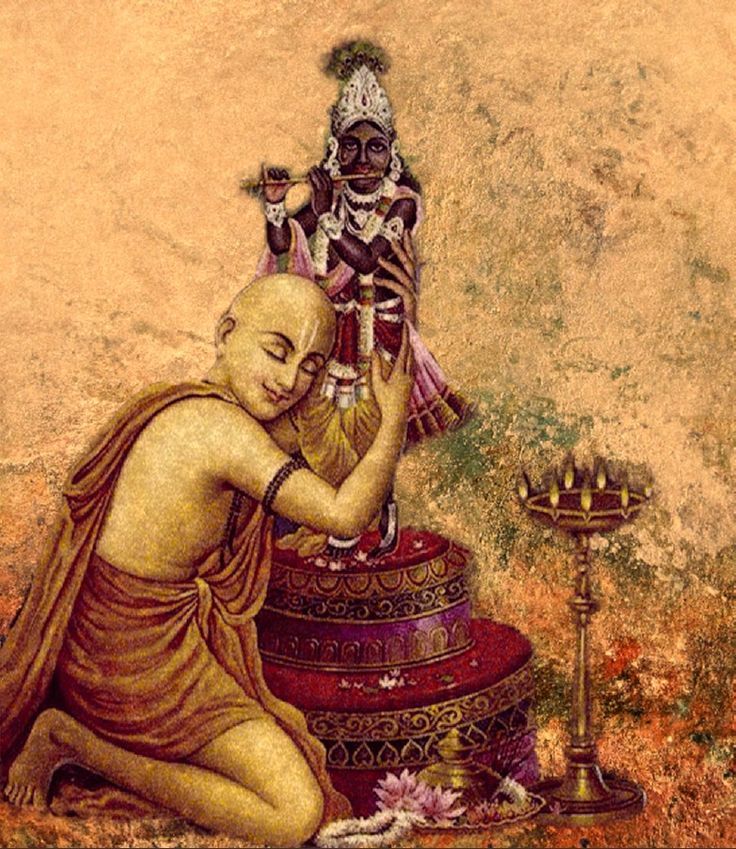
Let me offer my respectful obeisances unto Śrī Caitanya Mahāprabhu, who personally tasted the nectar of ecstatic love for Kṛṣṇa and then instructed His devotees how to taste it. Thus He enlightened them about ecstatic love of Kṛṣṇa to initiate them into transcendental knowledge. (1) All glories to Śrī Caitanya Mahāprabhu! All glories to Lord Nityānanda! All glories to Advaita Ācārya! And all glories to all the devotees of the Lord! (2) Śrī Caitanya Mahāprabhu thus stayed at Jagannātha Purī in the association of His devotees, always merged in ecstatic devotional love. (3) The next year, as usual, all the devotees from Bengal went to Jagannātha Purī, and, as in previous years, there was a meeting between Śrī Caitanya Mahāprabhu and the devotees. (4)
Along with the devotees from Bengal came a gentleman named Kālidāsa. He never uttered anything but the holy name of Kṛṣṇa. (5) Kālidāsa was a very advanced devotee, yet he was simple and liberal. He would chant the holy name of Kṛṣṇa while performing all his ordinary dealings. (6) When he used to throw dice in jest, he would chant Hare Kṛṣṇa while throwing the dice. (7) Kālidāsa was an uncle of Raghunātha dāsa Gosvāmī. Throughout his entire life, even in his old age, he tried to eat the remnants of food left by Vaiṣṇavas. (8) Kālidāsa ate the remnants of food of as many Vaiṣṇavas as there were in Bengal. (9) He would go to all the Vaiṣṇavas born in brāhmaṇa families, be they neophyte or advanced devotees, and present them with gifts of first- class eatables. (10) He would beg remnants of food from such Vaiṣṇavas, and if he did not receive any, he would hide. (11) After the Vaiṣṇavas finished eating, they would throw away their leaf dishes, and Kālidāsa would come out of hiding, take the leaves and lick up the remnants. (12)
He would also take gifts to the homes of Vaiṣṇavas born in śūdra families. Then he would hide and in this manner eat the remnants of food they threw away. (13) There was a great Vaiṣṇava named Jhaḍu Ṭhākura, who belonged to the bhūṅimāli caste. Kālidāsa went to his home, taking mangoes with him. (14) Kālidāsa presented the mangoes to Jhaḍu Ṭhākura and offered him respectful obeisances. Then he also offered respectful obeisances to the Ṭhākura’s wife. (15) When Kālidāsa went to Jhaḍu Ṭhākura, he saw that saintly person sitting with his wife. As soon as Jhaḍu Ṭhākura saw Kālidāsa, he likewise offered his respectful obeisances unto him. (16) After a discussion with Kālidāsa that lasted for some time, Jhaḍu Ṭhākura spoke the following sweet words. (17) “I belong to a low caste, and you are a very respectable guest. How shall I serve you? (18) “If you will permit me, I shall send some food to a brāhmaṇa’s house, and there you may take prasādam. If you do so, I shall then live very comfortably.” (19)
Kālidāsa replied, “My dear sir, please bestow your mercy upon me. I have come to see you, although I am very fallen and sinful. (20) “Simply by seeing you, I have become purified. I am very much obligated to you, for my life is now successful. (21) “My dear sir, I have one desire. Please be merciful to me by kindly placing your feet upon my head so that the dust on your feet may touch it.” (22) Jhaḍu Ṭhākura replied, “It does not befit you to ask this of me. I belong to a very low- caste family, whereas you are a respectable rich gentleman.” (23) Kālidāsa then recited some verses, which Jhaḍu Ṭhākura was very happy to hear. (24) “‘Even though one is a very learned scholar in Sanskrit literature, if he is not engaged in pure devotional service, he is not accepted as My devotee. But if someone born in a family of dog- eaters is a pure devotee with no motives for enjoyment through fruitive activity or mental speculation, he is very dear to Me. All respect should be given to him, and whatever he offers should be accepted, for such devotees are indeed as worshipable as I am.’ (25)
“‘A person may be born in a brāhmaṇa family and have all twelve brahminical qualities, but if in spite of being qualified he is not devoted to the lotus feet of Lord Kṛṣṇa, who has a navel shaped like a lotus, he is not as good as a caṇḍāla who has dedicated his mind, words, activities, wealth and life to the service of the Lord. Simply to take birth in a brāhmaṇa family or to have brahminical qualities is not sufficient. One must become a pure devotee of the Lord. If a śva- paca or caṇḍāla is a devotee, he delivers not only himself but his whole family, whereas a brāhmaṇa who is not a devotee but simply has brahminical qualifications cannot even purify himself, what to speak of his family.’ (26)
“‘My dear Lord, anyone who always keeps Your holy name on his tongue is greater than an initiated brāhmaṇa. Although he may be born in a family of dog- eaters and therefore, by material calculations, be the lowest of men, he is glorious nevertheless. That is the wonderful power of chanting the holy name of the Lord. One who chants the holy name is understood to have performed all kinds of austerities. He has studied all the Vedas, he has performed all the great sacrifices mentioned in the Vedas, and he has already taken his bath in all the holy places of pilgrimage. It is he who is factually the Āryan.'” (27) Hearing these quotations from the revealed scripture Śrīmad- Bhāgavatam, Jhaḍu Ṭhākura replied, “Yes, this is true, for it is the version of śāstra. It is true, however, for one who is genuinely advanced in devotion to Kṛṣṇa. (28) “Such a position may befit others, but I do not possess such spiritual power. I belong to a lower class and have not even a pinch of devotion to Kṛṣṇa.” (29)
Kālidāsa again offered his obeisances to Jhaḍu Ṭhākura and asked his permission to go. The saint Jhaḍu Ṭhākura followed him as he left. (30) After bidding farewell to Kālidāsa, Jhaḍu Ṭhākura returned to his home, leaving the marks of his feet plainly visible in many places. (31) Kālidāsa smeared the dust from those footprints all over his body. Then he hid in a place near Jhaḍu Ṭhākura’s home. (32) Upon returning home, Jhaḍu Ṭhākura saw the mangoes Kālidāsa had presented. Within his mind he offered them to Kṛṣṇa- candra. (33) Jhaḍu Ṭhākura’s wife then took the mangoes from their covering of banana tree leaves and bark and offered them to Jhaḍu Ṭhākura, who began to suck and eat them. (34) When he finished eating, he left the seeds on the banana leaf, and his wife, after feeding her husband, later began to eat. (35) After she finished eating, she filled the banana leaves and bark with the seeds, picked up the refuse and then threw it into the ditch where all the refuse was thrown. (36)
Kālidāsa licked the banana bark and the mango seeds and skins, and while licking them he was overwhelmed with jubilation in ecstatic love. (37) In this way Kālidāsa ate the remnants of food left by all the Vaiṣṇavas residing in Bengal. (38) When Kālidāsa visited Jagannātha Purī, Nīlācala, Śrī Caitanya Mahāprabhu bestowed great mercy upon him. (39) Śrī Caitanya Mahāprabhu would regularly visit the temple of Jagannātha every day, and at that time Govinda, His personal servant, used to carry His waterpot and go with Him. (40) On the northern side of the Siṁha- dvāra, behind the door, there are twenty- two steps leading to the temple, and at the bottom of those steps is a ditch. (41) Śrī Caitanya Mahāprabhu would wash His feet in this ditch, and then He would enter the temple to see Lord Jagannātha. (42) Śrī Caitanya Mahāprabhu ordered His personal servant Govinda that no one should take the water that had washed His feet. (43)
Because of the Lord’s strict order, no living being could take the water. Some of His intimate devotees, however, would take it by some trick. (44) One day as Śrī Caitanya Mahāprabhu was washing His feet in that place, Kālidāsa came and extended his palm to take the water. (45) Kālidāsa drank one palmful and then a second and a third. Then Śrī Caitanya Mahāprabhu forbade him to drink more. (46) “Do not act in this way any more. I have fulfilled your desire as far as possible.” (47) Śrī Caitanya Mahāprabhu is the most exalted, omniscient Supreme Personality of Godhead, and therefore He knew that Kālidāsa, in the core of his heart, had full faith in Vaiṣṇavas. (48) Because of this quality, Śrī Caitanya Mahāprabhu satisfied him with mercy not attainable by anyone else. (49) On the southern side, behind and above the twenty- two steps, is a Deity of Lord Nṛsiṁhadeva. It is on the left as one goes up the steps toward the temple. (50)
Śrī Caitanya Mahāprabhu, His left side toward the Deity, offered obeisances to Lord Nṛsiṁha as He proceeded toward the temple. He recited the following verses again and again while offering obeisances. (51) “‘I offer my respectful obeisances unto You, Lord Nṛsiṁhadeva. You are the giver of pleasure to Mahārāja Prahlāda, and Your nails cut the chest of Hiraṇyakaśipu like a chisel cutting stone. (52) “‘Lord Nṛsiṁhadeva is here, and He is also there on the opposite side. Wherever I go, there I see Lord Nṛsiṁhadeva. He is outside and within my heart. Therefore I take shelter of Lord Nṛsiṁhadeva, the original Supreme Personality of Godhead.'” (53)
Having offered obeisances to Lord Nṛsiṁhadeva, Śrī Caitanya Mahāprabhu visited the temple of Lord Jagannātha. Then He returned to His residence, finished His noon duties and took His lunch. (54) Kālidāsa was standing outside the door, expecting the remnants of food from Śrī Caitanya Mahāprabhu. Knowing this, Mahāprabhu gave an indication to Govinda. (55) Govinda understood all the indications of Śrī Caitanya Mahāprabhu. Therefore he immediately delivered the remnants of Śrī Caitanya Mahāprabhu’s food to Kālidāsa. (56) Taking the remnants of the food of Vaiṣṇavas is so valuable that it induced Śrī Caitanya Mahāprabhu to offer Kālidāsa His supreme mercy. (57)
Deepen your Bhakti-yoga practice, harmonize relationships, and receive guided coaching — all at Vedavarsity.com