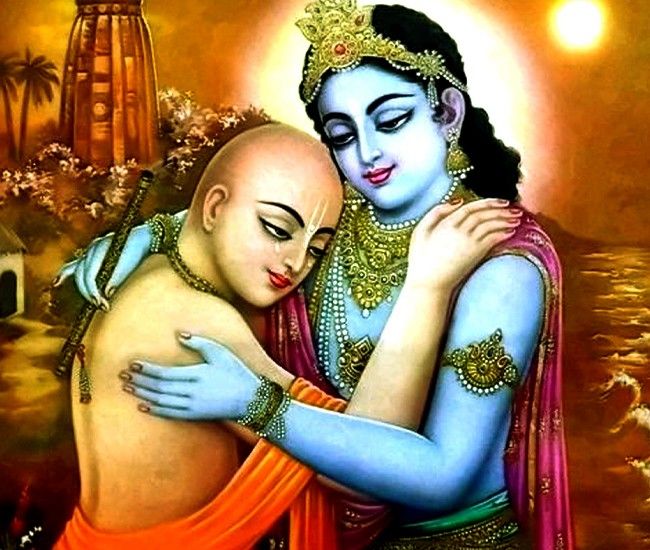
I shall now describe a very small portion of the activities performed by Śrī Caitanya Mahāprabhu with His mind, intelligence and body when He was bewildered by strong feelings of separation from Kṛṣṇa. (1) All glories to Śrī Caitanya Mahāprabhu, the Supreme Personality of Godhead! All glories to Lord Gauracandra, the life and soul of His devotees! (2) All glories to Lord Nityānanda, who is Śrī Caitanya Mahāprabhu’s very life! And all glories to Advaita Ācārya, who is extremely dear to Śrī Caitanya Mahāprabhu! (3) All glories to Svarūpa Dāmodara and all the other devotees, headed by Śrīvāsa Ṭhākura! Please give me the strength to describe the character of Śrī Caitanya Mahāprabhu. (4)
Śrī Caitanya Mahāprabhu’s emotion of transcendental madness in separation from Kṛṣṇa is very deep and mysterious. Even though one is very advanced and learned, he cannot understand it. (5) How can one describe unfathomable subject matters? It is possible only if Śrī Caitanya Mahāprabhu gives him the capability. (6) Svarūpa Dāmodara Gosvāmī and Raghunātha dāsa Gosvāmī recorded all these transcendental activities of Śrī Caitanya Mahāprabhu in their notebooks. (7) In those days, Svarūpa Dāmodara and Raghunātha dāsa Gosvāmī lived with Śrī Caitanya Mahāprabhu, whereas all other commentators lived far away from Him. (8) These two great personalities [Svarūpa Dāmodara and Raghunātha dāsa Gosvāmī] recorded the activities of Śrī Caitanya Mahāprabhu moment by moment. They described these activities briefly as well as elaborately in their notebooks. (9)
Svarūpa Dāmodara wrote short notes, whereas Raghunātha dāsa Gosvāmī wrote elaborate descriptions. I shall now describe Śrī Caitanya Mahāprabhu’s activities more elaborately, as if fluffing out compressed cotton. (10) Please hear faithfully this description of Caitanya Mahāprabhu’s ecstatic emotions. Thus you will come to know of His ecstatic love, and ultimately you will achieve love of Godhead. (11) When Śrī Caitanya Mahāprabhu felt separation from Kṛṣṇa, His condition exactly corresponded to that of the gopīs in Vṛndāvana after Kṛṣṇa’s departure for Mathurā. (12) The lamentation of Śrīmatī Rādhārāṇī when Uddhava visited Vṛndāvana gradually became a feature of Śrī Caitanya Mahāprabhu’s transcendental madness. (13)
Śrī Caitanya Mahāprabhu’s emotions exactly corresponded to those of Śrīmatī Rādhārāṇī when She met Uddhava. The Lord always conceived of Himself in Her position and sometimes thought that He was Śrīmatī Rādhārāṇī Herself. (14) Such is the state of transcendental madness. Why is it difficult to understand? When one is highly elevated in love of Kṛṣṇa, he becomes transcendentally mad and talks like a madman. (15) “When the ecstatic emotion of enchantment gradually progresses, it becomes similar to bewilderment. Then one reaches the stage of astonishment [vaicitrī], which awakens transcendental madness. Udghūrṇā and citra- jalpa are two among the many divisions of transcendental madness.” (16)
One day while He was resting, Śrī Caitanya Mahāprabhu dreamed He saw Kṛṣṇa performing His rāsa dance. (17) Śrī Caitanya Mahāprabhu saw Lord Kṛṣṇa standing with His beautiful body curved in three places, holding His flute to His lips. Wearing yellow garments and garlands of forest flowers, He was enchanting even to Cupid. (18) The gopīs were dancing in a circle, and in the middle of that circle, Kṛṣṇa, the son of Mahārāja Nanda, danced with Rādhārāṇī. (19) Seeing this, Śrī Caitanya Mahāprabhu was overwhelmed with the transcendental mellow of the rāsa dance, and He thought, “Now I am with Kṛṣṇa in Vṛndāvana.” (20) When Govinda saw that the Lord had not yet risen, he awakened Him. Understanding that He had only been dreaming, the Lord was somewhat unhappy. (21) Śrī Caitanya Mahāprabhu performed His customary daily duties, and at the usual time He went to see Lord Jagannātha in the temple. (22)
As He viewed Lord Jagannātha from behind the Garuḍa column, hundreds and thousands of people in front of Him were seeing the Deity. (23) Suddenly, a woman from Orissa, unable to see Lord Jagannātha because of the crowd, climbed the column of Garuḍa, placing her foot on Śrī Caitanya Mahāprabhu’s shoulder. (24) When he saw this, Caitanya Mahāprabhu’s personal servant, Govinda, hastily got her down from her position. Śrī Caitanya Mahāprabhu, however, chastised him for this. (25) Śrī Caitanya Mahāprabhu said to Govinda, “O ādi- vasyā [uncivilized man], do not forbid this woman to climb the Garuḍa- stambha. Let her see Lord Jagannātha to her satisfaction.” (26)
When the woman came to her senses, however, she quickly climbed back down to the ground and, seeing Śrī Caitanya Mahāprabhu, immediately begged at His lotus feet for forgiveness. (27) Seeing the woman’s eagerness, Śrī Caitanya Mahāprabhu said, “Lord Jagannātha has not bestowed so much eagerness upon Me. (28) “She has fully absorbed her body, mind and life in Lord Jagannātha. Therefore she was unaware that she was putting her foot on My shoulder. (29) “Alas! How fortunate this woman is! I pray at her feet that she favor Me with her great eagerness to see Lord Jagannātha.” (30) Just previously, Śrī Caitanya Mahāprabhu had been seeing Lord Jagannātha as Kṛṣṇa, the son of Mahārāja Nanda, in person. (31) Becoming fully absorbed in that vision, Śrī Caitanya Mahāprabhu had assumed the mood of the gopīs, so much so that everywhere He looked He saw Kṛṣṇa standing with His flute to His lips. (32)
After seeing the woman, the Lord’s external consciousness returned, and He saw the original deity forms of Lord Jagannātha, Subhadrā and Lord Balarāma. (33) When He saw the deities, Lord Caitanya thought He was seeing Kṛṣṇa in Kurukṣetra. He wondered, “Have I come to Kurukṣetra? Where is Vṛndāvana?” (34) Lord Caitanya grew very much agitated, like a person who has just lost a recently acquired jewel. Then He became very morose and returned home. (35) Śrī Caitanya Mahāprabhu sat down on the ground and began to mark it with His fingernails. He was blinded by tears, which flowed from His eyes like the Ganges. (36) Śrī Caitanya Mahāprabhu said, “I found Kṛṣṇa, the Lord of Vṛndāvana, but I have lost Him again. Who has taken My Kṛṣṇa? Where have I come?” (37)
When Śrī Caitanya Mahāprabhu dreamed of the rāsa dance, He was fully absorbed in transcendental bliss, but when His dream broke, He thought He had lost a precious jewel. (38) Thus Śrī Caitanya Mahāprabhu would chant and dance, always absorbed in the bliss of transcendental madness. He carried out the necessities of the body, such as eating and bathing, merely out of habit. (39) At night, Lord Caitanya would reveal to Svarūpa Dāmodara and Rāmānanda Rāya the ecstatic feelings of His mind. (40) Śrī Caitanya Mahāprabhu said, “At first My mind somehow achieved the treasure of Kṛṣṇa, but it again lost Him. Therefore it gave up My body and home because of lamentation and accepted the religious principles of a kāpālika- yogī. Then My mind went to Vṛndāvana with its disciples, My senses.” (41)
Having lost His acquired gem, Śrī Caitanya Mahāprabhu became overwhelmed with lamentation by remembering its attributes. Then, grasping the necks of Rāmānanda Rāya and Svarūpa Dāmodara Gosvāmī, He cried, “Alas, where is My Lord Hari? Where is Hari?” Finally He became restless and lost all patience. (42) “My dear friends,” He said, “please hear of Kṛṣṇa’s sweetness. Because of a great desire for that sweetness, My mind has given up all social and Vedic religious principles and taken to the profession of begging, exactly like a mystic yogī. (43) “The ring of Kṛṣṇa’s rāsa- līlā, manufactured by Śukadeva Gosvāmī, the most auspicious craftsman, is as pure as an earring made from a conchshell. The yogī of My mind is wearing that earring upon his ear. From a gourd he has carved out the bowl of My aspirations, and he has taken the bag of My expectations on his shoulder. (44)
“The yogī of My mind wears the torn quilt of anxiety on his dirty body, which is covered with dust and ashes. His only words are ‘Alas! Kṛṣṇa!’ He wears twelve bangles of distress on his wrist and a turban of greed on his head. Because he has not eaten anything, he is very thin. (45) “The great yogī of My mind always studies the poetry and discussions of Lord Kṛṣṇa’s Vṛndāvana pastimes. In Śrīmad- Bhāgavatam and other scriptures, great saintly yogīs like Vyāsadeva and Śukadeva Gosvāmī have described Lord Kṛṣṇa as the Supersoul, beyond all material contamination. (46) “The mystic yogī of My mind has assumed the name Mahābāula and made disciples of My ten senses. Thus My mind has gone to Vṛndāvana, leaving aside the home of My body and the great treasure of material enjoyment. (47) “In Vṛndāvana, he goes from door to door begging alms with all his disciples. He begs from both the moving and the inert inhabitants-the citizens, the trees and the creepers. In this way he lives on fruits, roots and leaves. (48)
“The gopīs of Vrajabhūmi always taste the nectar of Kṛṣṇa’s attributes, His beauty, His sweetness, His aroma, the sound of His flute and the touch of His body. My mind’s five disciples, the senses of perception, gather the remnants of that nectar from the gopīs and bring them to the yogī of My mind. The senses maintain their lives by eating those remnants. (49) “There is a solitary garden where Kṛṣṇa enjoys His pastimes, and in one corner of a pavilion in that garden, the yogī of My mind, along with his disciples, practices mystic yoga. Wanting to see Kṛṣṇa directly, this yogī remains awake throughout the night, meditating on Kṛṣṇa, who is the Supersoul, uncontaminated by the three modes of nature. (50) “When My mind lost the association of Kṛṣṇa and could no longer see Him, he became depressed and took up mystic yoga. In the void of separation from Kṛṣṇa, he experienced ten transcendental transformations. Agitated by these transformations, My mind fled, leaving My body, his place of residence, empty. Thus I am completely in trance.” (51)
When the gopīs felt separation from Kṛṣṇa, they experienced ten kinds of bodily transformations. These same symptoms appeared in the body of Śrī Caitanya Mahāprabhu. (52) “The ten bodily transformations resulting from separation from Kṛṣṇa are anxiety, wakefulness, mental agitation, thinness, uncleanliness, talking like a madman, disease, madness, illusion and death.” (53) Śrī Caitanya Mahāprabhu was overwhelmed night and day by these ten ecstatic conditions. Whenever such symptoms arose, His mind became unsteady. (54) After speaking in this way, Śrī Caitanya Mahāprabhu fell silent. Then Rāmānanda Rāya began to recite various verses. (55) Rāmānanda Rāya recited verses from Śrīmad- Bhāgavatam, and Svarūpa Dāmodara Gosvāmī sang of Kṛṣṇa’s pastimes. In this way, they brought Śrī Caitanya Mahāprabhu to external consciousness. (56)
After half the night had passed in this way, Rāmānanda Rāya and Svarūpa Dāmodara Gosvāmī made Śrī Caitanya Mahāprabhu lie down on His bed in the inner room. (57) Then Rāmānanda Rāya returned home, and Svarūpa Dāmodara Gosvāmī and Govinda lay down in front of the door to Śrī Caitanya Mahāprabhu’s room. (58) Śrī Caitanya Mahāprabhu remained awake throughout the entire night, chanting the Hare Kṛṣṇa mantra very loudly. (59) After some time, Svarūpa Dāmodara could no longer hear Śrī Caitanya Mahāprabhu chanting. When he entered the room, he found the three doors locked, but Śrī Caitanya Mahāprabhu was gone. (60) All the devotees were very anxious when they saw that the Lord was not in His room. They wandered about searching for Him with a warning lamp. (61)
After searching for some time, they came upon Śrī Caitanya Mahāprabhu lying in a corner by the northern side of the Siṁha- dvāra gate. (62) At first they were overjoyed to see Him, but when they saw His condition, all the devotees, headed by Svarūpa Dāmodara Gosvāmī, were very anxious. (63) Śrī Caitanya Mahāprabhu was lying unconscious, and His body had become elongated to five or six cubits. There was no breath from His nostrils. (64) Each of His arms and legs had become three cubits long; only skin connected the separated joints. The Lord’s body temperature, indicating life, was very low. All the joints in His arms, legs, neck and waist were separated by at least six inches. (65-66) It appeared that only skin covered His elongated joints. Seeing the Lord’s condition, all the devotees were very unhappy. (67) They almost died when they saw Śrī Caitanya Mahāprabhu with His mouth full of saliva and foam and His eyes turned upward. (68)
When they saw this, Svarūpa Dāmodara Gosvāmī and all the other devotees began to chant the holy name of Kṛṣṇa very loudly into Śrī Caitanya Mahāprabhu’s ear. (69) After they had chanted in this way for a long time, the holy name of Kṛṣṇa entered the heart of Śrī Caitanya Mahāprabhu, and He suddenly arose with a loud shout of “Haribol!” (70) As soon as the Lord returned to external consciousness, all His joints contracted and His entire body returned to normal. (71) Śrīla Raghunātha dāsa Gosvāmī has described these pastimes elaborately in his book Gaurāṅga- stava- kalpavṛkṣa. (72)
“In the house of Kāśī Miśra, Śrī Caitanya Mahāprabhu would sometimes be greatly aggrieved, feeling separation from Kṛṣṇa. The joints of His transcendental body would slacken, and His arms and legs would become elongated. Rolling on the ground, the Lord would cry out in distress in a faltering voice and weep very sorrowfully. The appearance of Śrī Caitanya Mahāprabhu, awakening in my heart, maddens me.” (73) Śrī Caitanya Mahāprabhu was very much astonished to find Himself in front of the Siṁha- dvāra. He asked Svarūpa Dāmodara Gosvāmī, “Where am I? What am I doing here?” (74) Svarūpa Dāmodara said, “My dear Lord, please get up. Let us go to Your place. There I shall tell You everything that has happened.” (75)
Thus all the devotees, supporting Śrī Caitanya Mahāprabhu, took Him back to His residence. Then they all described to Him what had happened. (76) Hearing the description of His condition while He had lain near the Siṁha- dvāra, Śrī Caitanya Mahāprabhu was very much astonished. He said, “I do not remember any of these things. (77) “All I can remember is that I saw My Kṛṣṇa, but only for an instant. He appeared before Me and then, like lightning, immediately disappeared.” (78) Just then, everyone heard the blowing of the conchshell at the Jagannātha temple. Śrī Caitanya Mahāprabhu immediately took His bath and went to see Lord Jagannātha. (79)
Deepen your Bhakti-yoga practice, harmonize relationships, and receive guided coaching — all at Vedavarsity.com