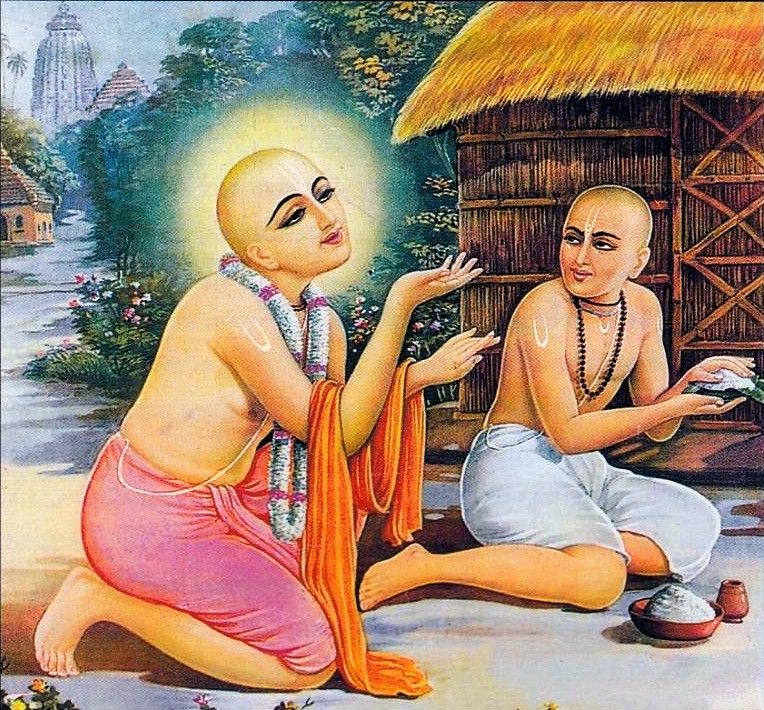
Every day Śrī Caitanya Mahāprabhu would go there to meet these two stalwart devotees and discuss topics of Kṛṣṇa with them for some time. (52) The offerings of prasādam in the temple of Lord Jagannātha were of the highest quality. Śrī Caitanya Mahāprabhu would bring this prasādam and deliver it to the two devotees. (53) One day when the Lord came to meet them, He suddenly began speaking to Sanātana Gosvāmī. (54) “My dear Sanātana,” He said, “if I could attain Kṛṣṇa by committing suicide, I would certainly give up millions of bodies without a moment’s hesitation. (55) “You should know that one cannot attain Kṛṣṇa simply by giving up the body. Kṛṣṇa is attainable by devotional service. There is no other means for attaining Him. (56)
“Acts such as suicide are influenced by the mode of ignorance, and in ignorance and passion one cannot understand who Kṛṣṇa is. (57) “Unless one discharges devotional service, one cannot awaken one’s dormant love for Kṛṣṇa, and there is no means for attaining Him other than awakening that dormant love. (58) “[The Supreme Personality of Godhead, Kṛṣṇa, said:] ‘My dear Uddhava, neither through aṣṭāṅga- yoga [the mystic yoga system for controlling the senses], nor through impersonal monism or an analytical study of the Absolute Truth, nor through study of the Vedas, nor through austerities, charity or acceptance of sannyāsa can one satisfy Me as much as by developing unalloyed devotional service unto Me.’ (59)
“Measures like suicide are causes for sin. A devotee never achieves shelter at Kṛṣṇa’s lotus feet by such actions.(60) “Because of feelings of separation from Kṛṣṇa, an exalted devotee sometimes wants to give up his life. By such ecstatic love, however, one attains the audience of Kṛṣṇa, and at that time he cannot give up his body. (61) “One who is deeply in love with Kṛṣṇa cannot tolerate separation from the Lord. Therefore such a devotee always desires his own death. (62) “‘O lotus- eyed one, great personalities like Lord Śiva desire to bathe in the dust of Your lotus feet to drive away ignorance. If I do not get the mercy of Your Lordship, I shall observe vows to reduce the duration of my life, and thus I shall give up bodies for hundreds of births if it is possible to get Your mercy in that way.’ (63)
“‘O dear Kṛṣṇa, by Your smiling glances and melodious talk, You have awakened a fire of lusty desire in our hearts. Now You should extinguish that fire with a stream of nectar from Your lips by kissing us. Kindly do this. Otherwise, dear friend, the fire within our hearts will burn our bodies to ashes because of separation from You. Thus by meditation we shall claim shelter at Your lotus feet.'” (64) Caitanya Mahāprabhu told Sanātana Gosvāmī, “Give up all your nonsensical desires, for they are unfavorable for getting shelter at the lotus feet of Kṛṣṇa. Engage yourself in chanting and hearing. Then you will soon achieve the shelter of Kṛṣṇa without a doubt. (65) “A person born in a low family is not unfit for discharging devotional service to Lord Kṛṣṇa, nor is one fit for devotional service simply because he is born in an aristocratic family of brāhmaṇas. (66) “Anyone who takes to devotional service is exalted, whereas a nondevotee is always condemned and abominable. Therefore in the discharge of devotional service to the Lord, there is no consideration of the status of one’s family. (67)
“The Supreme Personality of Godhead, Kṛṣṇa, is always favorable to the humble and meek, but aristocrats, learned scholars and the wealthy are always proud of their positions. (68) “‘One may be born in a brāhmaṇa family and have all twelve brahminical qualities, but if in spite of being thus qualified he is not devoted to the lotus feet of Lord Kṛṣṇa, who has a navel shaped like a lotus, he is not as good as a caṇḍāla who has dedicated his mind, words, activities, wealth and life to the service of the Lord. Simply to take birth in a brāhmaṇa family or to have brahminical qualities is not sufficient. One must be a pure devotee of the Lord. Thus if a śva- paca, or caṇḍāla, is a devotee, he delivers not only himself but his entire family as well, whereas a brāhmaṇa who is not a devotee but simply has brahminical qualifications cannot even purify himself, what to speak of his family.’ (69)
“Among the ways of executing devotional service, the nine prescribed methods are the best, for these processes have great potency to deliver Kṛṣṇa and ecstatic love for Him. (70) “Of the nine processes of devotional service, the most important is to always chant the holy name of the Lord. If one does so, avoiding the ten kinds of offenses, one very easily obtains the most valuable love of Godhead.” (71) After hearing this, Sanātana Gosvāmī was exceedingly astonished. He could understand, “My decision to commit suicide has not been greatly appreciated by Śrī Caitanya Mahāprabhu.” (72) Sanātana Gosvāmī concluded, “Lord Śrī Caitanya Mahāprabhu, who knows everything-past, present and future-has forbidden me to commit suicide.” He then fell down, touching the lotus feet of the Lord, and spoke to Him as follows. (73) “My Lord, You are the omniscient, merciful, independent Supreme Lord. Exactly like an instrument of wood, I dance as You make me do so. (74) “I am lowborn. Indeed, I am the lowest. I am condemned, for I have all the characteristics of a sinful man. If You keep me alive, what will be the profit?” (75)
Lord Śrī Caitanya Mahāprabhu said, “Your body is My property. You have already surrendered unto Me. Therefore you no longer have any claim to your body. (76) “Why should you want to destroy another’s property? Can’t you consider what is right and wrong? (77) “Your body is My principal instrument for executing many necessary functions. By your body I shall carry out many tasks. (78) “You shall have to ascertain the basic principles of a devotee, devotional service, love of Godhead, Vaiṣṇava duties and Vaiṣṇava characteristics. (79) “You will also have to explain Kṛṣṇa’s devotional service, establish centers for cultivation of love of Kṛṣṇa, excavate lost places of pilgrimage and teach people how to adopt the renounced order. (80) “Mathurā- Vṛndāvana is My own very dear abode. I want to do many things there to preach Kṛṣṇa consciousness. (81) “By the order of My mother I am sitting here in Jagannātha Purī; therefore, I cannot go to Mathurā- Vṛndāvana to teach people how to live there according to religious principles. (82)
“I have to do all this work through your body, but you want to give it up. How can I tolerate this?” (83) At that time Sanātana Gosvāmī said to Śrī Caitanya Mahāprabhu, “I offer my respectful obeisances unto You. No one can understand the deep ideas You plan within Your heart. (84) “A wooden doll chants and dances according to the direction of a magician but does not know how he is dancing and singing. (85) “My dear Lord, as You cause one to dance, he dances accordingly, but how he dances and who is causing him to dance he does not know.” (86) Śrī Caitanya Mahāprabhu then said to Haridāsa Ṭhākura, “My dear Haridāsa, please hear Me. This gentleman wants to destroy another’s property. (87) “One who is entrusted with another’s property does not distribute it or use it for his own purposes. Therefore, tell him not to do such an unlawful thing.” (88) Haridāsa Ṭhākura replied, “We are falsely proud of our capabilities. Actually we cannot understand Your deep intentions. (89) “Unless You inform us, we cannot understand what Your purpose is or what You want to do through whom. (90)
“My dear Sir, since You, a great personality, have accepted Sanātana Gosvāmī, he is greatly fortunate; no one can be as fortunate as he.” (91) Thus Śrī Caitanya Mahāprabhu embraced both Haridāsa Ṭhākura and Sanātana Gosvāmī and then got up and left to perform His noon duties. (92) “My dear Sanātana,” Haridāsa Ṭhākura said, embracing him, “no one can find the limits of your good fortune. (93) “Śrī Caitanya Mahāprabhu has accepted your body as His own property. Therefore no one can equal you in good fortune. (94) “What Śrī Caitanya Mahāprabhu cannot do with His personal body He wants to do through you, and He wants to do it in Mathurā. (95) “Whatever the Supreme Personality of Godhead wants us to do will successfully be accomplished. This is your great fortune. That is my mature opinion. (96)
“I can understand from the words of Śrī Caitanya Mahāprabhu that He wants you to write books about the conclusive decision of devotional service and about the regulative principles ascertained from the revealed scriptures. (97) “My body could not be used in the service of Śrī Caitanya Mahāprabhu. Therefore although it took birth in the land of India, this body has been useless.” (98) Sanātana Gosvāmī replied, “O Haridāsa Ṭhākura, who is equal to you? You are one of the associates of Śrī Caitanya Mahāprabhu. Therefore you are the most fortunate. (99) “The mission of Śrī Caitanya Mahāprabhu, for which He has descended as an incarnation, is to spread the importance of chanting the holy name of the Lord. Now instead of personally doing so, He is spreading it through you. (100) “My dear sir, you are chanting the holy name 300,000 times daily and informing everyone of the importance of such chanting. (101)
“Some behave very well but do not preach the cult of Kṛṣṇa consciousness, whereas others preach but do not behave properly. (102) “You simultaneously perform both duties in relation to the holy name by your personal behavior and by your preaching. Therefore you are the spiritual master of the entire world, for you are the most advanced devotee in the world.” (103) In this way the two of them passed their time discussing subjects concerning Kṛṣṇa. Thus they enjoyed life together. (104) During the time of Ratha- yātrā, all the devotees arrived from Bengal to visit the car festival as they had done previously. (105) During the Ratha- yātrā festival, Śrī Caitanya Mahāprabhu again danced before the car of Jagannātha. When Sanātana Gosvāmī saw this, his mind was astonished. (106)
The Lord’s devotees from Bengal stayed at Jagannātha Purī during the four months of the rainy season, and Lord Śrī Caitanya Mahāprabhu introduced Sanātana Gosvāmī to them all. (107) Śrī Caitanya Mahāprabhu introduced Sanātana Gosvāmī to these and other selected devotees: Advaita Ācārya, Nityānanda Prabhu, Śrīvāsa Ṭhākura, Vakreśvara Paṇḍita, Vāsudeva Datta, Murāri Gupta, Rāghava Paṇḍita, Dāmodara Paṇḍita, Paramānanda Purī, Brahmānanda Bhāratī, Svarūpa Dāmodara, Gadādhara Paṇḍita, Sārvabhauma Bhaṭṭācārya, Rāmānanda Rāya, Jagadānanda Paṇḍita, Śaṅkara Paṇḍita, Kāśīśvara and Govinda. (108 110)
The Lord asked Sanātana Gosvāmī to offer obeisances to all the devotees in a way that befitted each one. Thus He introduced Sanātana Gosvāmī to them all, just to make him an object of their mercy. (111) Sanātana Gosvāmī was dear to everyone because of his exalted qualities and learning. Suitably, therefore, they bestowed upon him mercy, friendship and honor. (112) When all the other devotees returned to Bengal after the Ratha- yātrā festival, Sanātana Gosvāmī stayed under the care of the lotus feet of Śrī Caitanya Mahāprabhu. (113) Sanātana Gosvāmī observed the Dola- yātrā ceremony with Lord Śrī Caitanya Mahāprabhu. In this way, his pleasure increased in the company of the Lord. (114) Sanātana Gosvāmī had come to see Śrī Caitanya Mahāprabhu at Jagannātha Purī during the month of April-May, and during the month of May June Śrī Caitanya Mahāprabhu tested him. (115)
Deepen your Bhakti-yoga practice, harmonize relationships, and receive guided coaching — all at Vedavarsity.com