


I offer my respectful obeisances unto the lotus feet of my spiritual master and of all the other preceptors on the path of devotional service, unto all the Vaiṣṇavas and unto the six Gosvāmīs, including Śrīla Rūpa Gosvāmī, Śrīla Sanātana Gosvāmī, Raghunātha dāsa Gosvāmī, Jīva Gosvāmī and their associates. I offer my respectful obeisances unto Śrī Advaita Ācārya Prabhu, Śrī Nityānanda Prabhu and Śrī Caitanya Mahāprabhu, as well as all His devotees, headed by Śrīvāsa Ṭhākura. I then offer my respectful obeisances unto the lotus feet of Lord Kṛṣṇa and Śrīmatī Rādhārāṇī and all the gopīs, headed by Lalitā and Viśākhā. (1) All glories to Śrī Caitanya Mahāprabhu! All glories to Nityānanda Prabhu! All glories to Advaita Ācārya! And all glories to all the devotees of Śrī Caitanya Mahāprabhu! (2)
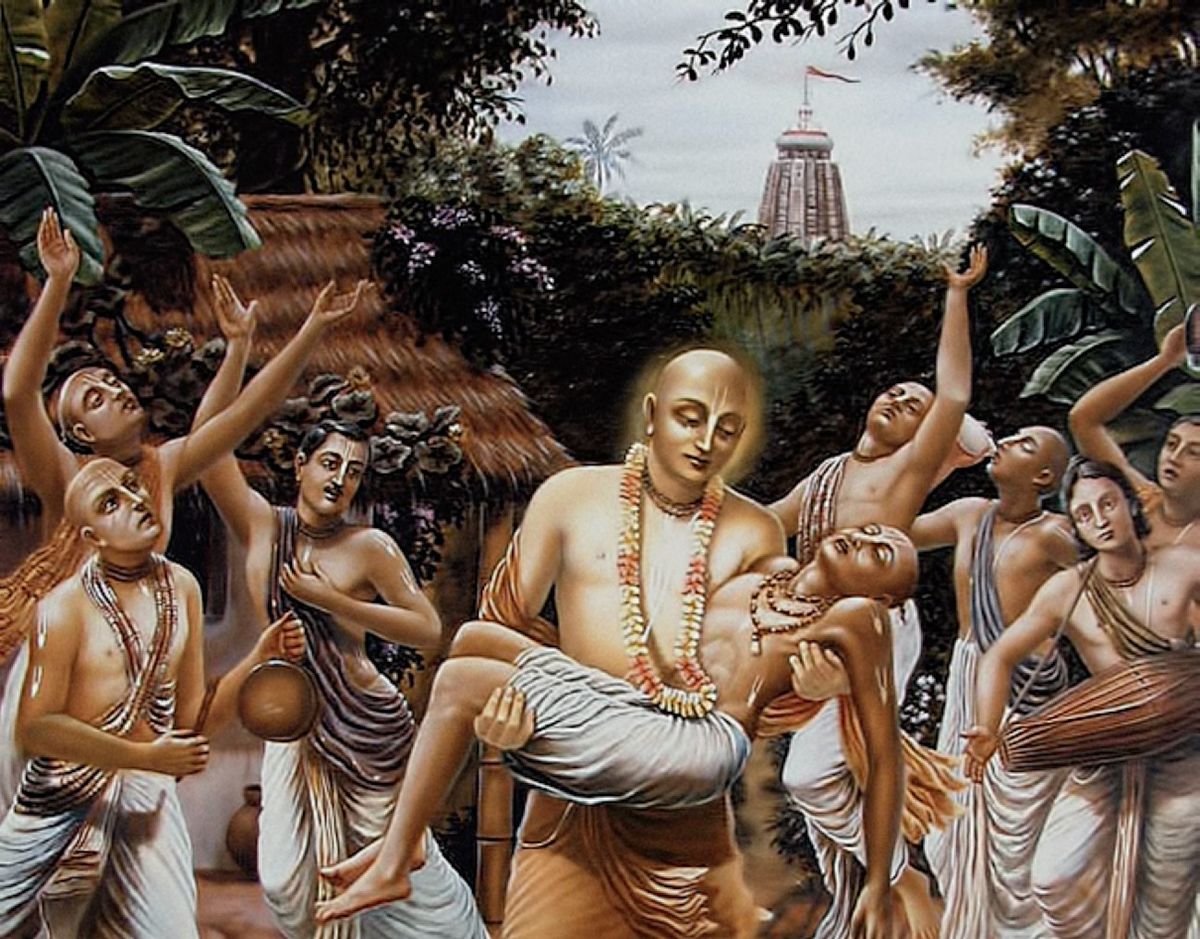
In Jagannātha Purī there was a young boy who had been born of an Orissan brāhmaṇa but had later lost his father. The boy’s features were very beautiful, and his behavior was extremely gentle. (3) The boy came daily to Śrī Caitanya Mahāprabhu and offered Him respectful obeisances. He was free to talk with Śrī Caitanya Mahāprabhu because the Lord was his life and soul, but the boy’s intimacy with the Lord and the Lord’s mercy toward him were intolerable for Dāmodara Paṇḍita. (4 5) Dāmodara Paṇḍita again and again forbade the son of the brāhmaṇa to visit the Lord, but the boy could not bear staying home and not seeing Śrī Caitanya Mahāprabhu. (6) The boy came every day to Śrī Caitanya Mahāprabhu, who treated him with great affection. It is the nature of any boy to go see a man who loves him. (7)
This was intolerable for Dāmodara Paṇḍita. He became greatly unhappy, but there was nothing he could say, for the boy would ignore his restrictions. (8) One day when the boy came to Śrī Caitanya Mahāprabhu, the Lord very affectionately inquired from him about all kinds of news. (9) After some time, when the boy stood up and left, the intolerant Dāmodara Paṇḍita began to speak. (10) Dāmodara Paṇḍita impudently said to the Lord, “Everyone says that You are a great teacher because of Your instructions to others, but now we shall find out what kind of teacher You are. (11) “You are known as Gosāñi [teacher or ācārya], but now talk about Your attributes and reputation will spread throughout the city of Puruṣottama. How Your position will be impaired!” (12)
Although Śrī Caitanya Mahāprabhu knew that Dāmodara Paṇḍita was a pure and simple devotee, upon hearing this impudent talk the Lord said, “My dear Dāmodara, what nonsense are you speaking?” Dāmodara Paṇḍita replied, “You are the independent Personality of Godhead, beyond all criticism. (13) “My dear Lord, You can act as You please. No one can say anything to restrict You. Nevertheless, the entire world is impudent. People can say anything. How can You stop them? (14) “Dear Lord, You are a learned teacher. Why then don’t You consider that this boy is the son of a widowed brāhmaṇī? Why are You so affectionate to him? (15) “Although the boy’s mother is completely austere and chaste, she has one natural fault-she is a very beautiful young girl. (16) “And You, my dear Lord, are a handsome, attractive young man. Therefore certainly people will whisper about You. Why should You give them such an opportunity?” (17)
Having said this, Dāmodara Paṇḍita became silent. Śrī Caitanya Mahāprabhu smiled, pleased within Himself, and considered the impudence of Dāmodara Paṇḍita. (18) [Śrī Caitanya Mahāprabhu thought:] “This impudence is also a sign of pure love for Me. I have no other intimate friend like Dāmodara Paṇḍita.” (19) Thinking in this way, Śrī Caitanya Mahāprabhu went to perform His noon duties. The next day, He called Dāmodara Paṇḍita to a solitary place. (20) The Lord said, “My dear friend Dāmodara, you had better go to Nadia and stay with My mother. (21) “I see no one but you to protect her, for you are so careful that you can caution even Me. (22) “You are the most neutral among My associates. This is very good, for without being neutral one cannot protect religious principles. (23)
“You can do whatever I cannot. Indeed, you can chastise even Me, what to speak of others. (24) “It is best for you to go to the shelter of My mother’s lotus feet, for no one will be able to behave independently in front of you. (25) “At intervals you may come see Me here and then soon again go there. (26) “Offer My mother millions of My obeisances. Please speak to her about My happiness here and thus give her happiness. (27) “Tell her that I sent you to inform her of My personal activities so that she may share in My happiness. (28) “Speaking in this way, satisfy the mind of mother Śacī. Also, remind her of one most confidential incident with this message from Me. (29) “‘I come to your home again and again to eat all the sweetmeats and vegetables you offer. (30)
“‘You know that I come and eat the offerings, but because of external separation, you consider this a dream. (31) “‘During the last Māgha- saṅkrānti festival, you cooked varieties of vegetables, condensed milk, cakes and sweet rice for Me. (32) “‘You offered the food to Lord Kṛṣṇa, and while you were in meditation I suddenly appeared, and your eyes filled with tears. (33) “‘I went there in great haste and ate everything. When you saw Me eating, you felt great happiness. (34) “‘In a moment, after you had wiped your eyes, you saw that the plate you had offered Me was empty. Then you thought, “I dreamt as if Nimāi were eating everything.” (35) “‘In the condition of external separation, you were again under illusion, thinking that you had not offered the food to Lord Viṣṇu. (36)
“‘Then you went to see the cooking pots and found that every pot was filled with food. Therefore you again offered the food, after cleansing the place for the offering. (37) “‘Thus I again and again eat everything you offer Me, for I am attracted by your pure love. (38) “‘Only by your order am I living in Nīlācala [Jagannātha Purī]. Nevertheless, you still pull Me near you because of your great love for Me.'” (39) Śrī Caitanya Mahāprabhu told Dāmodara Paṇḍita, “Remind mother Śacī in this way again and again and worship her lotus feet in My name.” (40) After saying this, Śrī Caitanya Mahāprabhu ordered that varieties of prasādam offered to Lord Jagannātha be brought. The Lord then gave him the prasādam, separately packed, to offer to various Vaiṣṇavas and His mother. (41)
In this way Dāmodara Paṇḍita went to Nadia [Navadvīpa]. After meeting mother Śacī, he stayed under the care of her lotus feet. (42) He delivered all the prasādam to such great Vaiṣṇavas as Advaita Ācārya. Thus he stayed there and behaved according to the order of Śrī Caitanya Mahāprabhu. (43) Everyone knew that Dāmodara Paṇḍita was strict in practical dealings. Therefore everyone was afraid of him and dared not do anything independent. (44) Dāmodara Paṇḍita would verbally chastise every devotee of Śrī Caitanya Mahāprabhu whom he found deviating even slightly from proper behavior. Thus he established the standard etiquette. (45) In this way I have described Dāmodara Paṇḍita’s verbal chastisements. As one hears about this, atheistic principles and ignorance depart. (46)
The pastimes of Śrī Caitanya Mahāprabhu are deeper than millions of seas and oceans. Therefore no one can understand what He does or why He does it. (47) I do not know the deep meaning of Śrī Caitanya Mahāprabhu’s activities. As far as possible I shall try to explain them externally. (48) One day Śrī Caitanya Mahāprabhu met Haridāsa Ṭhākura as usual, and in the course of discussion He inquired as follows. (49) “My dear Ṭhākura Haridāsa, in this Age of Kali most people are bereft of Vedic culture, and therefore they are called yavanas. They are concerned only with killing cows and brahminical culture. In this way they all engage in sinful acts. (50) “How will these yavanas be delivered? To My great unhappiness, I do not see any way.” (51) Haridāsa Ṭhākura replied, “My dear Lord, do not be in anxiety. Do not be unhappy to see the condition of the yavanas in material existence. (52)
“Because the yavanas are accustomed to saying ‘hā rāma, hā rāma’ [‘O Lord Rāmacandra’], they will very easily be delivered by this nāmābhāsa. (53) “A devotee in advanced ecstatic love exclaims, ‘O my Lord Rāmacandra! O my Lord Rāmacandra!’ But the yavanas also chant, ‘hā rāma, hā rāma!’ Just see their good fortune!” (54) Nāmācārya Haridāsa Ṭhākura, the authority on the chanting of the holy name, said, “The chanting of the Lord’s holy name to indicate something other than the Lord is an instance of nāmābhāsa. Even when the holy name is chanted in this way, its transcendental power is not destroyed. (55) “‘Even a mleccha who is being killed by the tusk of a boar and who cries in distress again and again, “hā rāma, hā rāma” attains liberation. What then to speak of those who chant the holy name with veneration and faith?’ (56)
“Ajāmila was a great sinner during his life, but at the time of death he accidentally called for his youngest son, whose name was Nārāyaṇa, and the attendants of Lord Viṣṇu came to relieve him from the bonds of Yamarāja, the superintendent of death. (57) “The word ‘rāma’ consists of the two syllables ‘rā’ and ‘ma.’ These are unseparated and are decorated with the loving word ‘hā,’ meaning ‘O.’ (58) “The letters of the holy name have so much spiritual potency that they act even when uttered improperly. (59) “If a devotee once utters the holy name of the Lord, or if it penetrates his mind or enters his ear, which is the channel of aural reception, that holy name will certainly deliver him from material bondage, whether vibrated properly or improperly, with correct or incorrect grammar, or properly joined or vibrated in separate parts. O brāhmaṇa, the potency of the holy name is therefore certainly great. However, if one uses the vibration of the holy name for the benefit of the material body, for material wealth and followers, or under the influence of greed or atheism-in other words, if one utters the name with offenses such chanting will not produce the desired result very soon. Therefore one should diligently avoid offenses in chanting the holy name of the Lord.'” (60)
Nāmācārya Haridāsa Ṭhākura continued, “If one offenselessly utters the holy name even imperfectly, one can be freed from all the results of sinful life. (61) “‘O reservoir of all good qualities, just worship Śrī Kṛṣṇa, the purifier of all purifiers, the most exalted of the personalities worshiped by choice poetry. Worship Him with a faithful, unflinching mind, without duplicity and in a highly elevated manner. Thus worship the Lord, whose name is like the sun, for just as a slight appearance of the sun dissipates the darkness of night, so a slight appearance of the holy name of Kṛṣṇa can drive away all the darkness of ignorance that arises in the heart due to greatly sinful activities performed in previous lives.’ (62) “Even a faint light from the holy name of the Lord can eradicate all the reactions of sinful life. (63) “‘While dying, Ajāmila chanted the holy name of the Lord, intending to call his son Nārāyaṇa. Nevertheless, he attained the spiritual world. What then to speak of those who chant the holy name with faith and reverence?’ (64) “Because of even the faintest rays of the effulgence of the Lord’s holy name, one can attain liberation. We can see this in all the revealed scriptures. The evidence appears in the story of Ajāmila in Śrīmad- Bhāgavatam.” (65)
Deepen your Bhakti-yoga practice, harmonize relationships, and receive guided coaching — all at Vedavarsity.com