


A devotee named Choṭa Haridāsa used to sing for Śrī Caitanya Mahāprabhu. Bhagavān Ācārya called him to his home and spoke as follows. (102) “Please go to the sister of Śikhi Māhiti. In my name, ask her for a māna of white rice and bring it here.” (103) Śikhi Māhiti’s sister was named Mādhavī- devī. She was an elderly lady who always performed austerities. She was very advanced in devotional service. (104) Śrī Caitanya Mahāprabhu accepted her as having formerly been an associate of Śrīmatī Rādhārāṇī. In the entire world, three and a half people were His intimate devotees. (105) The three were Svarūpa Dāmodara Gosvāmī, Rāmānanda Rāya and Śikhi Māhiti, and the half a person was Śikhi Māhiti’s sister. (106)
After begging the rice from her, Junior Haridāsa brought it to Bhagavān Ācārya, who was very pleased to see its quality. (107) In great affection, Bhagavān Ācārya cooked varieties of vegetables and other preparations dear to Śrī Caitanya Mahāprabhu. He also obtained remnants of food from Lord Jagannātha and digestive aids such as ground ginger and also lime with salt. (108) At noon, when Śrī Caitanya Mahāprabhu came to eat the offerings of Bhagavān Ācārya, He first appreciated the fine rice and therefore questioned him. (109) “Where did you get such fine rice?” the Lord asked. Bhagavān Ācārya replied, “I got it by begging from Mādhavī- devī.” (110) When Śrī Caitanya Mahāprabhu asked who had begged the rice and brought it back, Bhagavān Ācārya mentioned the name of Junior Haridāsa. (111)
Praising the quality of the rice, Śrī Caitanya Mahāprabhu partook of the prasādam. Then, after returning to His residence, He gave the following order to Govinda, His personal assistant. (112) “From this day forward, do not allow Choṭa Haridāsa to come here.” (113) When Junior Haridāsa heard that he had been ordered not to approach Śrī Caitanya Mahāprabhu, he was very unhappy. No one could understand why he had been ordered not to come. (114) Haridāsa fasted continuously for three days. Then Svarūpa Dāmodara Gosvāmī and other confidential devotees approached Śrī Caitanya Mahāprabhu to inquire from Him. (115) “What great offense has Junior Haridāsa committed? Why has he been forbidden to come to Your door? He has now been fasting for three days.” (116)
The Lord replied, “I cannot tolerate seeing the face of a person who has accepted the renounced order of life but who still talks intimately with a woman. (117) “So strongly do the senses adhere to the objects of their enjoyment that indeed a wooden statue of a woman attracts the mind of even a great saintly person. (118) “‘One should not sit closely with one’s mother, sister or daughter, for the senses are so strong that they may attract even a person advanced in knowledge.’ (119) “There are many persons with little in their possession who accept the renounced order of life like monkeys. They go here and there engaging in sense gratification and speaking intimately with women.” (120) After saying this, Śrī Caitanya Mahāprabhu entered His room. Seeing Him in such an angry mood, all the devotees fell silent. (121)
The next day, all the devotees together approached the lotus feet of Śrī Caitanya Mahāprabhu to submit an appeal on behalf of Junior Haridāsa. (122) “Haridāsa has committed a small offense,” they said. “Therefore, O Lord, please be merciful to him. Now he has received a sufficient lesson. In the future he will not commit such an offense.” (123) Śrī Caitanya Mahāprabhu said, “My mind is not under My control. It does not like to see anyone in the renounced order who talks intimately with women. (124) “You should all tend to your respective engagements. Give up this useless talk. If you speak this way again, I shall go away, and you will no longer see Me here.” (125) Hearing this, all the devotees covered their ears with their hands, got up and went about their respective duties. (126)
Śrī Caitanya Mahāprabhu also left that place to perform His noon duties. No one could understand His pastimes. (127) The next day, all the devotees went to Śrī Paramānanda Purī and requested him to pacify the Lord. (128) Paramānanda Purī thereupon went alone to the residence of Śrī Caitanya Mahāprabhu. The Lord, after offering him obeisances, seated him by His side with great respect. (129) The Lord inquired, “What is your order? For what purpose have you come here?” Paramānanda Purī then submitted his prayer that the Lord show favor to Junior Haridāsa. (130) Hearing this request, Śrī Caitanya Mahāprabhu replied, “My dear lord, please hear Me. It is better for you to stay here with all the Vaiṣṇavas. (131) “Please give Me permission to go to Ālālanātha. I shall remain there alone; only Govinda will go with Me.” (132) After saying this, the Lord called for Govinda. Offering obeisances to Paramānanda Purī, He got up and began to leave. (133)
In great haste Paramānanda Purī Gosāñi went before Him and with great humility persuaded Him to sit down in His room. (134) Paramānanda Purī said, “My dear Lord Caitanya, You are the independent Personality of Godhead. You can do whatever You like. Who can say anything above You? (135) “All Your activities are for the benefit of people in general. We cannot understand them, for Your intentions are deep and grave.” (136) After saying this, Paramānanda Purī Gosāñi left for his own home. Then all the devotees went to see Junior Haridāsa. (137) Svarūpa Dāmodara Gosāñi said, “Please hear us, Haridāsa, for we all wish you well. Please believe this. (138) “At present Śrī Caitanya Mahāprabhu is persisting in His mood of anger because He is the independent Supreme Personality of Godhead. At some time, however, He will surely be merciful, for at heart He is very kind. (139) “The Lord is persisting, and if you also persist, His persistence will increase. It is better for you to bathe and take prasādam. In due course, His anger will automatically subside.” (140)
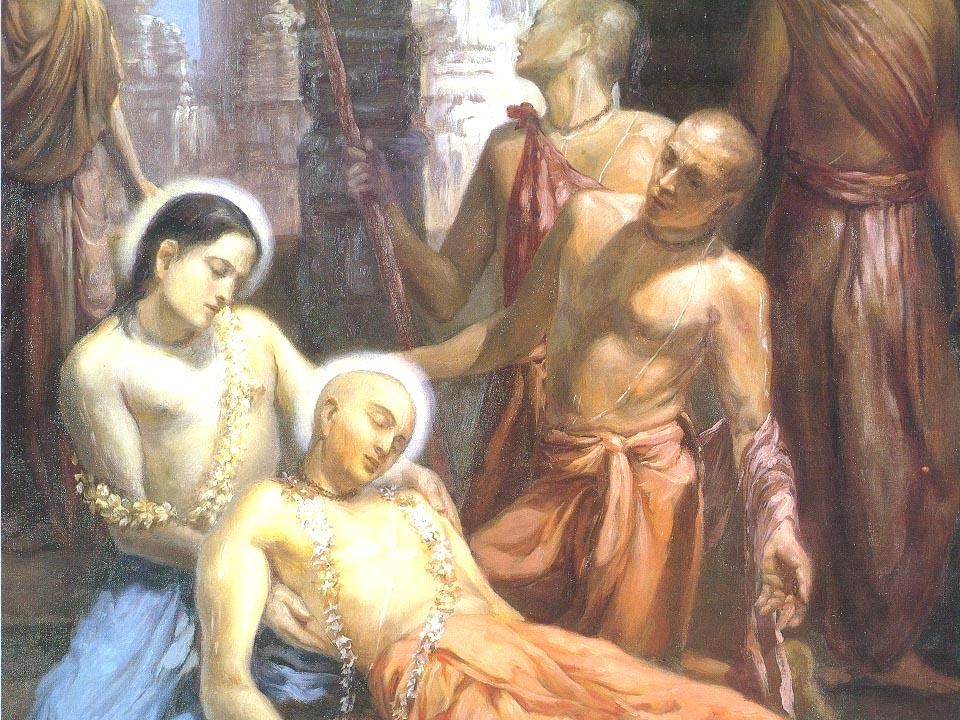
Having said this, Svarūpa Dāmodara Gosvāmī induced Haridāsa to bathe and take prasādam. After thus reassuring him, he returned home. (141) When Śrī Caitanya Mahāprabhu went to see Lord Jagannātha in the temple, Haridāsa would stay a long distance away and see Him. (142) Śrī Caitanya Mahāprabhu is the ocean of mercy. Who can understand Him? When He chastises His dear devotees, He certainly does so to reestablish the principles of religion or duty. (143) After all the devotees saw this example, a mentality of fear grew among them. Therefore they all stopped talking with women, even in dreams. (144) In this way a complete year passed for Junior Haridāsa, but still there was not a sign of Śrī Caitanya Mahāprabhu’s mercy toward him. (145) Thus at the end of one night, Junior Haridāsa, after offering Śrī Caitanya Mahāprabhu his respectful obeisances, departed for Prayāga without saying anything to anyone. (146) Junior Haridāsa had conclusively decided to attain shelter at the lotus feet of Śrī Caitanya Mahāprabhu. Thus he entered deep into the water at Triveṇī, the confluence of the Ganges and Yamunā at Prayāga, and in this way gave up his life. (147)
Immediately after committing suicide in this way, he went in his body to Śrī Caitanya Mahāprabhu and received the mercy of the Lord. However, he still remained invisible. (148) In a spiritual body resembling that of a Gandharva, Junior Haridāsa, although invisible, would sing at night for Śrī Caitanya Mahāprabhu to hear. No one but the Lord, however, knew of this. (149) One day Śrī Caitanya Mahāprabhu inquired from the devotees, “Where is Haridāsa? Now you may bring him here.” (150) The devotees all replied, “One night at the end of a full year, Junior Haridāsa got up and went away. No one knows where he has gone.” (151) While hearing the devotees lament, Śrī Caitanya Mahāprabhu was mildly smiling. Thus all the devotees were very much astonished. (152) One day Jagadānanda, Svarūpa, Govinda, Kāśīśvara, Śaṅkara, Dāmodara and Mukunda all went to bathe in the sea. They could hear Haridāsa singing from a distant place as if calling them in his original voice. (153 154)
Deepen your Bhakti-yoga practice, harmonize relationships, and receive guided coaching — all at Vedavarsity.com