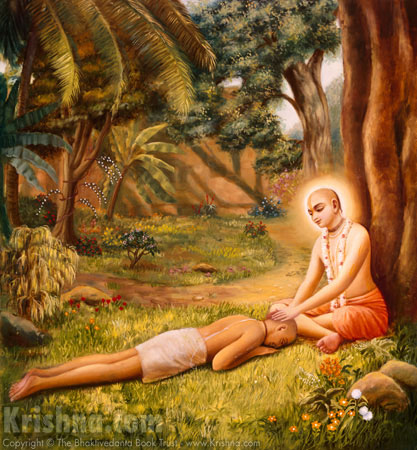
'Sri Chaitanya Mahaprabhu then placed His hand on Sanatana Goswami's head and benedicted him, saying, "Let all these instructions be manifest to you."'
-Excerpt from Chaitanya-caritamrita, Madhya-lila, 23.120-124
Having heard these verses recited by Rūpa Gosvāmī, Śrīla Rāmānanda Rāya said, “Your poetic expressions are like continuous showers of nectar. Kindly let me hear the introductory portion of the second drama.” (172) Śrīla Rūpa Gosvāmī said, “In your presence, which is just like brilliant sunshine, I am as insignificant as the light of a glowworm. (173) “It is even impudent for me to open my mouth before you.” Then, having said this, he recited the introductory verse of the Lalita- mādhava. (174) “‘The beautiful moonlike glories of Mukunda give distress to the lotuslike faces of the wives of the demons and to their raised breasts, which are like gleaming cakravāka birds. Those glories, however, are pleasing to all His devotees, who are like cakora birds. May those glories forever give pleasure to you all.'” (175)
When Śrīla Rāmānanda Rāya further inquired about the second introductory verse, Śrīla Rūpa Gosvāmī was somewhat hesitant, but nevertheless he began to recite. (176) “‘The moonlike Supreme Personality of Godhead, who is known as the son of mother Śacī, has now appeared on earth to spread devotional love of Himself. He is the emperor of the brāhmaṇa community. He can drive away all the darkness of ignorance and control the mind of everyone in the world. May that rising moon bestow upon us all good fortune.'” (177) Although Śrī Caitanya Mahāprabhu was inwardly greatly pleased when He heard this verse, externally He spoke as if angry. (178) “Your exalted poetic descriptions of the mellows of Lord Kṛṣṇa’s pastimes are like an ocean of nectar. But why have you put in a false prayer about Me? It is like a drop of detestable alkali.” (179) Śrīla Rāmānanda Rāya objected, “It is not alkali at all. It is a particle of camphor he has put into the nectar of his exalted poetic expression.” (180) Śrī Caitanya Mahāprabhu said, “My dear Rāmānanda Rāya, you are jubilant at hearing these poetic expressions, but I am ashamed to hear them, for people in general will joke about the subject of this verse.” (181)
Rāmānanda Rāya said, “Instead of joking, people in general will feel great pleasure in hearing such poetry, for the initial remembrance of the worshipable Deity invokes good fortune.” (182) Rāmānanda Rāya inquired, “By which subdivision of style do the players enter?” Rūpa Gosvāmī then began to speak specifically about this subject. (183) “‘While dancing on the stage after having killed the ruler of uncivilized men [Kaṁsa], Lord Kṛṣṇa, master of all arts, will at the proper time accept the hand of Śrīmatī Rādhārāṇī, who is qualified with all transcendental attributes.’ (184) “This introduction is technically called udghātyaka, and the whole scene is called vīthī. You are so expert in dramatic expression that each of my statements before you is like a wave from an ocean of impudence. (185) “‘To explain an unclear word, men generally join it with other words. Such an attempt is called udghātyaka.'” (186) When Rāmānanda Rāya requested Śrīla Rūpa Gosvāmī to speak further about various portions of the play, Śrīla Rūpa Gosvāmī briefly quoted his Lalita- mādhava. (187)
“‘The dust from cows and calves on the road creates a kind of darkness indicating that Kṛṣṇa is returning home from the pasture. Also, the darkness of evening provokes the gopīs to meet Kṛṣṇa. Thus the pastimes of Kṛṣṇa and the gopīs are covered by a kind of transcendental darkness and are therefore impossible for ordinary scholars of the Vedas to see.’ (188) “‘May the sweet sound of Lord Kṛṣṇa’s flute, His authorized messenger, be glorified, for it expertly releases Śrīmatī Rādhārāṇī from Her shyness and attracts Her from Her home to the forest.’ (189) “‘My dear friend, who is this fearless young man? He is as bright as a lightning cloud, and He wanders in His pastimes like a maddened elephant. From where has He come to Vṛndāvana? Alas, by His restless movements and attractive glances He is plundering from the vault of My heart the treasure of My patience.’ (190)
“‘Śrīmatī Rādhārāṇī is the Ganges in which the elephant of My mind enjoys pastimes. She is the shining of the full autumn moon for the cakora birds of My eyes. She is the dazzling ornament, the bright and beautiful arrangement of stars, on the border of the sky of My chest. Now today I have gained Śrīmatī Rādhārāṇī because of the highly elevated state of My mind.'” (191) After hearing this, Śrīla Rāmānanda Rāya submitted at the lotus feet of Śrī Caitanya Mahāprabhu the superexcellence of Śrīla Rūpa Gosvāmī’s poetic expression and began to praise it as if he had thousands of mouths. (192) Śrīla Rāmānanda Rāya said, “This is not a poetic presentation; it is a continuous shower of nectar. Indeed, it is the essence of all ultimate realizations, appearing in the form of plays. (193) “The wonderful descriptions of Rūpa Gosvāmī are superb arrangements to express loving affairs. Hearing them will plunge the heart and ears of everyone into a whirlpool of transcendental bliss. (194)
“‘What is the use of a bowman’s arrow or a poet’s poetry if they penetrate the heart but do not cause the head to spin?’ (195) “Without Your mercy such poetic expressions would be impossible for an ordinary living being to write. My guess is that You have given him the power.” (196) Śrī Caitanya Mahāprabhu replied, “I met Śrīla Rūpa Gosvāmī at Prayāga. He attracted and satisfied Me because of his qualities.” (197) Śrī Caitanya Mahāprabhu praised the metaphors and other literary ornaments of Śrīla Rūpa Gosvāmī’s transcendental poetry. Without such poetic attributes, He said, there is no possibility of preaching transcendental mellows. (198) Śrī Caitanya Mahāprabhu requested all His personal associates to bless Rūpa Gosvāmī so that he might continuously describe the pastimes of Vṛndāvana, which are full of emotional love of Godhead. (199) Śrī Caitanya Mahāprabhu said, “Śrīla Rūpa Gosvāmī’s elder brother, whose name is Sanātana Gosvāmī, is such a wise and learned scholar that no one is equal to him.” (200)
Śrī Caitanya Mahāprabhu told Rāmānanda Rāya, “Sanātana Gosvāmī’s renunciation of material connections is just like yours. Humility, renunciation and excellent learning exist in him simultaneously. (201) “I empowered both of these brothers to go to Vṛndāvana to expand the literature of bhakti.” (202) Śrīla Rāmānanda Rāya replied to Śrī Caitanya Mahāprabhu, “My Lord, You are the Supreme Personality of Godhead. If You like, You can cause even a wooden doll to dance. (203) “I see that the truths regarding transcendental mellows that You expounded through my mouth are all explained in the writings of Śrīla Rūpa Gosvāmī. (204) “Because of Your causeless mercy toward Your devotees, You want to describe the transcendental pastimes in Vṛndāvana. Anyone empowered to do this can bring the entire world under Your influence.” (205)
Śrī Caitanya Mahāprabhu then embraced Rūpa Gosvāmī and asked him to offer prayers at the lotus feet of all the devotees present. (206) Advaita Ācārya, Nityānanda Prabhu and all the other devotees showed their causeless mercy to Rūpa Gosvāmī by embracing him in return. (207) Seeing Śrī Caitanya Mahāprabhu’s special mercy toward Śrīla Rūpa Gosvāmī and seeing his personal qualities, all the devotees were struck with wonder. (208) Then, when Śrī Caitanya Mahāprabhu left with all of His devotees, Haridāsa Ṭhākura also embraced Śrīla Rūpa Gosvāmī. (209) Haridāsa Ṭhākura told him, “There is no limit to your good fortune. No one can understand the glories of what you have described.” (210) Śrī Rūpa Gosvāmī said, “I do not know anything. The only transcendental words I can utter are those which Śrī Caitanya Mahāprabhu makes me speak. (211)
“Although I am the lowest of men and have no knowledge, the Lord has mercifully bestowed upon me the inspiration to write transcendental literature about devotional service. Therefore I offer my obeisances at the lotus feet of Śrī Caitanya Mahāprabhu, the Supreme Personality of Godhead, who has given me the chance to write these books.” (212) In this way Śrīla Rūpa Gosvāmī passed his time in close association with Haridāsa Ṭhākura by discussing the pastimes of Lord Kṛṣṇa in great happiness. (213) All the devotees of Śrī Caitanya Mahāprabhu thus spent four months with Him. Then the Lord bade them farewell, and they returned to Bengal. (214) Śrīla Rūpa Gosvāmī, however, stayed at the lotus feet of Śrī Caitanya Mahāprabhu, and when the Dola- yātrā festival took place, he saw it in great happiness with the Lord. (215)
After the Dola- yātrā festival ended, Śrī Caitanya Mahāprabhu bade farewell to Rūpa Gosvāmī also. The Lord empowered him and bestowed upon him all kinds of mercy. (216) “Now go to Vṛndāvana and stay there,” the Lord said. “You may send here your elder brother, Sanātana. (217) “When you go to Vṛndāvana, stay there, preach transcendental literature and excavate the lost holy places. (218) “Establish the service of Lord Kṛṣṇa and preach the mellows of Lord Kṛṣṇa’s devotional service. I shall also go to Vṛndāvana once more.” (219) Having thus spoken, Śrī Caitanya Mahāprabhu embraced Rūpa Gosvāmī, who then placed the lotus feet of the Lord upon his head. (220) Śrīla Rūpa Gosvāmī took leave of all the devotees of Śrī Caitanya Mahāprabhu and returned to Vṛndāvana by the path through Bengal. (221) Thus I have described the second meeting of Rūpa Gosvāmī and Śrī Caitanya Mahāprabhu. Anyone who hears of this incident will certainly attain shelter at the lotus feet of Śrī Caitanya Mahāprabhu. (222) Praying at the lotus feet of Śrī Rūpa and Śrī Raghunātha, always desiring their mercy, I, Kṛṣṇadāsa, narrate Śrī Caitanya- caritāmṛta, following in their footsteps. (223)
Deepen your Bhakti-yoga practice, harmonize relationships, and receive guided coaching — all at Vedavarsity.com